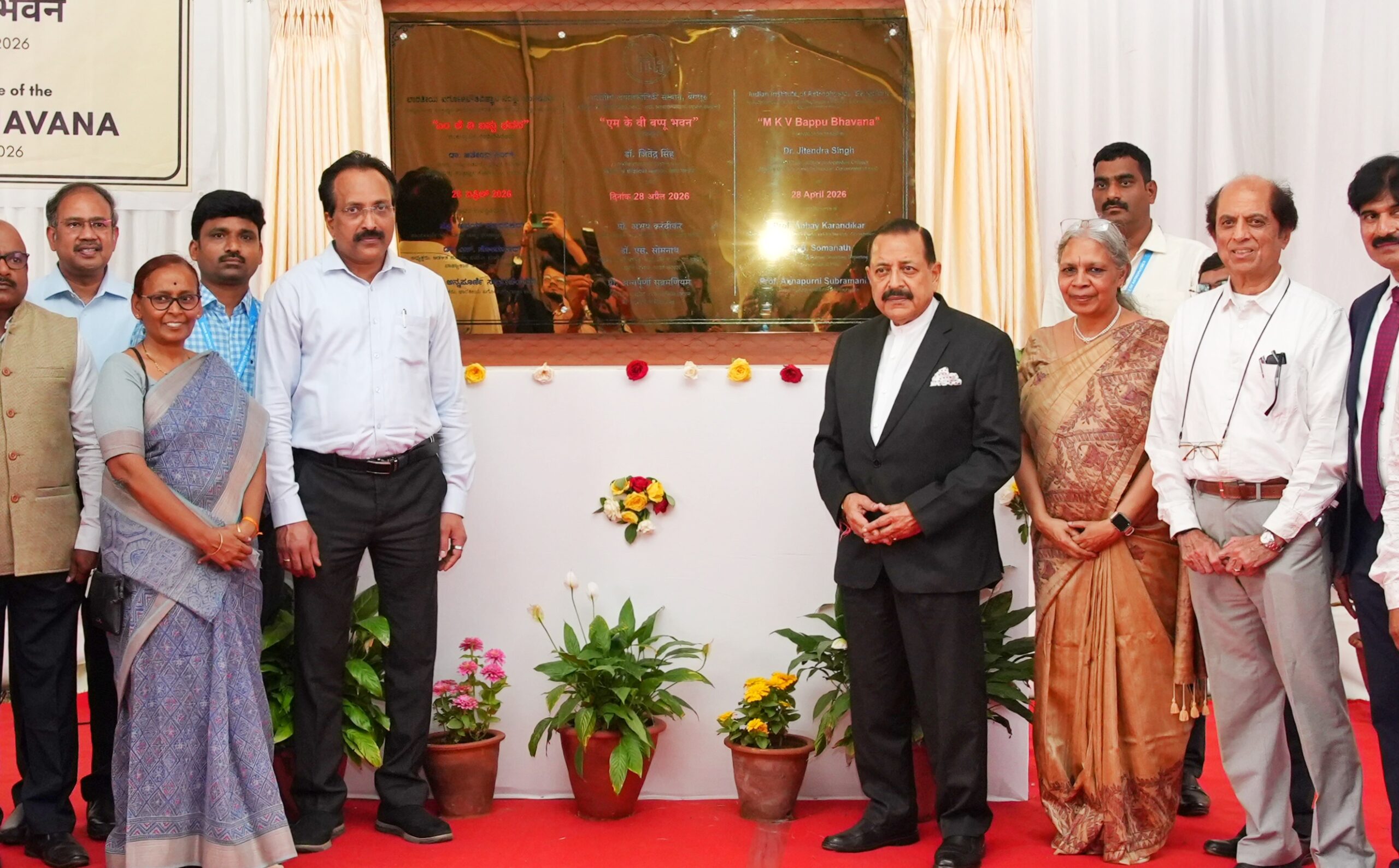
Bengaluru: In a significant push to India’s space science and astronomy ecosystem, Union Minister of State (Independent Charge) Dr. Jitendra Singh on Tuesday laid the foundation stone for a ₹75 crore state-of-the-art additional building at the Indian Institute of Astrophysics (IIA) in Bengaluru.
Coming up at the institute’s Koramangala campus, the seven-storey facility will span nearly one lakh square feet and is envisioned as a major scientific hub to strengthen India’s capabilities in advanced astronomy research and space instrumentation. Technologies developed at IIA are already being deployed in missions by Indian Space Research Organisation and other global collaborations, underlining the institute’s growing international relevance.
The foundation stone ceremony was attended by Chairman of the Governing Council Dr. S. Somanath, IIA Director Dr. Annapurni Subramanian, senior scientists, and officials from the Department of Science and Technology and Central Public Works Department. The event featured the unveiling of the plaque, inauguration of a medium-sized Aspheric Grinder & Polisher in the optics laboratory, and presentations on upcoming projects.
Highlighting IIA’s legacy, Singh described it as a premier institution with roots tracing back to the historic Madras Observatory. He noted that the new infrastructure would cater to the expanding needs of researchers and students while strengthening India’s position in cutting-edge observational astronomy.
The Minister also referred to IIA’s network of observatories located in Kodaikanal, Kavalur, Gauribidanur and Hanle, which support both solar and night-time astronomy. He acknowledged the institute’s contributions to major space missions, including the UltraViolet Imaging Telescope onboard AstroSat and the Aditya-L1 mission.
Singh further highlighted four major telescope projects announced in the Union Budget 2026 — the National Large Solar Telescope, National Large Optical-Infrared Telescope, Himalayan Chandra Telescope upgrade, and COSMOS-2 Planetarium — all set to be implemented by IIA to expand India’s astronomical capabilities.
Emphasising accountability alongside investment, he said the new facility brings both opportunity and responsibility to deliver impactful outcomes. He also stressed the importance of engaging young minds through outreach and digital platforms amid growing public interest in space science.
The upcoming building, proposed to be named “M.K.V. Bappu Bhavana” after IIA’s founding director Manali Kallat Vainu Bappu, will include modern laboratories, classrooms, office spaces and a conference facility. The project, being executed by the CPWD, is expected to be completed within two years.