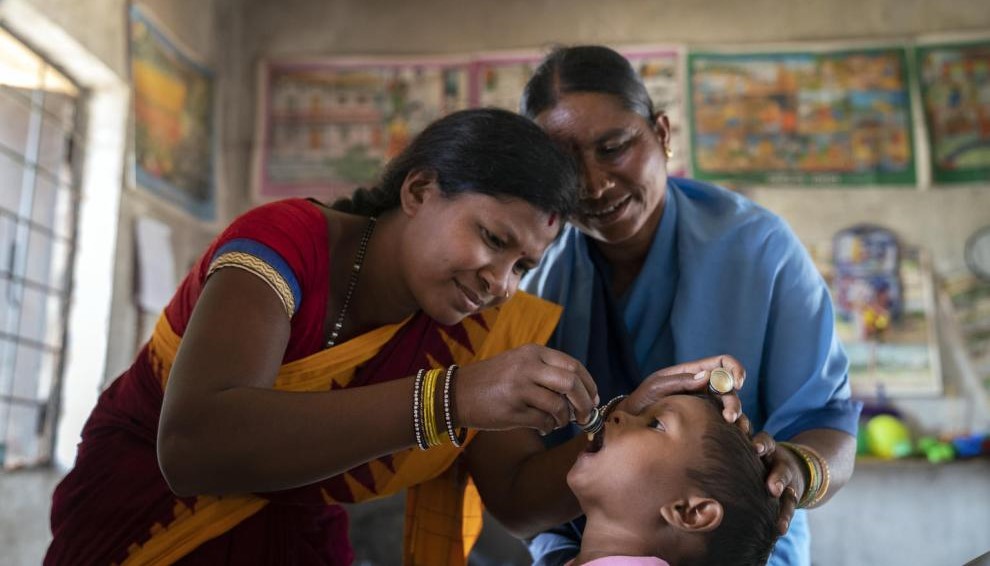
New Delhi: UNICEF India on Thursday released global flagship report on ‘The State of the World’s Children 2023: For Every Child, Vaccination,’ highlighting the significance of childhood immunization.
The report based on studies of new data collected by The Vaccine Confidence Project (London School of Hygiene and Tropical Medicine) revealed that China, India and Mexico are the three countries out of 55 where the popular perception of the importance of vaccines for children held firm or improved.
The State of the World’s Children 2023 report highlights India as one of the countries with the highest vaccine confidence in the world. “This is a recognition of the Government of India’s political and social commitment and demonstrates that the largest vaccines drive during the pandemic has paid off in building confidence and strengthening systems for routine immunization to vaccinate every child,” said Cynthia McCaffrey, UNICEF India Representative.
“Immunization is one of humanity’s most remarkable success stories, allowing children to live healthy lives and contribute to society. Reaching the last child with immunization is a key marker of equity that benefits not only the child but also the whole community. Routine immunizations and strong health systems can best prepare us in preventing future pandemics and reducing morbidity and mortality,” added McCaffrey.
Despite an increase in the number of zero-dose (unreached or missed out) children to three million – between 2020 and 2021 – during the pandemic, India was able to arrest the backslide and bring down the number to 2.7 million, which represents a smaller proportion of the India’s under -5 child population given its size and the world's largest birth cohort. This achievement can be attributed to sustained evidence-based catch-up campaigns initiated by the government, including the Intensified Mission Indradhanush (IMI), continued provision of comprehensive Primary Health Care services, a strong Routine Immunization programme and
dedicated health workers. Continued progress is being made to reach the last mile and the last child.
In Odisha, immunization coverage has been note-worthy, with 90.5 percent of children fully immunized which is significantly higher than the national average of 76.4 percent as per NFHS5.
“This has been possible due to unique initiatives by the Government of Odisha to immunize children in hard-to-reach areas and encouraging the participation of community through Panchayati Raj institutions and self-help groups. especially in low-coverage areas. As a result 20 out of the state’s 30 districts have achieved more than 90 percent of full immunization coverage,” read the report.
“Odisha’s high immunization rates are despite the significant challenges posed by the state’s hilly terrain and forest cover, especially in 144 tribal blocks and 13 Particularly Vulnerable Tribal Groups (PVTG) residing in areas with non-motorable roads and seasonally cut-off villages. To ensure full immunization were motivated through special immunization campaigns ensuring frontline workers travel to remote pockets and families are reached for immunization,” it further mentioned.
The state government’s investment to ensure an efficient cold chain system to maintain the potency and effectiveness of vaccines throughout the state has also been acknowledged as a driver for high quality of immunization coverage in Odisha.
New data produced for the report by the International Center for Equity in Health found that in the poorest households, 1 in 5 children are zero-dose while in the wealthiest, it is just 1 in 20.
It found unvaccinated children often live in hard-to-reach communities such as rural areas or urban slums. They often have mothers who have not been able to go to school and who are given little say in family decisions. These challenges are greatest in low- and middle-income countries, where about 1 in 10 children in urban areas are zero dose and 1 in 6 in rural areas.
In upper-middle-income countries, there is almost no gap between urban and rural children.
Bhubaneswar: In a push to upgrade primary education infrastructure, Chief Minister Mohan Charan Majhi on…
Bhubaneswar: Strengthening development in Kandhamal district, Odisha Chief Secretary Anu Garg reviewed key projects across…
Jagatsinghpur: Around 25 heritage enthusiasts from across Odisha participated in the 14th edition of the…
Bhubaneswar: Emphasising long-term development and citizen participation, Chief Minister Mohan Charan Majhi on Tuesday described…
Bhubaneswar: Odisha has emerged as a leading state in urban transformation, registering strong progress under…
Bhubaneswar: The seventh day of the ongoing Odia Pakhya was celebrated as “Shishu Katha Divas”…