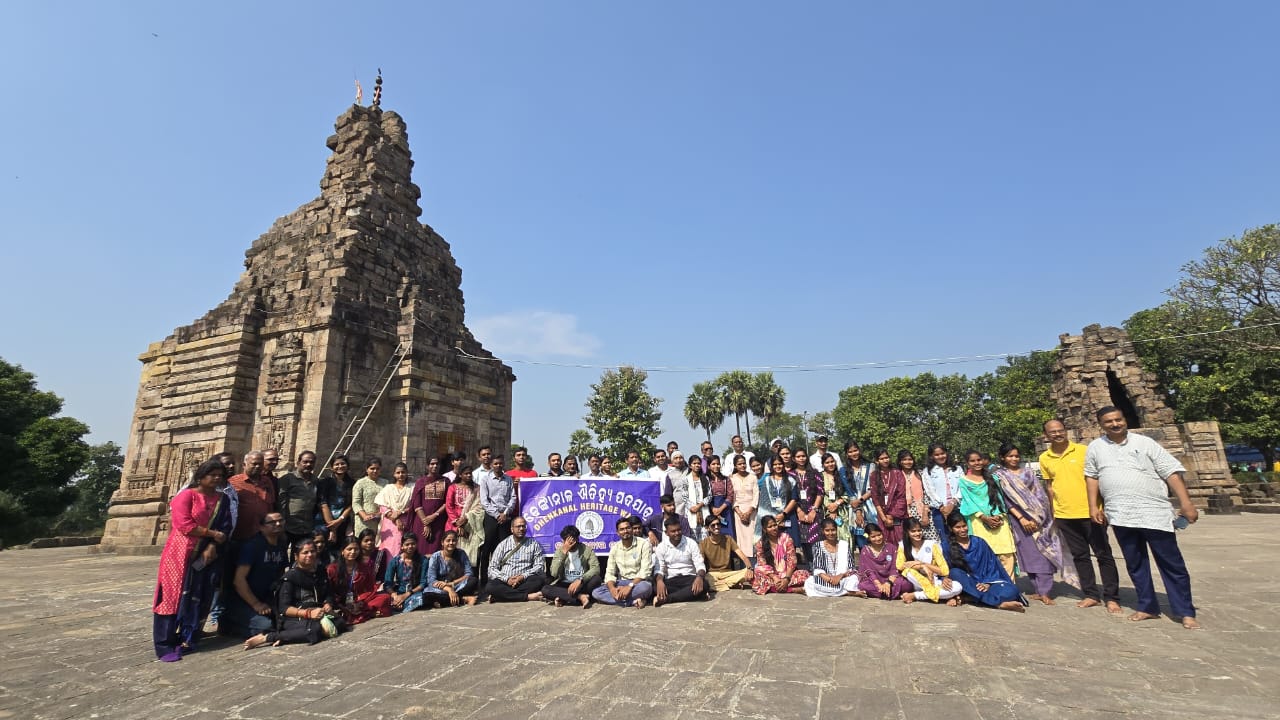
Dhenkanal: The 31st edition of the Dhenkanal Heritage Walks (DHW) on Sunday brought together 65 heritage enthusiasts historians, conservationists, and volunteers for an immersive exploration of two remarkable archaeological sites—Kualo, home to the ancient Ashtashambhu Shiva Temples, and Saranga, known for its majestic Ananta Sayana Vishnu sculpture on the bank of the Brahmani River under guidance of DHW convenor Suresh Prasad Mishra.
Ashtashambhu Shiva of Kualo
The heritage walk began at Kualo (Kuala), one of the oldest settlements in the region. Scholars believe the name Kualo may be a later form of Kodalaka, the historical headquarters of the Stambha/Sulki Dynasty of the 9th Century. Known temple patrons like their contemporaries—the Bhanjas of Khiching—the Sulkis left behind distinctive architectural contributions, much of which survive in fragmented yet invaluable form today.
At the heart of Kualo lies the Ashtashambhu group of temples, a complex of eight shrines dedicated to Lord Shiva. These temples house eight ancient Shiva lingams:
Kanakeswar, Swapneswar, Aisneswar, Kapileswar, Baidhyanatheswar, Baneswar, Lokanatheswar, and the Astasambhu shrine situated near the Uttareswara Temple.
Among these, the Kanakeswar Temple stands out. Although in ruins, its 24-metre-high spire and surviving sculptural fragments represent some of the earliest examples of Kalingan temple-building traditions in Odisha. Architectural features such as the bada divisions and pabhaga mouldings indicate construction activity dating back to around the 8th Century, with some shrines possibly belonging to even earlier periods.
Five of the eight temples stand in a straight alignment and are locally revered as the Pancha Pandava Temples. Records and surviving structural evidence suggest that many of these shrines once featured porches (jagamohana), of which only traces remain today.
Despite their weathered condition, the Ashtashambhu temples continue to speak volumes about the Sulki Dynasty’s artistic vision, religious traditions, and architectural evolution. During the walk, experts highlighted the need for urgent conservation and systematic documentation, emphasizing the significance of these monuments in reconstructing early medieval Odisha’s history.
Ananta Sayana Vishnu
The second leg of the heritage walk led participants to Saranga, home to the iconic Ananta Sayana Vishnu, an extraordinary example of rock-cut iconography in Odisha.
The colossal sculpture depicts Lord Vishnu in the cosmic reclining posture (Ananta Sayana) atop the serpent Shesha. Carved on a massive rock outcrop on the banks of the Brahmani River, this image is believed to date back to the 8th–10th Century, corresponding to the early medieval period of Odisha’s art history.
Historians accompanying the team noted similarities with the Ananta Sayana images found at Bhubaneswar, Badamal, and other early medieval sites, suggesting that the Saranga sculpture belongs to the same broader artistic tradition. Its placement on the riverbank symbolically reflects the Purāṇic concept of Vishnu resting on the cosmic ocean.
The site remains one of the finest open-air Vishnu reliefs in Odisha, combining religious symbolism, craftsmanship, and natural landscape in a single visual narrative.
Throughout the walk, historians, conservation experts, and volunteers shared valuable insights on both sites, covering architectural analysis, dynastic history, iconography, and heritage conservation practices. Several short lectures were delivered on-site, helping participants understand the deeper cultural and historical context of these monuments.
Both locations were thoroughly documented and photographed for archival and future research purposes. The need for protective conservation, structural stabilization, and community involvement was strongly emphasized.
With its successful 31st edition, DHW continues to strengthen public engagement with local history, ensuring that forgotten monuments like Kualo’s Ashtashambhu Temples and Saranga’s Ananta Sayana Vishnu receive the attention and preservation they deserve.
Bhubaneswar: In a major push to industrialisation, Chief Minister Mohan Charan Majhi on Wednesday inaugurated…
Bhubaneswar: In a push to upgrade primary education infrastructure, Chief Minister Mohan Charan Majhi on…
Bhubaneswar: Strengthening development in Kandhamal district, Odisha Chief Secretary Anu Garg reviewed key projects across…
Jagatsinghpur: Around 25 heritage enthusiasts from across Odisha participated in the 14th edition of the…
Bhubaneswar: Emphasising long-term development and citizen participation, Chief Minister Mohan Charan Majhi on Tuesday described…
Bhubaneswar: Odisha has emerged as a leading state in urban transformation, registering strong progress under…