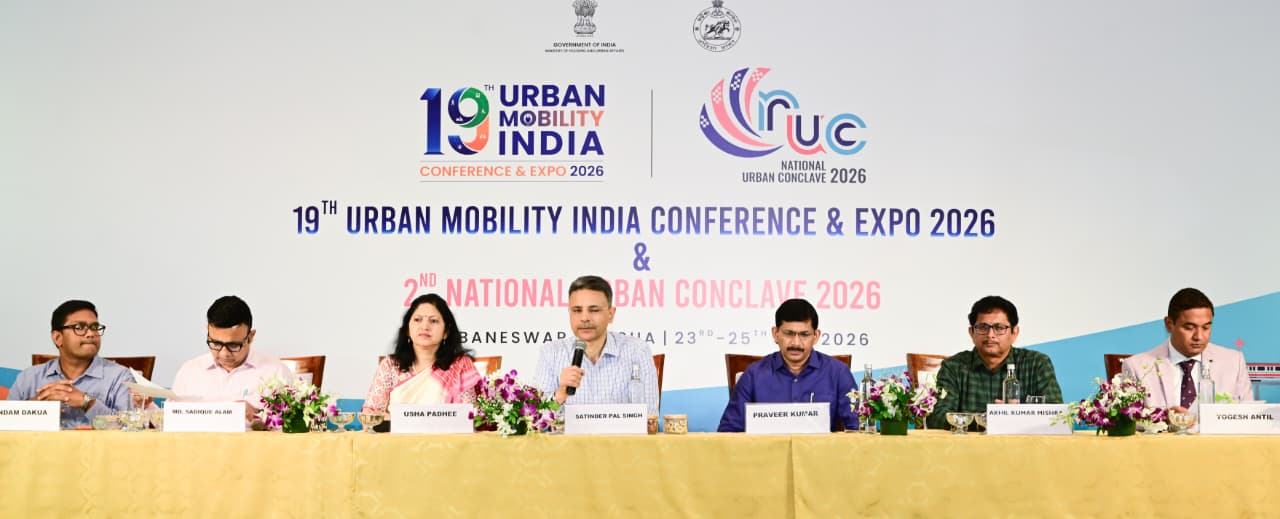
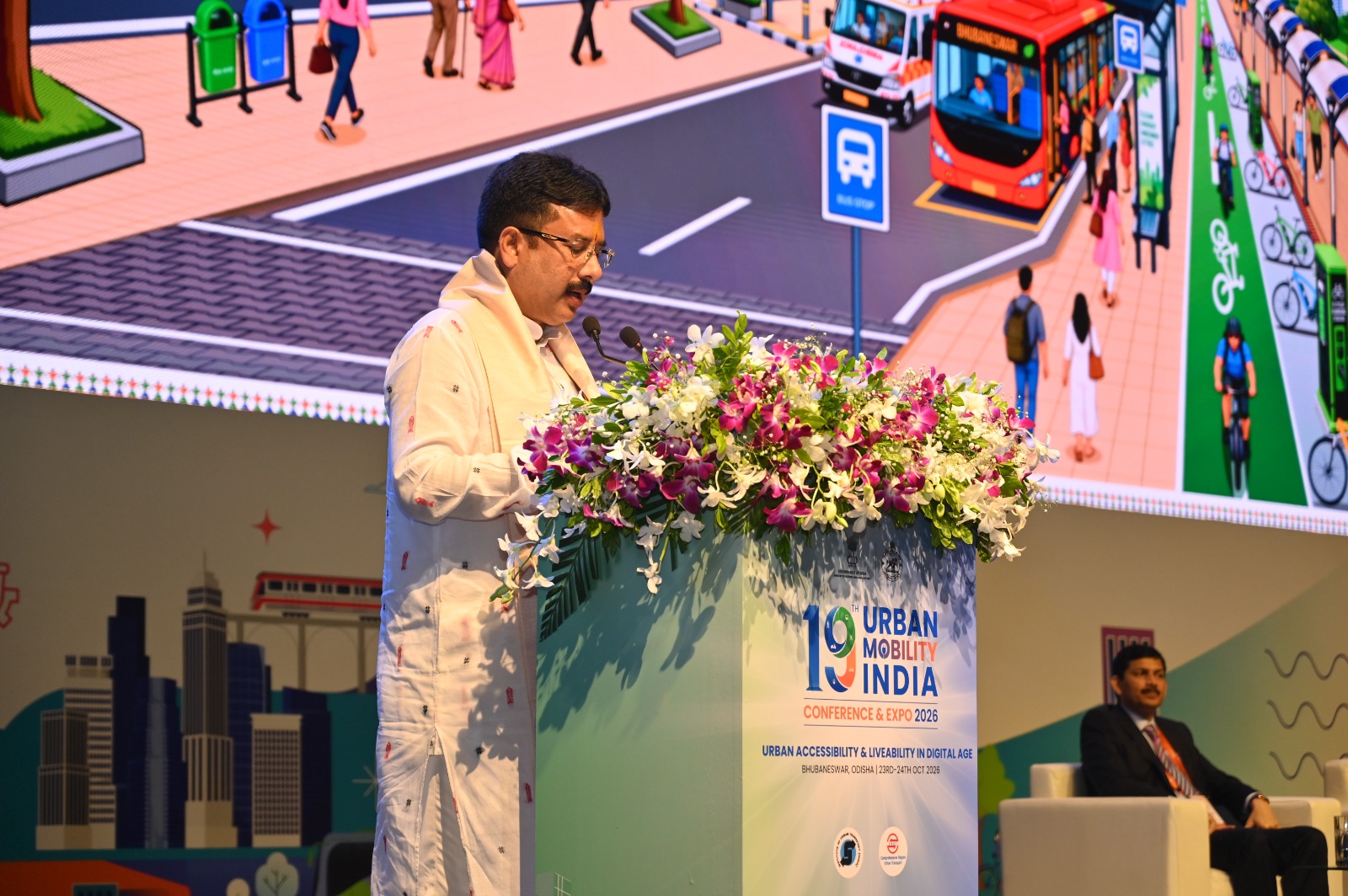
Bhubaneswar: The 19th Urban Mobility India (UMI) Conference and Exhibition 2026 opened in Bhubaneswar on Friday, bringing together policymakers, urban transport experts, government officials and industry representatives to discuss technology-driven, inclusive and sustainable mobility solutions for Indian cities.
Union Minister of State for Housing and Urban Affairs Tokhan Sahu inaugurated the two-day conference along with Odisha Housing and Urban Development Minister Krushna Chandra Mahapatra at Hotel Mayfair Sanctuary. Organised by the Ministry of Housing and Urban Affairs (MoHUA) through the Institute of Urban Transport (India), with support from the Odisha government, the conference is being held on October 23 and 24 under the theme ‘Urban Accessibility and Liveability in Digital Age’.
The inaugural session was attended by Odisha Chief Secretary Anu Garg, MoHUA Secretary Satendra Singh and Additional Chief Secretary of the Housing and Urban Development Department Usha Padhee, among other senior officials and experts. Around 1,500 delegates from India and abroad are expected to participate in the event.
Metro network expands to 1,185 km: Union Minister
Addressing the gathering, Tokhan Sahu said the UMI Conference had emerged as an important national platform for shaping the future of urban transport. He stressed that urban development should be assessed by how safely, comfortably and independently people—including women, children, senior citizens and persons with disabilities—can travel within cities.
Highlighting the expansion of metro rail infrastructure, Sahu said India’s operational metro network had grown from 248 km in 2014 to more than 1,185 km across 26 cities. Work is underway on another 998 km of metro lines, he added.
He said initiatives such as the National Common Mobility Card, QR-based ticketing and PM e-Bus Sewa were helping make public transport more accessible and sustainable.
Appreciating Odisha’s efforts, Sahu cited the State’s Ama Bus services as an example of modern, technology-enabled public transport. He said efficient and inclusive urban mobility would play an important role in achieving the vision of Viksit Bharat 2047.
Odisha focuses on people-centric mobility
Odisha Housing and Urban Development Minister Krushna Chandra Mahapatra said urban mobility was not merely about transportation but also about improving citizens’ quality of life and making cities more accessible, inclusive and sustainable.
He said the State was working towards safe, reliable and affordable public transport systems to meet the everyday needs of commuters. Initiatives such as Ama Bus and Ama E-Ride, he added, were aimed at making urban travel more convenient for students, working professionals, women and other passengers.
Mahapatra said the conference offered an opportunity for states and urban transport experts to exchange experiences and explore innovative solutions for future mobility needs.
Chief Secretary Anu Garg outlined Odisha’s approach to urban mobility, describing it as an “8S approach”—Service Access and Service Reliability, Smart Mobility, Sustainability, Systems, Safety, Seamlessness, Samaveshi and Satisfaction.
She said Capital Region Urban Transport (CRUT) was operating around 800 buses across eight cities, with efforts to strengthen digital ticketing, increase women’s participation as drivers and improve commuter convenience. The State was also expanding electric vehicle infrastructure to support an integrated and sustainable mobility ecosystem, she added.
Earlier, MoHUA Secretary Satendra Singh said the conference, being held in Bhubaneswar for the first time, had evolved since its inception in 2008 into an international platform for sharing best practices and addressing urban transport challenges.
He said the technical sessions, round-table discussions and research symposiums would help shape strategies for providing efficient, sustainable and high-quality transport services to India’s growing urban population.
Exhibition showcases transport technologies
An exhibition featuring urban transport best practices, emerging technologies and innovative mobility solutions was inaugurated by Sahu in the presence of Mahapatra and other dignitaries.
A total of 28 exhibitors from the Odisha government, metro rail companies, public sector organisations and private enterprises are participating. The exhibition provides a platform for showcasing developments in transport technology and exchanging knowledge on sustainable mobility solutions.
Digital technology, gender-responsive planning in focus
The first day featured a conclave session, a technical session, three round-table discussions and a special session on comprehensive regional mobility planning.
The conclave session on ‘Liveability, Mobility and Accessibility in Digital Age’ examined how digital technologies could improve urban connectivity and create more inclusive living environments. Discussions covered accessibility for senior citizens and persons with disabilities, digital connectivity that could reduce the need for physical travel, and the integration of safety, privacy and inclusivity into mobility systems.
The technical session on ‘Data Governance and Intelligent Transport’ focused on the use of real-time data, cameras, sensors, GPS and artificial intelligence in traffic management and transport operations. Participants discussed data security, privacy, interoperability and the development of integrated mobility platforms.
A round-table discussion on ‘Institutionalising Gender-Responsive Urban Planning’ examined ways to incorporate women’s mobility needs into urban planning, municipal regulations, budgets and development frameworks. The use of gender-disaggregated data and inclusive provisions in master plans and development regulations also featured in the deliberations.
Another session, ‘Modernizing Bus Systems – Role of SPVs and PM e-Bus Sewa Scheme: Lessons from CRUT’, explored the role of dedicated Special Purpose Vehicles in improving bus operations. Drawing on Odisha’s experience, the discussion covered technology-enabled transport management, service modernisation and integration between different modes of transport.
The round table on ‘Transport, Air Quality and Public Health’ examined the potential of Low Emission Zones to reduce transport-related pollution and exposure to harmful emissions. Participants discussed the legal, institutional, financial and technological requirements for implementing such zones and the possibility of a national strategy.
The special session on comprehensive regional mobility planning highlighted CRUT’s experience in connecting urban and regional transport services through Ama Bus and feeder services such as Ama E-Ride. Discussions covered integrated transport across Bhubaneswar, Cuttack, Khordha, Puri, Rourkela, Sambalpur and Berhampur, including integrated ticketing and technology-enabled operations.
Research symposium to recognise young scholars
A research symposium is being organised to encourage young researchers and PhD scholars to present their work on urban mobility. Of the 46 papers selected through peer review, 20 will be presented by candidates, while 26 will be showcased through poster presentations.
The three best papers selected by a jury will receive cash awards of ₹25,000 each. Certificates will be presented to all participants presenting their research.
The second day, on October 24, will feature discussions on transit-oriented development, people-centric streets, behavioural change and public communication, intelligent and secure mobility, and rail-led integrated urban development.
The conference will conclude with a valedictory session and awards for excellence and best-practice projects in urban transport across different categories. Union Minister for Housing and Urban Affairs and Power Manohar Lal is scheduled to deliver the valedictory address and present the awards along with Mahapatra.
The UMI Conference will be followed by the National Urban Conclave 2026, scheduled for October 24 and 25 at the same venue. The two events will bring together stakeholders to deliberate on urban transport, planning, governance and service delivery.