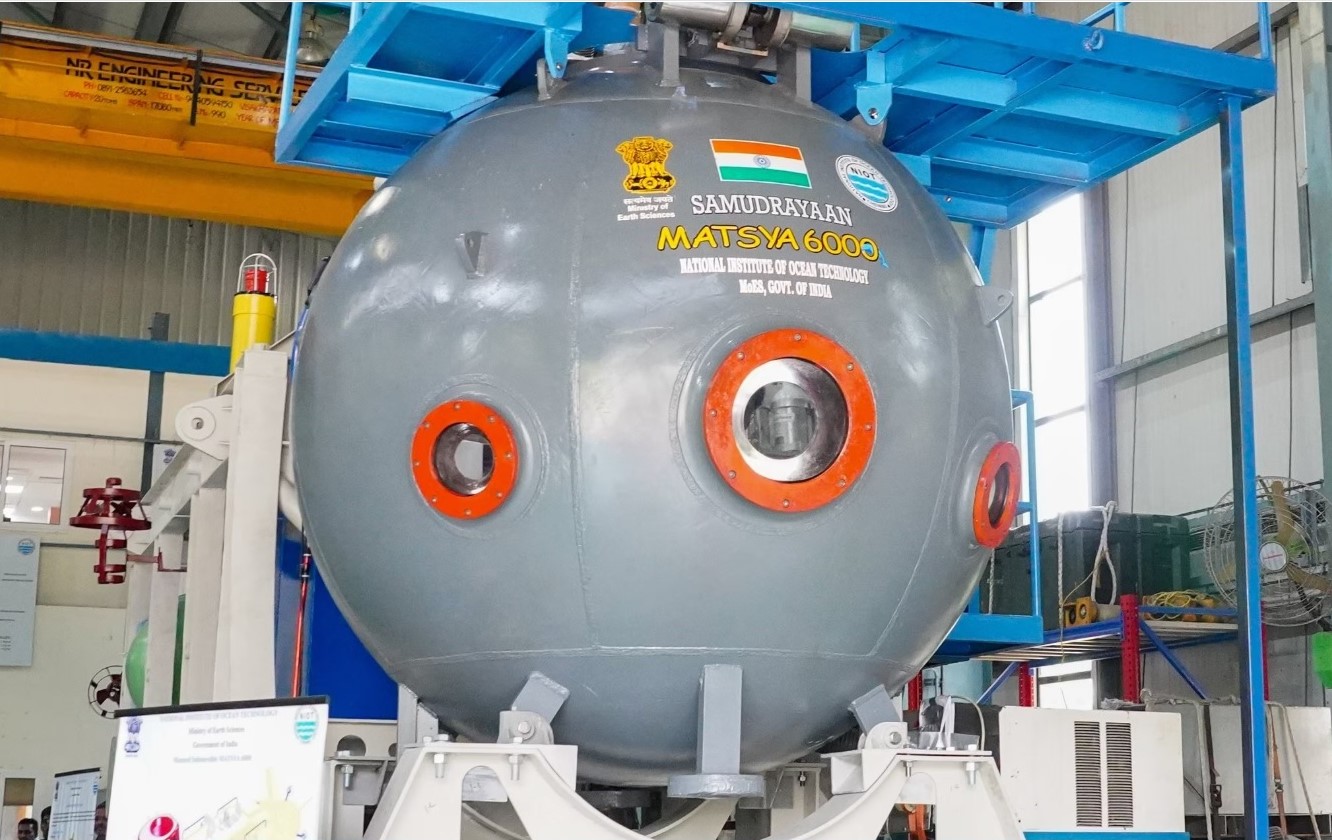
New Delhi: India is making significant strides in deep-sea exploration with the development of Matsya 6000, a manned submersible capable of reaching depths of 6,000 meters. The National Institute of Ocean Technology (NIOT), Chennai, under the Ministry of Earth Sciences, is spearheading the project, which is expected to be realized by 2026 as part of the ambitious Deep Ocean Mission.
Designed to accommodate three people, Matsya 6000 will be equipped with advanced scientific sensors for ocean exploration, biodiversity surveys, and resource assessment. Union Minister of State (Independent Charge) for Science & Technology and Earth Sciences, Dr. Jitendra Singh, informed the Rajya Sabha today that the technologies developed under this initiative will not only enhance India’s capability in deep-sea vehicle development but also promote sustainable exploration of deep-sea living and non-living resources. The mission is expected to generate significant advancements in underwater engineering, asset inspection, and ocean literacy.
A key feature of Matsya 6000 is its Titanium alloy personnel sphere, which has an internal diameter of 2.1 meters, ensuring the safe transportation of humans to extreme depths. The sphere is being integrated in collaboration with the Indian Space Research Organisation (ISRO). The submersible will be equipped with buoyancy management systems, power and control systems, maneuvering propellers, subsea intervention manipulators, navigation and positioning devices, communication systems, and onboard energy storage batteries.
The submersible is designed to conduct continuous operations at 6,000 meters for up to 12 hours, with an emergency endurance of up to 96 hours. To ensure human safety, a Human Support and Safety System has been developed, providing acclimatization support and emergency protocols for the three-person crew.
The Deep Ocean Mission is aligned with the United Nations’ guidelines on deep-sea exploration, ensuring that activities adhere to international regulations. Additionally, the mission includes initiatives such as the development of ocean climate change advisory services, aimed at enhancing data acquisition and analysis to predict sea level changes, cyclone intensity, storm surges, and coastal erosion.
Furthering its commitment to ocean research, the government is also acquiring a multidisciplinary research vessel and establishing an Advanced Marine Station for Ocean Biology (AMSOB) to expand marine biology research in India.
Bhubaneswar: Olympian hockey player and East Coast Railway (ECoR) Sports Officer Amit Rohidas was felicitated…
Bhubaneswar: Adapting government communication to the rapidly evolving digital and artificial intelligence (AI) landscape while…
Bhubaneswar: The Information and Public Relations (I&PR) Department organised a one-day orientation programme on “Emerging…
Bhubaneswar: Odisha’s disaster management model continues to draw interest from students pursuing disaster management studies,…
Bhubaneswar: School infrastructure across Odisha is set for a boost, with projects worth ₹7.73 crore…
Bhubaneswar: Odisha is set to strengthen its environmental monitoring framework with greater use of technology,…