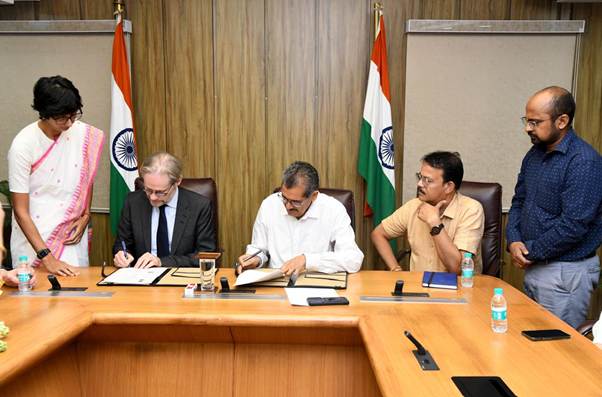
New Delhi: In a significant collaboration to explore India’s maritime past and strengthen underwater heritage research, the Archaeological Survey of India (ASI) and the National Museum of Denmark have signed a Memorandum of Understanding (MoU) to undertake a joint underwater archaeological investigation of the historic Danish ship Oresund, believed to have sunk off the coast near Karaikal in present-day Puducherry in 1619 CE.
The project will be carried out by ASI’s Underwater Archaeology Wing in partnership with the National Museum of Denmark’s Njord – Centre for Maritime and Underwater Cultural Heritage, Copenhagen. The initiative aims to locate, document and scientifically study the remains of the vessel through non-invasive archaeological methods.
The Oresund holds particular historical significance as the earliest known Danish ship to reach Indian waters. However, shortly after arriving near the Indian coast in the early 17th century, the vessel was reportedly wrecked near Karaikal. Researchers believe that uncovering its remains could offer valuable insights into early maritime exchanges between India and Denmark and expand understanding of trade and navigation routes across the Indian Ocean region during that period.
As part of the collaboration, the exploration will rely on advanced survey technologies and scientific techniques without disturbing the seabed or damaging potential archaeological remains. The approach is expected to help identify possible traces of the ship while preserving the integrity of underwater cultural heritage sites.
The initiative also marks an important milestone for ASI’s Underwater Archaeology Wing, as it will be its first international collaborative archaeological project. Officials expect the partnership to open new avenues for research and strengthen institutional cooperation between India and Denmark in the field of maritime archaeology.
The project reflects a shared commitment by both institutions to document, preserve and promote underwater cultural heritage through scientific research and international collaboration, while contributing to a deeper understanding of historical links across the seas.