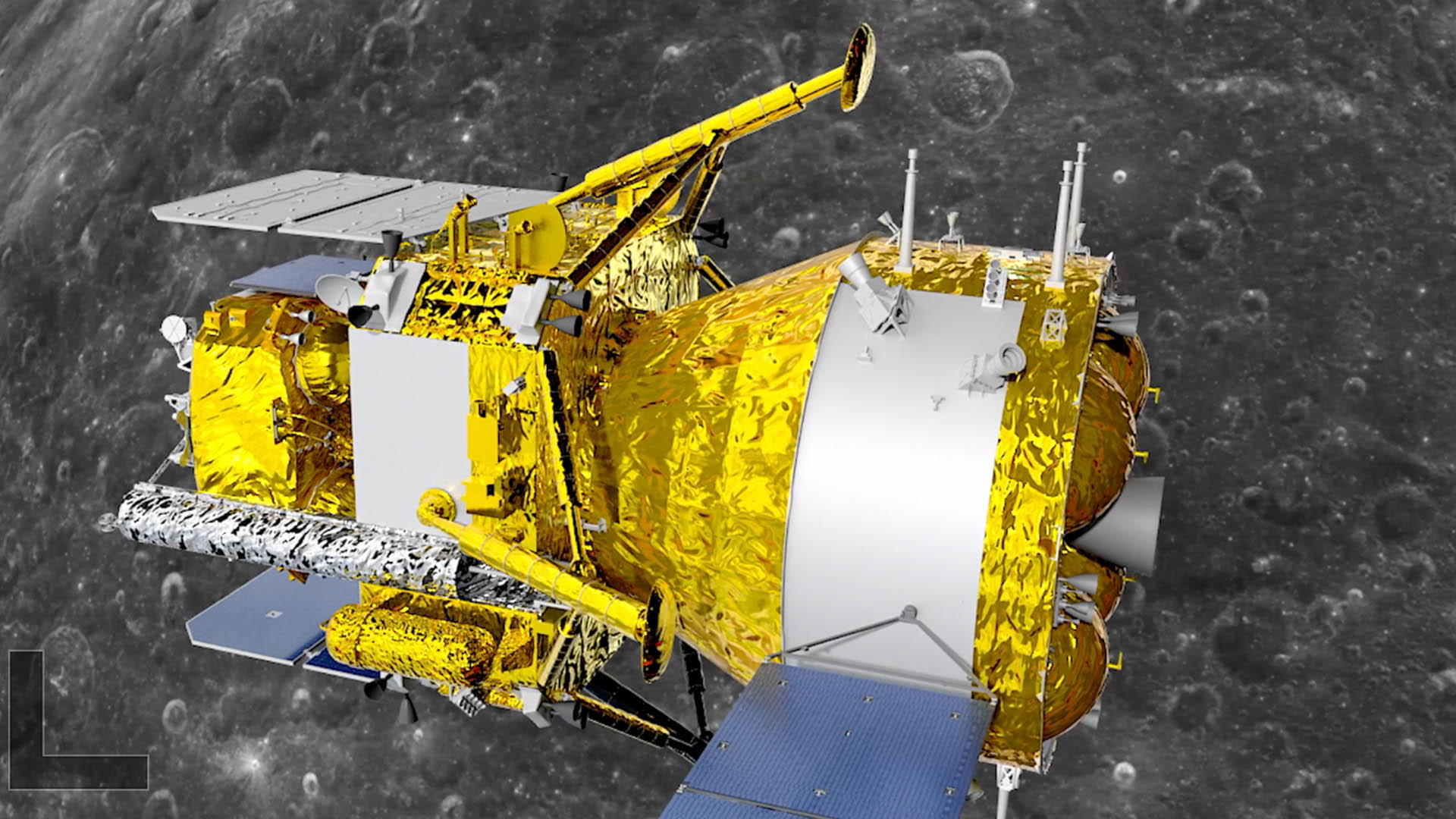
Beijing: China achieved a significant milestone in lunar exploration on Friday with the successful launch of its Chang’e-6 probe to the moon’s far side. Lifted into space by a Long March-5 YB rocket from the Wenchang launch center in Hainan province, the probe embarks on a mission aimed at retrieving samples from this lesser-explored region of the lunar surface.
The primary objective of the Chang’e-6 mission is to collect samples from the moon’s far side, offering valuable insights into the geological composition and characteristics unique to this area. China’s initiative is viewed as a strategic move to bolster its position in the international space race, particularly against the backdrop of competition with the United States for sustained lunar exploration.
NASA Administrator Bill Nelson expressed concerns about China potentially restricting access to lunar resources, highlighting the significance of the moon’s south pole, where water and potential rocket fuel sources are believed to exist. NASA aims to send US astronauts to the moon by 2026, collaborating with private entities like Blue Origin and SpaceX to achieve its goals.
The far side of the moon presents challenges for communication due to its lack of direct line-of-sight with Earth. To overcome this obstacle, China has deployed a relay satellite to facilitate communication with the Chang’e-6 probe. Once the samples are collected, the spacecraft is expected to return to Earth after 53 days, marking a historic moment in human lunar exploration.
China’s commitment to lunar exploration is well-established, with previous missions including the successful landing of the Chang’e-4 rover on the far side of the moon in 2019 and the return of samples from the near side in 2020. These missions have provided valuable data, including the discovery of water in lunar soil samples.
In a significant development, Pakistan launched its first satellite mission to the moon, iCube Qamar, aboard China’s Chang’e-6. Developed in collaboration with China’s Shanghai University and Pakistan’s national space agency SUPARCO, iCube Qamar aims to facilitate scientific research and technology development in space exploration.
Bhubaneswar: Two school-going sisters from Odisha have used a multiplication table to deliver a social…
Bhubaneswar: The Satwalipi Committee on Mahaprabhu Lingaraj Temple has submitted its third interim report to…
Bhubaneswar: Odisha will organise a state-level summit to finalise priorities and accelerate the implementation of…
Bhubaneswar: The Housing and Urban Development Department has asked Urban Local Bodies (ULBs) across Odisha…
Bhubaneswar: From exploring ancient temples and the story of Odisha’s capital city to discovering local…
Bhubaneswar: Odisha will prepare a dedicated lightning safety action plan for 2027 and a roadmap…
