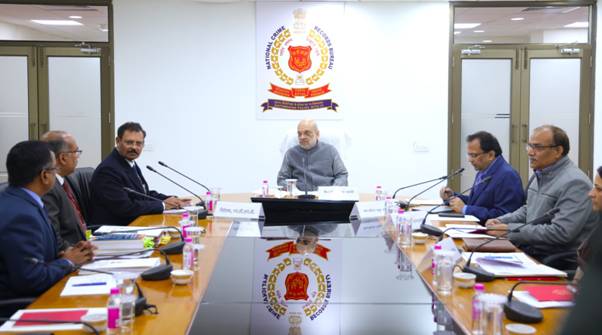
New Delhi: Union Home Minister and Minister of Cooperation Amit Shah chaired a high-level review meeting to assess the implementation of three new criminal laws in collaboration with the National Crime Records Bureau (NCRB). The meeting focused on the integration of critical systems, including the Crime and Criminal Tracking Network & Systems (CCTNS 2.0), National Automated Fingerprint Identification System (NAFIS), and the Inter-Operable Criminal Justice System (ICJS 2.0), with allied modules such as prisons, courts, prosecution, and forensics at a national level.
Union Home Secretary, Director NCRB, and senior officials from the Ministry of Home Affairs, NCRB, and NIC were in attendance.
During the meeting, Amit Shah underscored the importance of using advanced technological applications such as eSakshya, Nyaya Shruti, eSign, and eSummons across all states and union territories. He stressed the need for real-time alerts at predefined stages of criminal cases, from registration to disposal, to ensure timely updates for victims and complainants.
To expedite investigations, the Home Minister proposed generating alerts for investigation officers and senior officials based on predefined timelines. He emphasized deploying biometric technology to identify unidentified deceased individuals and missing persons effectively.
Shah directed NCRB to facilitate the full implementation of new criminal laws within the ICJS 2.0 framework. He advised forming teams of officers from the Ministry of Home Affairs and NCRB to visit states and union territories to enhance adoption rates of technical projects and provide necessary support.
He also called for regular interactions with senior police officials in states and UTs to monitor the progress of CCTNS and ICJS projects and maintain momentum in their execution.
Highlighting the role of data in modern investigations, Shah instructed NCRB to develop a robust, data-rich platform to support investigation officers and other stakeholders in the criminal justice system. He lauded NCRB’s efforts in implementing new criminal laws and the National Automated Fingerprint Identification System (NAFIS), emphasizing the bureau’s pivotal role in modernizing law enforcement practices.
This review underscores the government’s commitment to leveraging technology for a streamlined, transparent, and efficient criminal justice system. By integrating critical systems and adopting innovative solutions, the initiative aims to enhance law enforcement’s responsiveness and accountability, benefitting both victims and investigators.
Bhubaneswar: In a push to upgrade primary education infrastructure, Chief Minister Mohan Charan Majhi on…
Bhubaneswar: Strengthening development in Kandhamal district, Odisha Chief Secretary Anu Garg reviewed key projects across…
Jagatsinghpur: Around 25 heritage enthusiasts from across Odisha participated in the 14th edition of the…
Bhubaneswar: Emphasising long-term development and citizen participation, Chief Minister Mohan Charan Majhi on Tuesday described…
Bhubaneswar: Odisha has emerged as a leading state in urban transformation, registering strong progress under…
Bhubaneswar: The seventh day of the ongoing Odia Pakhya was celebrated as “Shishu Katha Divas”…
