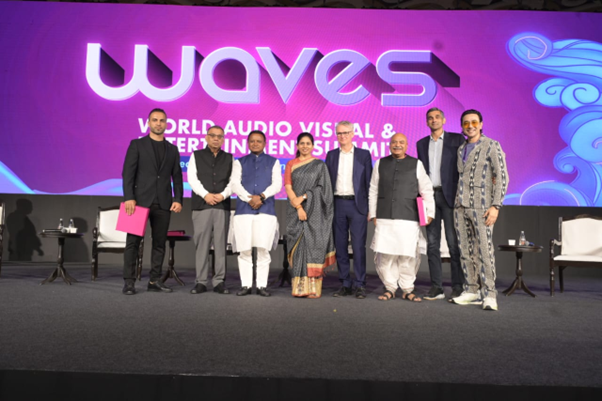
Mumbai: In a vibrant and thought-provoking panel session at the World Audio-Visual Entertainment Summit (WAVES) in Mumbai, the spotlight turned to India’s indigenous sports—their deep cultural roots and their rising global footprint. Titled “Indigenous Sports: From India to the Global Stage,” the session brought together policymakers, athletes, sports entrepreneurs, and international voices, all united by a powerful vision: to elevate traditional Indian games to global acclaim.
Delivering the keynote address, Mohan Charan Majhi, Chief Minister of Odisha, passionately underscored the intrinsic link between indigenous sports and India’s cultural identity. “These games are not just physical contests; they are living traditions, woven into the fabric of our communities,” he said, crediting Prime Minister Narendra Modi for championing the revival and internationalization of India’s native games. He added that Odisha—home to vibrant tribal cultures—has been at the forefront of preserving and promoting such heritage and is fast becoming a sports hub for rural and tribal talent.
Raksha Nikhil Khadse, Union Minister of State for Youth Affairs & Sports, lauded the WAVES platform and reaffirmed the Centre’s commitment to grassroots development through initiatives like Khelo India. “India has already become a global torchbearer of Yoga. Now, with sports like Kabaddi and Kho-Kho, we are ready to tell another Indian story to the world,” she stated, highlighting that sports serve as both a vehicle for wellness and a powerful force for social cohesion.
Anupam Goswami, League Commissioner of the Pro Kabaddi League (PKL), emphasized the market potential of India’s indigenous sports. “These games connect with audiences on an emotional and cultural level. The challenge now is to scale them globally,” he said.
International athlete Fazel Atrachali, a star of the PKL from Iran, shared a compelling personal narrative. “Kabaddi gave me purpose, fame, and financial stability. It transformed my life—and the lives of many,” he said, pointing to the league’s impact beyond Indian borders.
Nic Coward, Regulatory Chairperson of the English Cricket Board, called for a digital-first strategy. “To make these sports global, we must leverage modern distribution methods—especially digital platforms and e-sports adaptations,” he advised.
Adding data and direction, Sudhanshu Mittal, President of the Kho-Kho Federation of India, shared that Kho-Kho is now played in 55 countries, with the goal of expanding to over 90 nations by year-end. “Our games are strategic, demanding, and full of spirit. They can become India’s next soft power export—but they need structured government support and smart branding,” he asserted.
Yannick Colaco, Founder of Fancode, emphasized technology and fan engagement as key enablers. “The tools are here. It’s about using them effectively to bring fans closer and scale India’s sporting culture to global heights,” he said.
The session was moderated by Mantra Mugdh, who skillfully guided the dialogue, weaving together insights from across disciplines and geographies.
As the panel concluded, a clear consensus emerged: India’s indigenous sports are more than games—they are cultural ambassadors. With the right mix of policy support, media outreach, tech integration, and global collaborations, they can carve out a powerful identity on the world stage. WAVES 2025 is helping accelerate that journey.
4o