New Delhi: A new study reveals that the unprecedented global increase in greenhouse gases could drastically alter rainfall patterns in the equatorial region, leading to significant shifts in vegetation. This change may transform India’s biodiversity hotspots, such as the evergreen forests in the Western Ghats, northeast India, and the Andamans, into deciduous forests.
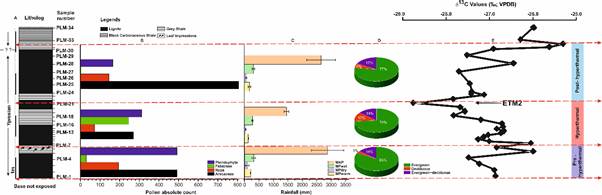
Researchers from the Birbal Sahni Institute of Palaeosciences (BSIP), an autonomous institute under the Department of Science and Technology, have utilized fossil pollen and carbon isotope data from the Eocene Thermal Maximum 2 (ETM-2) to quantify the terrestrial hydrological cycle during that period. ETM-2, also known as H-1 or Elmo, was a period of global warming that occurred around 54 million years ago.
During the ETM-2, the Indian plate lingered near the equator on its journey from the southern to the northern hemisphere. This unique geological history makes the Indian plate an ideal natural laboratory for understanding the vegetation-climate relationship near the equator during ETM-2. The researchers selected the Panandhro Lignite Mine in Kutch, Gujarat, for their study due to the availability of fossils from this period.
Their analysis of fossil pollen revealed that when atmospheric carbon dioxide concentrations exceeded 1000 parts per million by volume (ppmv) near the paleo-equator, there was a significant decrease in rainfall, resulting in the expansion of deciduous forests. This finding has profound implications for the survival of equatorial and tropical rainforests and biodiversity hotspots under current and future increases in carbon emissions.
The study, published in the journal Geoscience Frontiers, raises critical questions about the future of these biodiversity-rich regions. It highlights the importance of understanding the relationship between carbon dioxide levels and the hydrological cycle to aid in the conservation of these areas.
“This research provides valuable insights into how increased carbon emissions could impact equatorial and tropical regions,” said a spokesperson for the BSIP. “By examining past hyperthermal events, we can better predict and prepare for future climate scenarios.”
The findings emphasize the need for urgent action to mitigate greenhouse gas emissions and protect the fragile ecosystems that are vital for biodiversity. As the world grapples with the consequences of climate change, studies like this underscore the interconnectedness of atmospheric conditions, rainfall patterns, and vegetation, and the potential long-term impacts on our planet’s ecological balance.
Bhubaneswar: Chief Minister Mohan Charan Majhi on Sunday inaugurated two affordable housing projects in Bhubaneswar,…
Bhubaneswar: Odisha has received the prestigious ‘Wind India 2026: Leadership in Wind Energy De-risking’ award…
Bhubaneswar: The Police Commissionerate, Bhubaneswar-Cuttack, has announced traffic restrictions across Bhubaneswar from October 16 to…
Bhubaneswar: To manage the expected rise in passenger traffic during the upcoming Durga Puja and…
Greater Noida: Odisha’s traditional handlooms and handicrafts are attracting buyers and visitors from India and…
Bhubaneswar: Food vendors at this year's Bali Jatra in Cuttack will be encouraged to use…