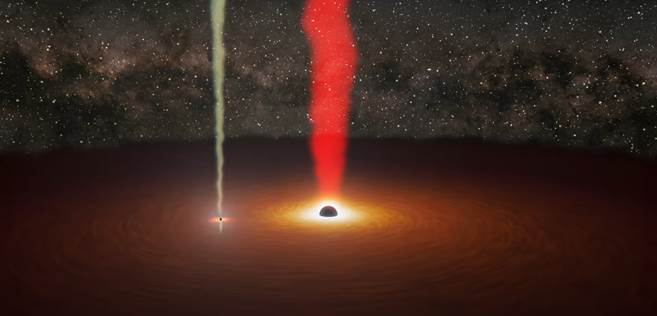
New Delhi: In a groundbreaking discovery, a team of 32 scientists from 10 countries including Finland, Poland, India, China, USA, Czech Republic, Japan, Germany, Spain, and Italy has observed a smaller black hole orbiting a larger one in the galaxy OJ 287, located four billion light-years away. This marks the first time an orbiting black hole has been directly “sighted.”
The existence of two black holes at the center of OJ 287 was initially proposed by astronomers at the University of Turku, Finland. In 2021, NASA’s Transiting Exoplanet Survey Satellite (TESS) was tasked with verifying this theory. TESS, known for discovering exoplanets, monitored the brightness of the primary black hole and its jet, revealing the presence of the smaller black hole through a sudden burst of brightness.
This unprecedented event, predicted by researcher Pauli Pihajoki in his 2014 doctoral dissertation, was observed on November 12, 2021, when TESS detected the expected flare. These observations, recently published in the Astrophysical Journal Letters, were further supported by data from NASA’s Swift telescope and a global collaboration led by Staszek Zola from the Jagiellonian University in Poland.
The team observed that the 12-hour burst of brightness occurred when the smaller black hole “swallowed” a large portion of the accretion disk surrounding the larger black hole, emitting a jet of gas that outshone the larger black hole. This burst temporarily changed the color of OJ 287 from red to yellow, indicating the light was from the smaller black hole.
“We can now say that we have ‘seen’ an orbiting black hole in the same way that TESS has seen planets orbiting other stars,” said Professor Mauri Valtonen from the University of Turku. “Due to OJ 287’s great distance, it will likely be a long time before our observation methods can capture a direct image even of the larger black hole.”
The smaller black hole is also expected to emit nano-Hertz gravitational waves, which should be detectable in the coming years by pulsar timing arrays, according to A. Gopakumar from the Tata Institute of Fundamental Research in Mumbai, India.
This discovery not only confirms the existence of the orbiting black hole but also opens new avenues for studying gravitational waves and the dynamics of black hole interactions.
Bhubaneswar: Responding to mounting criticism and political consensus, the Odisha government has begun the process…
Bhubaneswar: The inaugural edition of the National Indoor Athletics Championships concluded on a high note…
Bhubaneswar: The Higher Education Department, Government of Odisha has announced that the Common PG Entrance…
Bhubaneswar: The Government of Odisha has nearly concluded paddy procurement for the 2025–26 Kharif season,…
Bhubaneswar: Strengthening its efforts to stabilise farm incomes and streamline agricultural marketing, the Odisha Rural…
Bhubaneswar: With a growing focus on sustainable agriculture and income diversification, the Agricultural Promotion and…