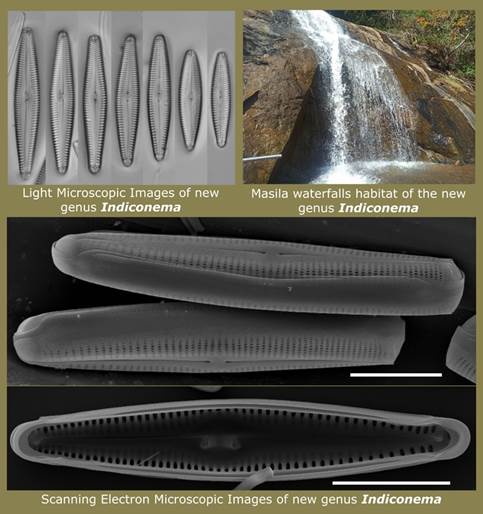
Pune: In a groundbreaking discovery, researchers from the Agharkar Research Institute (ARI) in Pune have identified a new genus of the Gomphonemoid diatom in the pristine waters of the Eastern Ghats. This newly discovered genus, named Indiconema, showcases a unique suite of features distinguishing it from other members of the Gomphonemoid group, particularly in valve symmetry and other valve characteristics.
Indiconema, derived from “India” to reflect its limited geographic distribution, underscores the importance of diatoms in shaping the biodiversity of India’s landscapes. Diatoms, microscopic algae, are vital to our ecosystem, producing 25% of the world’s oxygen—roughly every fourth breath we take. They also serve as the foundation of the aquatic food chain and are sensitive indicators of water quality.
India’s diatom research has a storied history, dating back to 1845 when Ehrenberg first recorded microorganisms in his publication Mikrogeologie. Over the years, numerous studies have documented diatoms in both freshwater and marine environments across India. Estimates suggest there are nearly 6,500 diatom taxa in India, with 30% being endemic, highlighting the country’s unique biodiversity. The diverse biogeographic zones of India, from freshwater lakes to marine environments, and from sea level to high mountains, support a wide array of diatom species.
The discovery of Indiconema is particularly significant due to its distinct morphological feature of having a pore field at both the head and foot poles, unlike other Gomphonemoid diatoms which typically have a pore field only at the foot pole. This discovery, published in the journal Phycologia, reports one species of Indiconema from the Eastern Ghats and another from the Western Ghats, showcasing a pattern of shared endemic elements between these mountain systems, similar to patterns observed in other groups such as reptiles.
The researchers have proposed that Indiconema is closely related to Afrocymbella, a genus endemic to East Africa, based on morphological similarities. This finding aligns with earlier observations of similarities between Gomphonema species from India and those from East Africa and Madagascar, suggesting a biogeographical connection.
This research, supported by the erstwhile Science and Engineering Research Board (SERB), now the Autonomous National Research Foundation (ANRF), emphasizes the ongoing need to explore diatom biogeography and their critical role in India’s biodiversity.
The evolution of monsoons has played a crucial role in structuring the rainforest biome across the Indian Peninsula, influencing the diatom flora. With the discovery of Indiconema, researchers are hopeful that further studies will continue to uncover the mysteries of diatom distribution and their ecological significance.
Bhubaneswar: East Coast Railway (ECoR) has introduced an Artificial Intelligence (AI)-powered robotic surveillance platform, DSC…
Bhubaneswar: A series of heritage walks across Chilika-Banapur, Bargarh and Dhenkanal is bringing renewed attention…
Bhubaneswar: The United Kingdom and Odisha on Tuesday explored avenues to deepen cooperation in trade,…
Bhubaneswar: Odisha took another step towards expanding its industrial base on Tuesday with the State…
Bhubaneswar: Odisha Health and Family Welfare Minister Dr Mukesh Mahaling on Tuesday conducted a comprehensive…
Bhubaneswar: The Election Commission of India (ECI) has intensified the Special Intensive Revision (SIR) of…