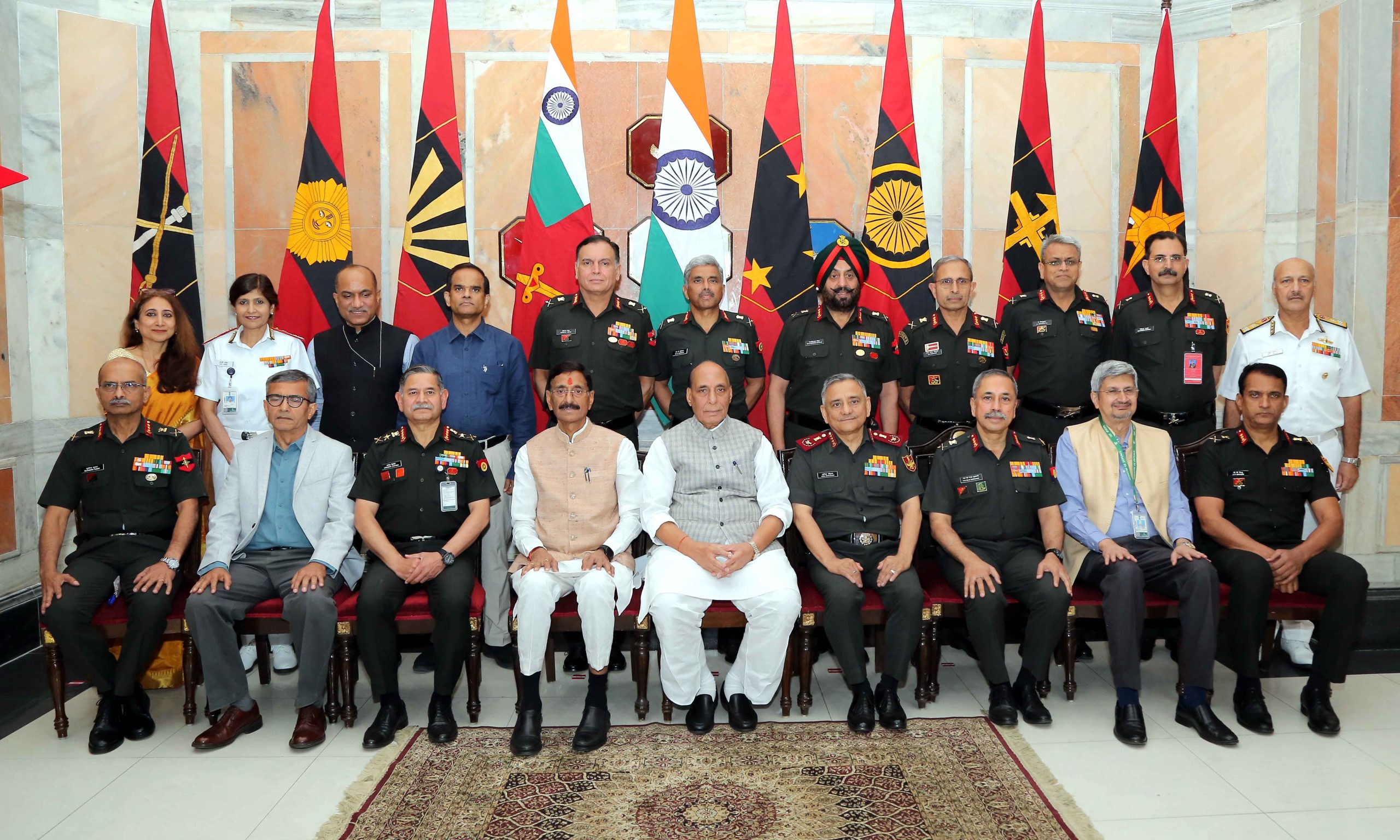
New Delhi: The Army Commanders’ Conference, a biannual apex-level event, commenced in New Delhi, bringing together the top leadership of the Indian Army to deliberate on critical security issues, organisational restructuring, and modernization efforts.
In his address Raksha Mantri Rajnath Singh, emphasized the Indian Army’s pivotal role in national security, humanitarian assistance, and internal stability.
During the conference, the senior leadership engaged in discussions on organizational restructuring, logistics, administration, human resource management, and modernization through indigenization. Special attention was given to the impact of global geopolitical shifts on India’s security framework and the integration of niche technologies in military operations.
In his address, Raksha Mantri Rajnath Singh reaffirmed the Indian Army’s position as one of the most trusted institutions in the country. He lauded the Army’s role in safeguarding borders, countering terrorism, and assisting civil authorities during crises.
He stated, “The Army is present in every domain—security, humanitarian assistance, disaster relief, and medical aid—playing an invaluable role in nation-building and overall national development.”
The Minister particularly appreciated the Army’s technological advancements and efforts to integrate cutting-edge capabilities. He noted that future warfare will be asymmetric, unconventional, and hybrid, incorporating elements of cyber, information, communication, trade, and finance warfare. He urged the Armed Forces to incorporate these factors into their strategic planning.
Addressing the security situation along India’s northern borders, the Raksha Mantri expressed full confidence in the armed forces and commended their unwavering vigilance. He also praised the Border Roads Organisation (BRO) for significantly improving road connectivity in challenging terrains.
On India’s western borders, he lauded the Army’s effective response to cross-border terrorism and acknowledged the continued threat posed by proxy warfare. He also praised the synergy between the Central Armed Police Forces (CAPF), state police, and the Army in counter-terror operations in Jammu and Kashmir, which has contributed to increased stability in the region.
The conference also focused on defense diplomacy and international cooperation, highlighting the role of Defence Attachés in fostering global military partnerships. Rajnath Singh stressed the importance of indigenous defense production and self-reliance (Atmanirbhar Bharat), applauding the Army’s collaboration with civil industries and academic institutions to develop niche technologies.
He remarked that discussions with NITI Aayog on achieving ‘Viksit Bharat’ during the conference further reinforce the government’s commitment to military modernization.
The Raksha Mantri reaffirmed the government’s unwavering commitment to veterans and the families of fallen soldiers, ensuring their welfare remains a priority. He paid tribute to the brave hearts who have sacrificed their lives in the defense of the nation.
Rajnath Singh concluded his address by emphasizing that defense diplomacy, technological advancements, information warfare, infrastructure development, and force modernization should be integral aspects of military strategy. He urged senior leadership to implement necessary doctrinal changes to ensure that the Indian Army remains future-ready.
“The Nation is proud of its Army, and the Government remains committed to facilitating its journey towards comprehensive reforms and enhanced operational capability,” he said.