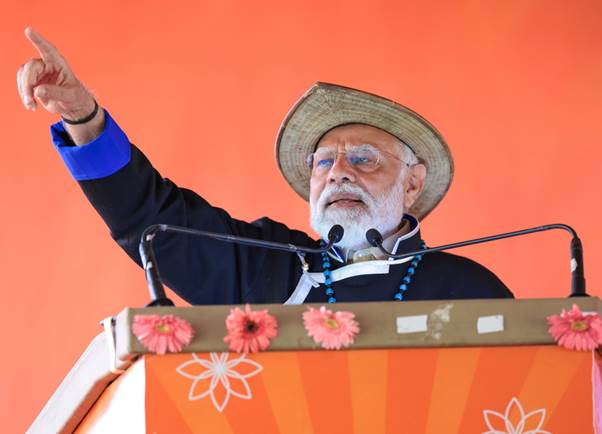
Itanagar: Prime Minister Narendra Modi laid the foundation stone of the 2,880 MW Dibang Multipurpose Hydropower Project in the Lower Dibang Valley district of Arunachal Pradesh. The ceremony, held during the Viksit Bharat Viksit North East Program, Prime Minister inaugurated, dedicated and initiated the foundation stone laying for various development projects worth approximately Rs. 55,600 crores across Manipur, Meghalaya, Nagaland, Sikkim, Tripura, and Arunachal Pradesh.
The Dibang Multipurpose Hydropower Project, expected to cost over Rs. 31,875 crores, will be the highest dam structure in India, generating electricity, aiding in flood moderation, and fostering employment opportunities and socioeconomic development in the region.
Addressing the gathering, Prime Minister Modi highlighted the commencement of work on the Dibang Multipurpose Hydropower Project, which will feature India’s highest dam. He emphasized the dedication of the highest bridge and dam to the Northeast region.
The project, situated near Munli village in Lower Dibang Valley District, Arunachal Pradesh, will include a 278-meters-high dam, making it the highest Concrete-Gravity Dam in India. The dam will be constructed using the Roller Compacted Concrete (RCC) technique, making it the highest RCC Dam in the world. The project aims to set a world record by placing over 5 lakh cubic meters of concrete in one month.
With an annual power generation capacity of 11,223 million units, the Dibang Project will contribute clean and green energy to the Northern Grid. The construction is scheduled to be completed in 108 months, with the project expected to be commissioned in February 2032. The project will provide direct employment to 500 people during the construction phase and 300 people during operation.
Moreover, the Dibang Project will allocate 12% free power and an additional 1% free power for the Local Area Development Fund, promoting the development of Arunachal Pradesh. The project is designed as an energy storage project, with flood moderation as a key objective, aligning with the vision of achieving Net Zero. To fulfill this, a reservoir capacity of 1,282.60 Million Cubic Meters will be created by maintaining the reservoir below the Full Reservoir Level during monsoons.
Bhubaneswar: Braj Mohan Ram on Sunday took oath as the new Governor of Odisha at…
Bhubaneswar: Recognising their gold medal-winning performances at the 2026 Asian Games in Japan, Odisha Chief…
Bhubaneswar: Two school-going sisters from Odisha have used a multiplication table to deliver a social…
Bhubaneswar: The Satwalipi Committee on Mahaprabhu Lingaraj Temple has submitted its third interim report to…
Bhubaneswar: Odisha will organise a state-level summit to finalise priorities and accelerate the implementation of…
Bhubaneswar: The Housing and Urban Development Department has asked Urban Local Bodies (ULBs) across Odisha…
