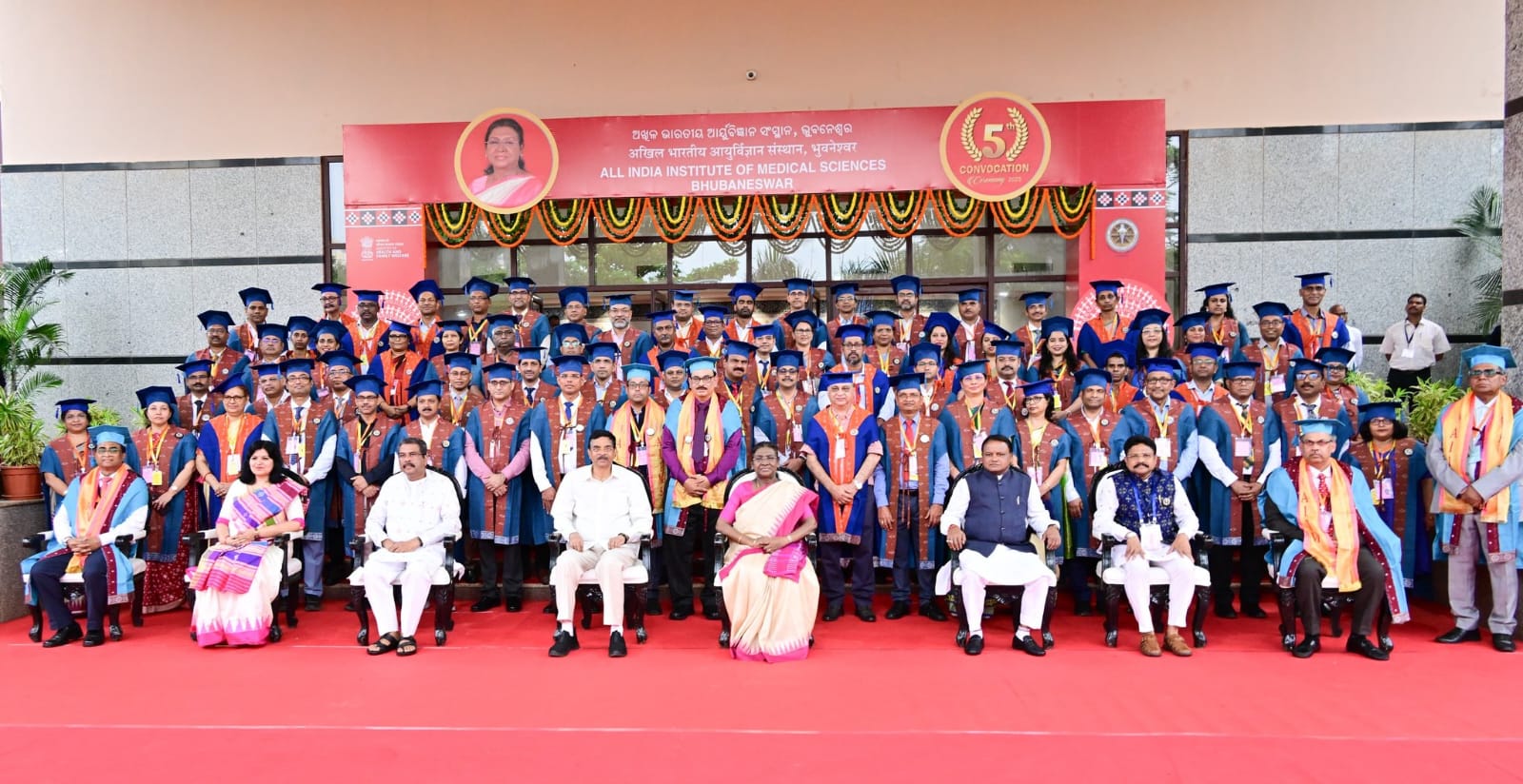
Bhubaneswar: President of India, Droupadi Murmu, addressed the fifth convocation of the All India Institute of Medical Sciences (AIIMS), Bhubaneswar, today, lauding the institution’s contribution to quality healthcare, research, and public service. The event marked a significant moment for graduating students and the broader medical community in Odisha and eastern India.
In her convocation address, the President highlighted the rapid progress of AIIMS Bhubaneswar since its establishment 12 years ago. “From patient care to medical research and social welfare initiatives, AIIMS Bhubaneswar has earned recognition and the trust of the people of Odisha and neighbouring states like West Bengal, Chhattisgarh, and Jharkhand,” she said.
The President also noted the institute’s growing reputation for excellence. She praised AIIMS Bhubaneswar for receiving the Asia Safe Surgical Implant Consortium QIP Award from the World Health Organisation for maintaining high surgical standards, and for consistently winning the National Kayakalpa Award for outstanding sanitation and hospital services over the past five years.
Applauding the AIIMS network across India, the President said these institutions are providing advanced medical care at affordable costs. She expressed confidence that India’s health sector, driven by AIIMS and similar institutions, will help the country become a global healthcare destination.
President Murmu also emphasized the transformative impact of medical research on controlling infectious diseases such as smallpox, leprosy, polio, and tuberculosis. She credited doctors, researchers, healthcare workers, and governments for their collective role in this progress.
Touching upon contemporary health challenges, the President expressed concern about the rising cases of depression and obesity. She stressed the importance of promoting mental health and healthy lifestyles, urging doctors to raise public awareness about the benefits of yoga, pranayama, and balanced living.
In a special message to medical professionals, the President urged them to address local health issues with greater focus. She called for intensified research on diseases prevalent in tribal communities, particularly Japanese Encephalitis and Sickle Cell Anemia. “Doctors must become agents of change, working not just in hospitals, but also at the grassroots to solve region-specific health problems,” she stated.
Bhubaneswar: In a push to upgrade primary education infrastructure, Chief Minister Mohan Charan Majhi on…
Bhubaneswar: Strengthening development in Kandhamal district, Odisha Chief Secretary Anu Garg reviewed key projects across…
Jagatsinghpur: Around 25 heritage enthusiasts from across Odisha participated in the 14th edition of the…
Bhubaneswar: Emphasising long-term development and citizen participation, Chief Minister Mohan Charan Majhi on Tuesday described…
Bhubaneswar: Odisha has emerged as a leading state in urban transformation, registering strong progress under…
Bhubaneswar: The seventh day of the ongoing Odia Pakhya was celebrated as “Shishu Katha Divas”…
