
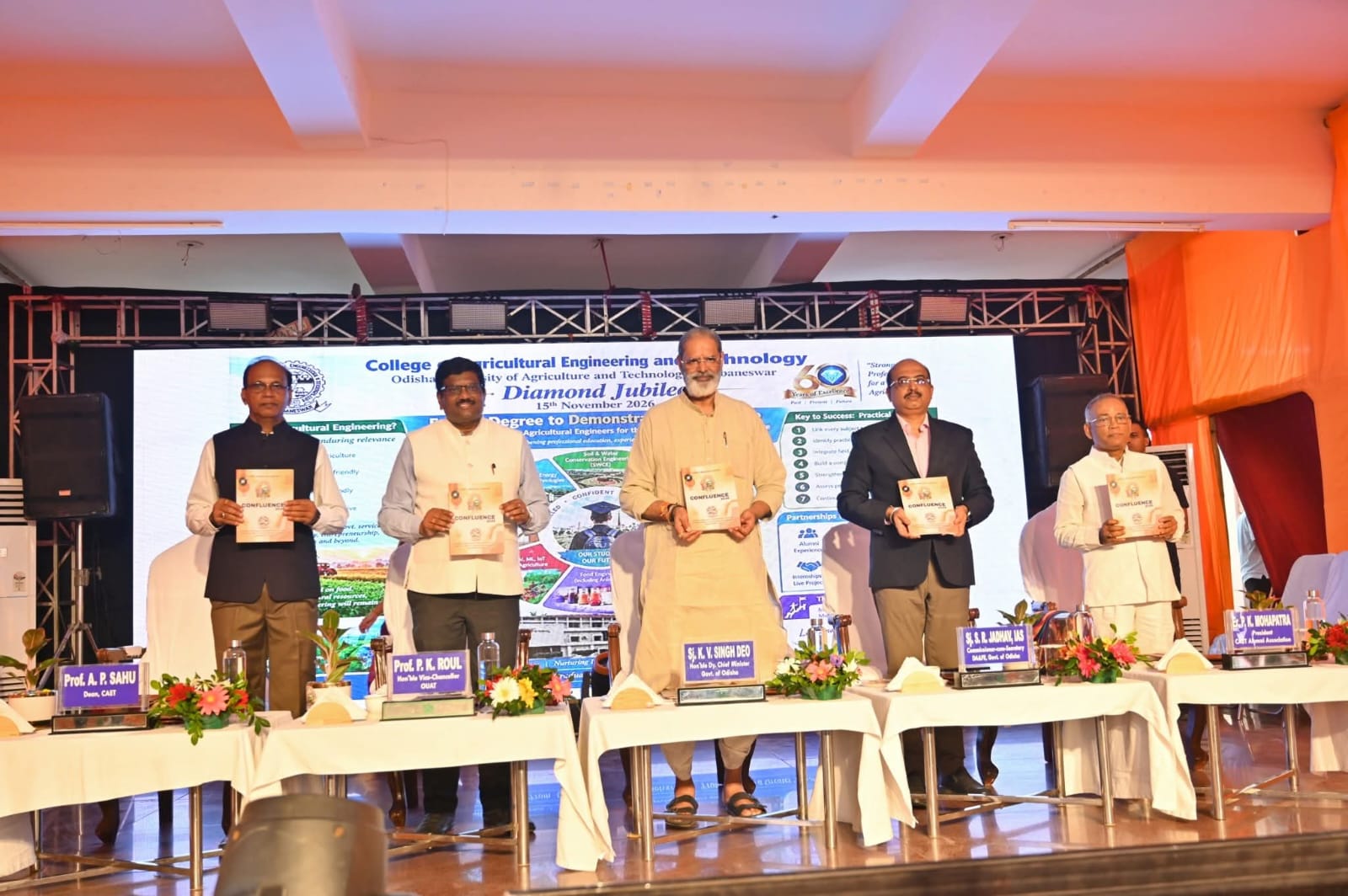
Bhubaneswar: The College of Agricultural Engineering and Technology (CAET) under the Odisha University of Agriculture and Technology (OUAT) celebrated its Diamond Jubilee on Sunday, marking six decades of contribution to agricultural mechanisation, technical education, research and technological advancement in Odisha.
Deputy Chief Minister and Agriculture and Farmers’ Empowerment and Energy Minister Kanak Vardhan Singh Deo inaugurated the year-long celebration in the presence of Agriculture Department Commissioner-cum-Secretary Sachin Ramchandra Jadhav and OUAT Vice-Chancellor Prof. (Dr.) Prabhat Kumar Roul.
Established in 1966, CAET has contributed to the development of agricultural engineering through education, research and innovation. Its key areas of work include farm machinery, soil and water conservation, post-harvest processing, agricultural structures, irrigation and drainage, civil and environmental engineering, and renewable energy.
As part of the inaugural ceremony, the dignitaries unveiled a Diamond Jubilee memorial on the college campus and inaugurated a technology exhibition showcasing innovations in agricultural mechanisation, post-harvest processing, soil and water conservation, drones and other modern farming technologies. They also released a special souvenir titled Confluence, documenting the institution’s history, achievements, research contributions and alumni experiences.
More than 1,000 alumni, students, faculty members, scientists, researchers, educationists and agricultural machinery manufacturers attended the celebration. A seminar, alumni-student interaction sessions and cultural programmes were also organised to mark the occasion.
Addressing the gathering, Alumni Association president Engineer P.K. Mahapatra called for restructuring the Agricultural Engineering Cadre and ensuring the appointment and deployment of agricultural engineers at the block level in the Agriculture, Horticulture, Soil Conservation and Watershed Development departments.
He said the presence of agricultural engineers at the grassroots would strengthen the implementation of farm mechanisation schemes, facilitate the adoption of modern equipment, improve soil and water resource management and provide technical assistance to farmers.
The Deputy Chief Minister and the departmental secretary assured government support for strengthening agricultural mechanisation in the state. They stressed the need to develop affordable, low-cost and locally suitable farm machinery, particularly for small and marginal farmers. They also highlighted the importance of promoting women-friendly equipment to reduce the physical drudgery of women engaged in agricultural activities.
The speakers underlined the growing role of emerging technologies, including drones, sensor-based farming, artificial intelligence, the Internet of Things (IoT) and advanced agricultural machinery, in improving farm productivity, reducing cultivation costs and enhancing farmers’ income.
The Diamond Jubilee celebration also provided a platform to discuss the future of agricultural engineering and the need for stronger collaboration among educational institutions, research organisations, industries and farmers to accelerate technological development and its adoption at the field level.
CAET aims to further strengthen research and innovation in agricultural mechanisation, irrigation and drainage, soil and water conservation, renewable energy, post-harvest processing, smart farming and digital agriculture. Its focus will remain on developing practical and affordable solutions for small and marginal farmers, women farmers and rural youth.
The 60-year milestone marks not only the institution’s contribution to agricultural education and research but also its renewed commitment to making agriculture more technologically advanced, economically viable and climate-resilient.