Bhubaneswar: Odisha will prepare a dedicated lightning safety action plan for 2027 and a roadmap for 2027–2030 to strengthen forecasting, early warning systems and emergency response, Revenue and Disaster Management Minister Suresh Pujari said on Thursday.
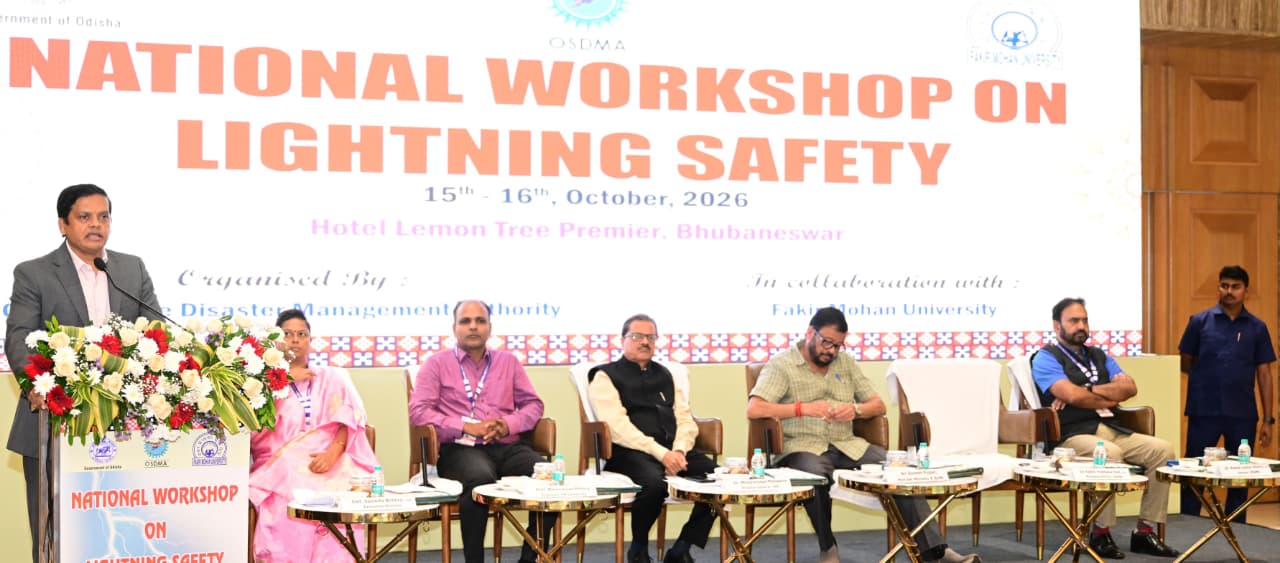
The announcement came during the inauguration of a two-day National Workshop on Lightning Safety, organised by the Odisha State Disaster Management Authority (OSDMA) at Hotel Lemon Tree Premier in Bhubaneswar on October 15 and 16. The workshop has brought together scientists, technical experts, researchers, disaster management institutions and administrative officials from across the country to discuss measures to reduce lightning-related deaths and damage.
Addressing the inaugural session, Pujari said lightning had emerged as a significant disaster because of its impact and the extent of damage it causes. He said OSDMA had been making sustained efforts to address the challenge and reduce casualties and losses.
The minister said the workshop would provide a platform for scientists, researchers, experts and administrative officials to exchange knowledge and identify effective measures to mitigate lightning hazards. He expressed confidence that the deliberations would further strengthen Odisha’s disaster risk reduction capacity.
Dr Mrutyunjay Mohapatra, Director General of the India Meteorological Department (IMD), attended the event as the guest of honour. He said the workshop would examine ways to improve lightning detection, monitoring and forecasting through satellite data integration, numerical weather prediction, Artificial Intelligence (AI), Machine Learning (ML) and panchayat-level decision-support systems.
He emphasised the importance of making existing disaster management mechanisms more effective through scientific research and technological advancements.
OSDMA Managing Director Rajesh Prabhakar Patil said the primary objective of the workshop was to strengthen lightning forecasting, risk assessment, early warning dissemination and public safety measures.
He said the two-day deliberations would focus on converting scientific knowledge and technological advances into practical interventions to protect vulnerable communities, particularly farmers, agricultural labourers, outdoor workers, students and people living in lightning-prone areas. He reiterated OSDMA’s commitment to public safety in a disaster-prone state like Odisha.
Focus on forecasting and last-mile warnings
Experts from several national scientific, technical and academic institutions are participating in the workshop. These include the IMD, Indian Institute of Tropical Meteorology, National Remote Sensing Centre, National Centre for Earth Science Studies, National Centre for Medium Range Weather Forecasting and IIT Bhubaneswar.
Other participating institutions include Fakir Mohan University, National Institute of Technology Patna, Council on Energy, Environment and Water, Central University of Jharkhand, CSIR National Institute of Data Science and Artificial Intelligence, Tripura University, Berhampur University, Siksha ‘O’ Anusandhan University, Climate Resilient Observing Systems Promotion Council and Cape Electric.
The technical sessions will examine ways to improve the accuracy of lightning forecasts, extend the lead time available for warnings and strengthen the use of scientific data in local-level decision-making. The discussions are also expected to improve coordination between scientific institutions and administrative agencies.
A key area of deliberation will be the preparation of a draft Standard Operating Procedure (SOP) for lightning safety and a proposed action plan for 2027. The framework is expected to clarify responsibilities, improve warning dissemination and strengthen emergency response arrangements.
The proposed “Lightning-Safe Odisha: Action Plan 2027 and Roadmap 2027–2030” will provide a framework for coordinated action on forecasting, risk reduction, public awareness, early warning dissemination and emergency response.
The inaugural session was attended by OSDMA Managing Director Rajesh Prabhakar Patil, IMD Director General Dr Mrutyunjay Mohapatra and Fakir Mohan University professor Manoranjan Mishra, among others. OSDMA Advisor Dr Kamal Lochan Mishra delivered the welcome address.