Bhubaneswar: The Odisha Government is looking to strengthen the welfare and social security of Gaja Sathis and mahouts as part of a broader strategy to improve elephant conservation and reduce human-elephant conflict in the state.
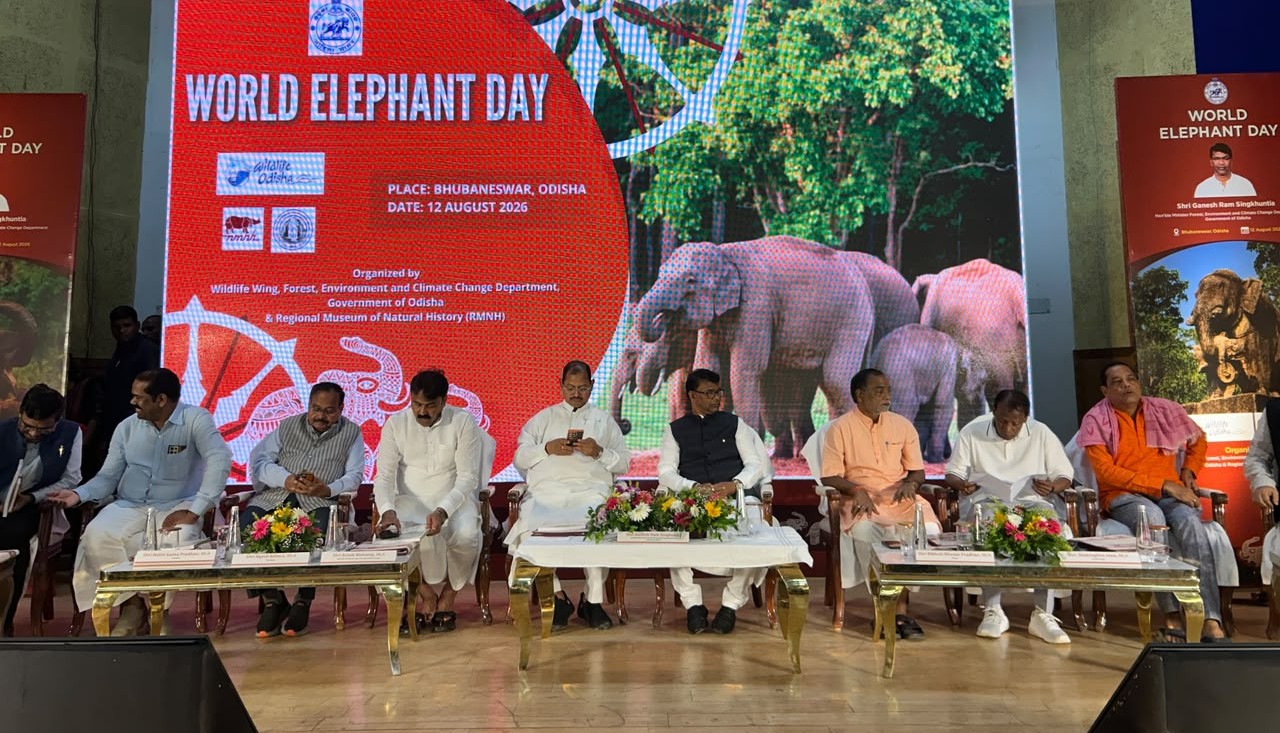
Forest, Environment and Climate Change Minister Ganesh Ram Singkhuntia said the government was exploring an insurance-based social security package for Gaja Sathis while addressing the state-level World Elephant Day programme at the RMNH Auditorium in Bhubaneswar on Wednesday.
The programme was organised jointly by the Wildlife Organisation of the Forest, Environment and Climate Change Department and the Save Elephant Foundation Trust (SEFT).
The proposed welfare package is expected to include accidental death and disability cover, hospitalisation benefits, daily hospital allowance, children’s education support and family transportation assistance at a minimal annual premium. The Minister said the government was examining all possible avenues to introduce accidental death insurance coverage for Gaja Sathis.
Gaja Sathis and mahouts work closely with forest authorities in tracking elephant movements, managing conflict situations and supporting conservation activities. The proposed measures are aimed at providing greater social and financial security to them and their families.
Science, Technology to Drive Conservation
Singkhuntia said Odisha’s elephant conservation strategy would increasingly focus on scientific management, technology-based interventions and community participation.
He stressed the importance of protecting elephant habitats, improving electrical safety in elephant-prone areas and strengthening rapid response systems to deal with conflict situations.
The Minister called for closer coordination among government departments, elected representatives, forest personnel and local communities to protect both human lives and elephants. He said sustainable coexistence would require active participation from communities living in and around elephant habitats.
Legislators Highlight Ground-Level Challenges
Several MLAs from elephant-conflict-prone areas of Angul and Dhenkanal districts attended the programme and shared concerns and suggestions based on the situation in their constituencies.
Those participating included Agasti Behera (Chhendipada), Pratap Chandra Pradhan (Angul), Ashok Mohanty (Pallahada), Nalini Kanta Pradhan (Athamallik), Shatrughna Jena (Kamakhyanagar) and Bibhuti Bhusan Pradhan (Parjanga). MLA of Ekamra Bhubaneswar Babu Singh also attended the programme.
The legislators highlighted local challenges related to elephant movement and human-elephant conflict and appreciated measures undertaken by the Wildlife Wing to support affected communities. They assured continued cooperation in strengthening conservation and community welfare measures.
Odisha’s Elephant Population Stands at 2,103
In a technical presentation, Prem Kumar Jha, PCCF (Wildlife) and Chief Wildlife Warden, Odisha, outlined the state’s conservation efforts and said Odisha has an elephant population of 2,103.
He highlighted measures involving protected landscapes, habitat restoration, technology-enabled conflict mitigation, community participation and stronger governance.
According to Jha, securing elephant habitats and landscapes, reducing human-elephant conflict and improving long-term coexistence remain key priorities for the state.
Dr Debabrata Swain, founder of SEFT and former PCCF & HoFF, and Dr K. Murugesan, PCCF & HoFF, Odisha, also shared their views on elephant conservation and coexistence.
Housing Assistance for Families Affected by Elephants
The government also highlighted its support for families whose homes have been completely damaged in elephant-related incidents.
Under the Anukampa Scheme, eligible families are being provided assistance equivalent to PMAY support for rebuilding their houses.
The initiative is aimed at providing timely support to communities affected by human-elephant conflict and reducing the economic burden on vulnerable families.
Awareness and Community Participation
The World Elephant Day programme brought together forest officials, wildlife experts, researchers, scientists, students, NGOs, conservation organisations, Gaja Sathis, members of Eco-Development Committees and Vana Surakshya Samitis, as well as local communities.
Individuals who have made significant contributions to elephant conservation were felicitated, while awareness publications and information materials were released.
The event also featured an elephant-themed Sankirtan by the Radhakrishna Sankirtan Mandali of Kendujhar, followed by the screening of an AI-based video prepared by the DFOs of Angul and Kendujhar, a musical video and an Odia video on elephant conservation.
The state-level observance served as a platform to discuss habitat protection, scientific management, conflict mitigation and community participation, reinforcing Odisha’s efforts to create safer conditions for both elephants and people.