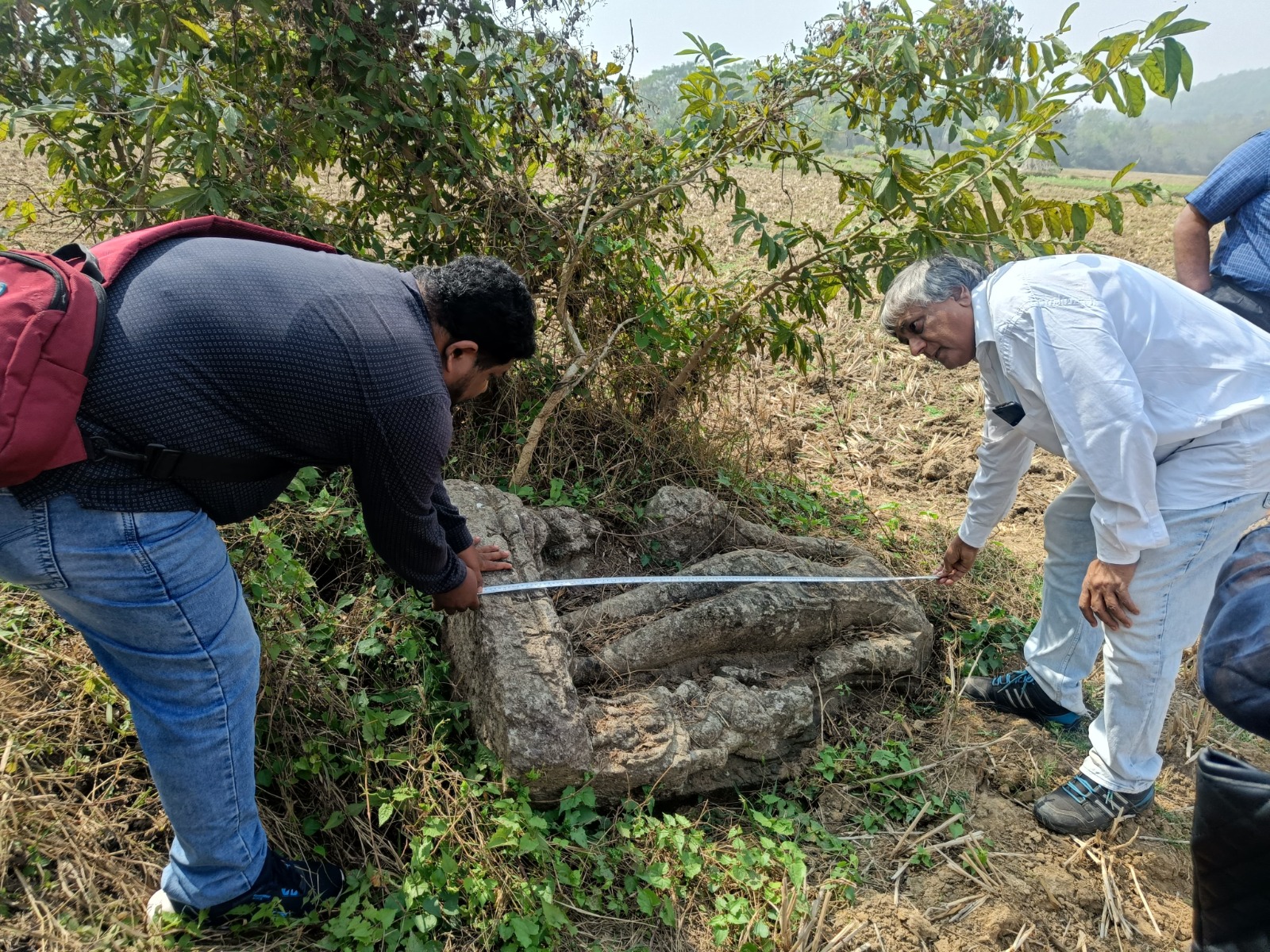
Bhubaneswar: A team from the Cuttack Chapter of the Indian National Trust For Art & Cultural Heritage (INTACH) has made a significant discovery of the remnants of a Buddhist site near Ganeswarapur village in Tangi Tehsil of Cuttack district. The site, featuring scattered Buddhist archaeological remains, was found near a small mound within a rice field at the far end of the village. The five-member team, including Dr. Biswajit Mohanty, Ritu Pattanaik, Deepak Kumar Nayak, Suman Prakash Swain, and Anil Dhir, visited the site for a preliminary survey and documentation of the archaeological findings. Notably, the site is located just 150 meters away from the Birupa embankment.
Deepak Kumar Nayak, Co-convenor of INTACH’s Cuttack Chapter, highlighted that both the present and ancient floodplains of the Birupa River are adorned with numerous Buddhist sites on both banks. The discovery of a large headless Abalokiteswar image, nearly six feet in height, lying on the ground near a small wooded grassy mound is a significant find. Despite the absence of the head, the iconography closely resembles Abalokiteswar images found in nearby Buddhist sites of Ratnagiri, Udayagiri, and Lalitagiri. The nearby Rameswar village hosts an excavated Buddhist Stupa across the river, where the images are now worshipped as Hanumancheswara Mahadev by the villagers.
Anil Dhir emphasized that this discovery further supports the notion that Buddhism flourished in the region during ancient times. The exact period can only be determined through systematic archaeological excavation; however, comparing the broken Abalokiteswar image with similar images from other locations suggests a period predating the 9th Century CE.
Dr. Biswajit Mohanty speculated that the existence of a Buddhist Stupa or temple, featuring large images, may have been buried under silt due to frequent flooding of the Birupa. The disfigured images at the site and a small shrine a few meters away hint at possible destruction by iconoclastic invaders during the Afghan-Moghul period. Local lore suggests that two other temples in the village, Panchupandava Temple and Tareswara Temple, were also demolished during Kalapahada’s invasion in the 16th Century CE.
The discovery of a temple base and various odd-shaped kiln-baked bricks suggests the presence of either a temple or a stupa buried in the mound. Additionally, a substantial number of broken potsherds, including both Red and Blackware, were unearthed. Gopal Behera, the Convener of the Cuttack Chapter, is reaching out to the ASI, the State Archaeology Department, and the Culture Directorate, urging them to send experts for further detailed surveys at the site.