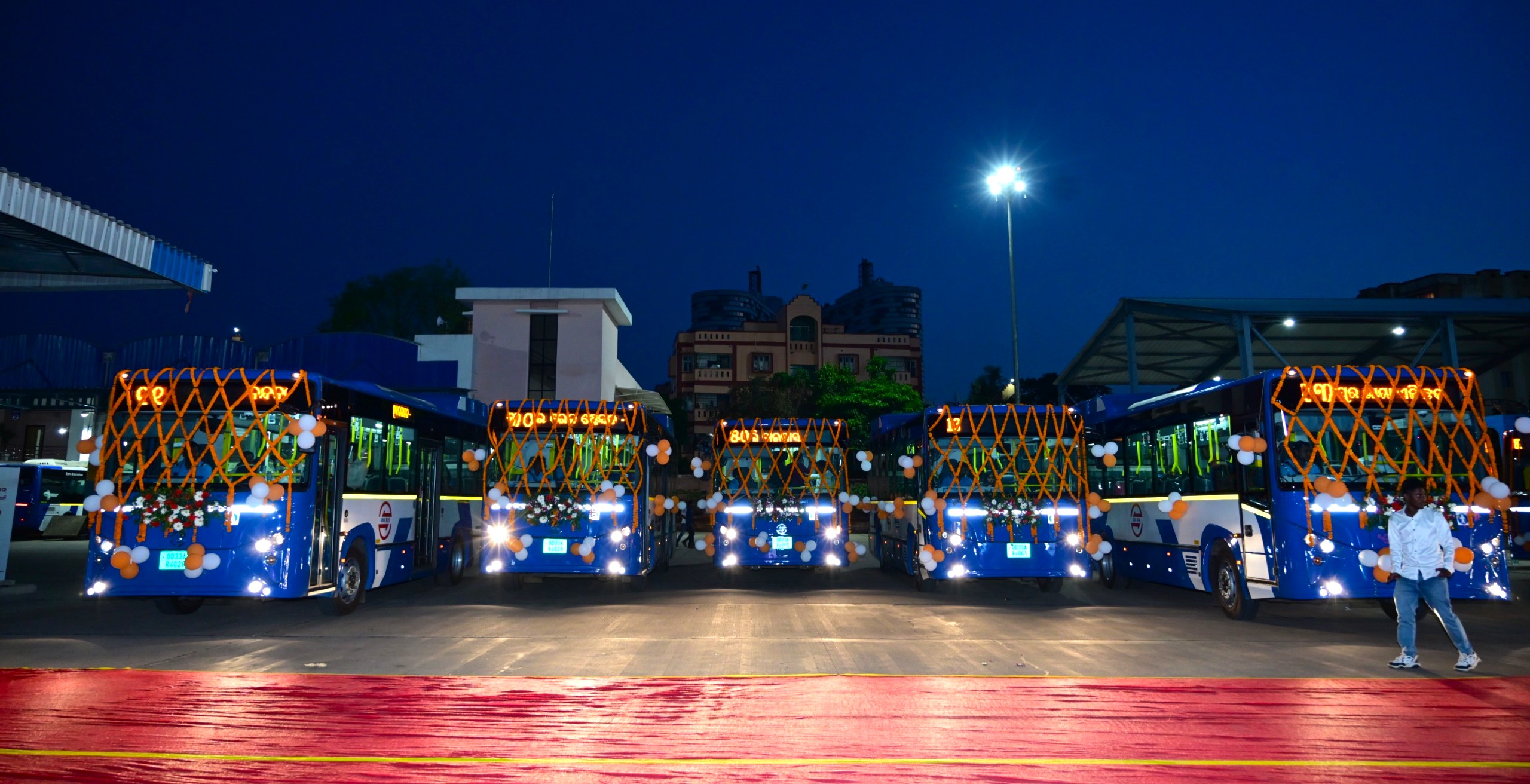
Bhubaneswar: Odisha government has strengthened its electric bus fleet with the addition of 40 new e-buses under the Capital Region Urban Transport (CRUT). This expansion aims to provide an eco-friendly, reliable, and efficient transportation system for the state’s growing urban population.
Flagging off the new buses at the Gadakana Depot on Thursday, Dr. Krushna Chandra Mahapatra, Minister for Housing & Urban Development and Public Enterprises, reiterated the government’s commitment to enhancing public transport infrastructure. “With over 3 lakh commuters relying on CRUT services daily, this initiative will improve accessibility and convenience while contributing to a greener future. This is a step towards realizing the vision of VIKSIT Odisha,” he said.
The newly inducted electric buses bring the total number of e-buses in CRUT’s fleet to 180 out of 560. The Ama Bus service currently operates across 106 routes in Bhubaneswar, Cuttack, Rourkela, Sambalpur, and Berhampur. To optimize service, bus frequency will be increased on key routes, and revised schedules will take effect from April 4, 2025. Notable changes include:
Route 27: Bhubaneswar Railway Station to Bhagwanpur via AIIMS
Route 40: AIIMS to Sai Mandira (Kesora)
Route 82: SCB Medical, Cuttack to Biju Patnaik International Airport
Further expansion of the fleet is planned, with 100 additional electric buses being procured under the state scheme and 400 more to be introduced under the PM e-Bus Sewa scheme. To support this growing fleet, electric bus depots are under construction in Pokhariput (Bhubaneswar) and Naraj (Cuttack), with additional depots planned in Chhend (Rourkela) and Modipara (Sambalpur).
The event was attended by Ekamra MLA Babu Singh, Principal Secretary of the Housing & Urban Development Department Usha Padhi, and CRUT Managing Director Dr. N. Thirumala Naik, among other dignitaries.
As part of its broader effort to enhance passenger safety and service reliability, CRUT has implemented several measures:
Speed Regulation: New speed limits have been introduced—electric buses are capped at 35 km/h, while diesel buses have limits of 40 km/h on city routes and 50 km/h on intercity highways.
Training & Safety Initiatives: Regular training programs are being conducted for bus captains and guides, focusing on safe driving, behavioral training, electric bus operations, and first aid.
Advanced Safety Technology: A pilot program is underway with ten agencies installing advanced driver assistance systems (ADAS) and dashcams in select buses.
Enhanced Monitoring: A dedicated enforcement team conducts daily checks to ensure compliance with speed limits, valid ticket usage, and designated stop adherence.
Alcohol Testing & Accident Review: Routine breathalyzer tests are conducted on drivers, and an accident review committee has been established to analyze incidents and enhance safety measures.
With these initiatives, Odisha’s urban transport system is set to become more efficient, eco-friendly, and commuter-centric, reinforcing the state’s commitment to sustainable development.
Bhubaneswar: Applicants who secure flats under the Bhubaneswar Development Authority’s (BDA) Ekamra Residency housing project…
Bhubaneswar: Shubhalakshmi Mahananda is driving change on the roads of Kendujhar, one bus journey at…
Bhubaneswar: Odisha will host a two-day National Workshop on Lightning Safety on October 15 and…
Bhubaneswar: Chief Minister Mohan Charan Majhi on Sunday inaugurated two affordable housing projects in Bhubaneswar,…
Bhubaneswar: Odisha has received the prestigious ‘Wind India 2026: Leadership in Wind Energy De-risking’ award…
Bhubaneswar: The Police Commissionerate, Bhubaneswar-Cuttack, has announced traffic restrictions across Bhubaneswar from October 16 to…