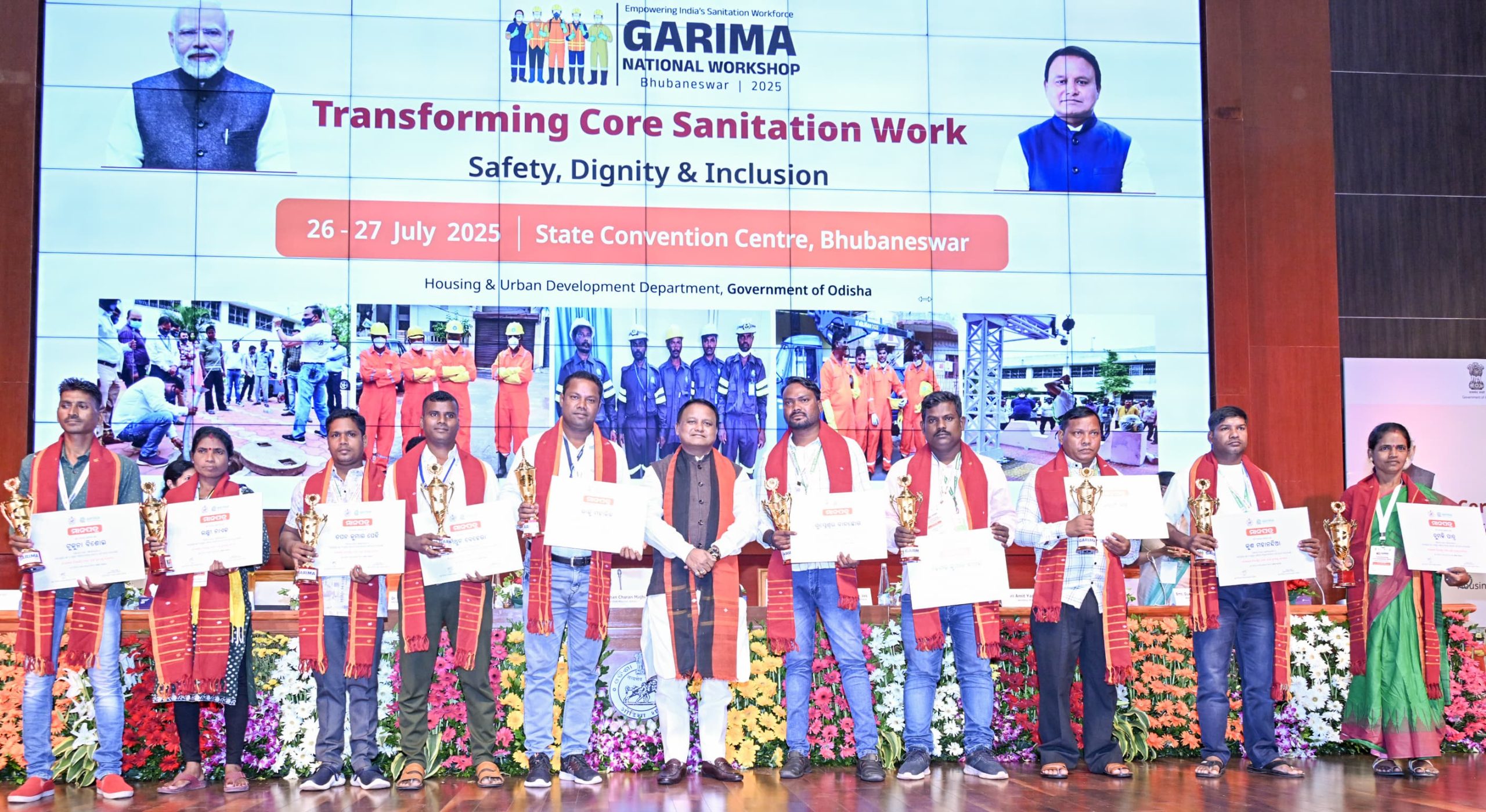
Bhubaneswar: Odisha Chief Minister Mohan Charan Majhi on Saturday unveiled a life insurance scheme worth ₹10 lakh for sanitation workers, reaffirming the state’s commitment to their safety and dignity. The announcement came during the two-day national workshop ‘GARIMA’ held at Lok Seva Bhawan in Bhubaneswar, aimed at transforming core sanitation work through enhanced safety, dignity, and inclusion.
The workshop, themed ‘Transforming Core Sanitation Work – Safety, Dignity & Inclusion’, brought together sanitation workers, urban development officials, and stakeholders from seven states. Addressing the gathering, the Chief Minister introduced a series of welfare measures including ₹30 lakh compensation for workers in case of death during duty, housing support under the Pradhan Mantri Awas Yojana (Urban), distribution of mobile phones, and a 15-day IEC campaign to promote sanitation awareness from August 15 to 30.
Majhi emphasized Odisha’s cultural reverence for cleanliness, drawing parallels with the Chera Pahara ritual of Rath Yatra. He said, “Sanitation is fundamental to development. Without clean homes and communities, true progress is not possible.” He added that Odisha will host the GARIMA workshop annually to encourage continuous engagement on sanitation reforms.
Under the GARIMA scheme, over 10,000 sanitation workers across 115 cities have been identified and trained. The initiative provides them with ID cards, protective gear, emergency support, skill training, and social security benefits.
The Chief Minister also inaugurated an exhibition of modern sanitation and safety equipment and felicitated sanitation workers who have shown exemplary service.
Urban Development Minister Dr. Krushna Chandra Mahapatra described sanitation workers as “the unseen heroes,” stressing the need for collective responsibility to protect their rights. Chief Secretary Manoj Ahuja highlighted Odisha’s growing national recognition for sanitation initiatives, while Union Social Justice Secretary Amit Yadav reiterated the Centre’s support for safeguarding sanitation workers’ welfare.
Experts, including Urban Management Centre founder Manvita Baradi, praised Odisha’s GARIMA model as a leading example for empowering sanitation workers beyond their daily duties.