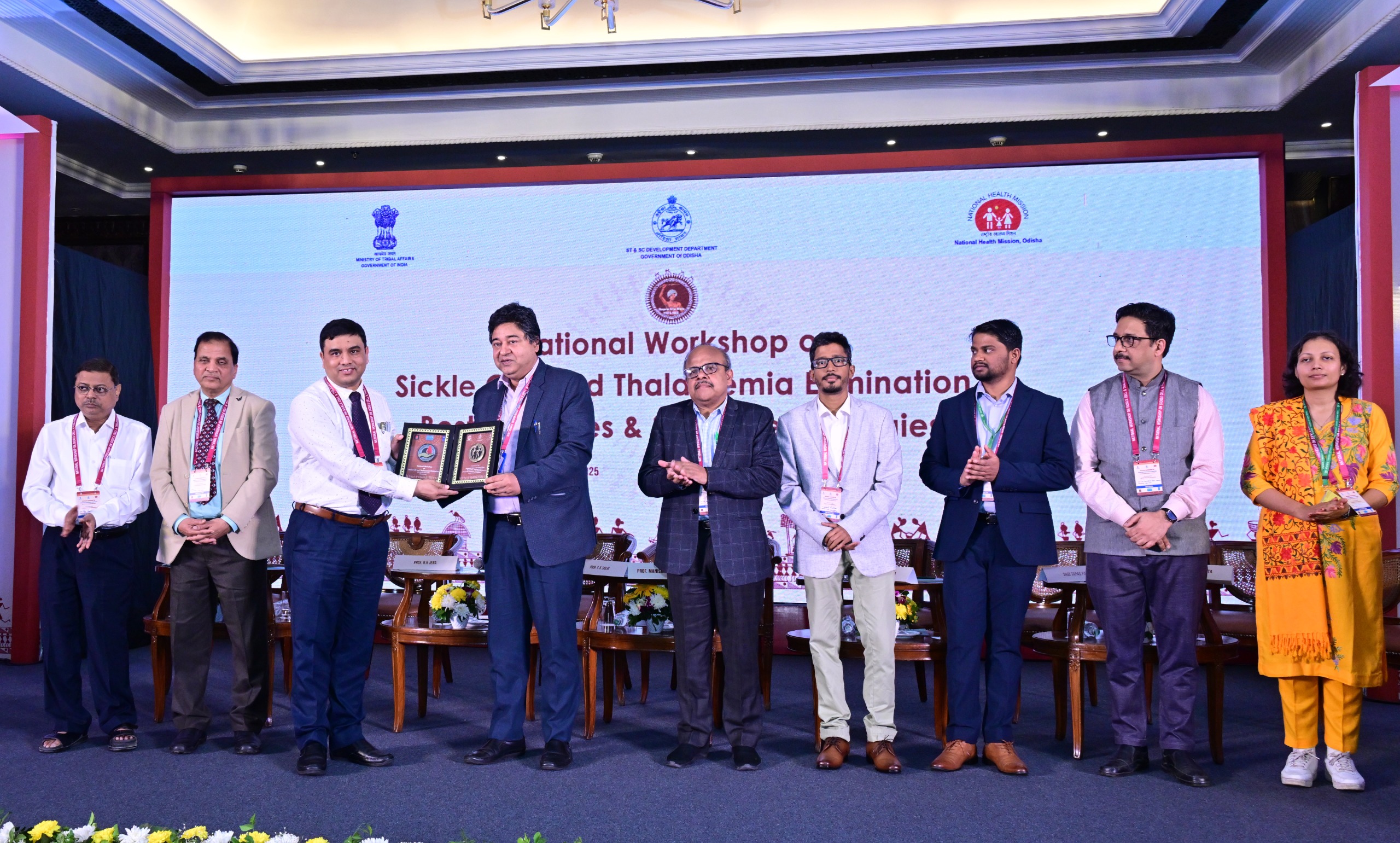
Bhubaneswar: A two-day National Workshop on Sickle Cell and Thalassemia Elimination: Best Practices and Scalable Strategies concluded successfully at Mayfair Convention, bringing together experts, policymakers, and stakeholders to discuss advancements and challenges in tackling sickle cell disease (SCD) and thalassemia in India.
The valedictory session was graced by Sanjeev Kumar Mishra, Principal Secretary, SSD Department; Dr. Poma Tudu, Director, ST; Dr. Raji N.S., Deputy Secretary, Ministry of Tribal Affairs, Government of India; and Dr. Brunda D., MD, NHM, Government of Odisha. More than 300 participants, including senior officials from the Ministry of Tribal Affairs and Ministry of Health and Family Welfare, international delegates, medical experts, and representatives from UNDP, UNICEF, ISHBT, and tribal welfare and health departments of 10 sickle cell-affected states, attended the workshop.
Over two days, the workshop delved into critical discussions on advances in SCD diagnosis, augmentation of the national SCD elimination program, best practices, scalable strategies, social and behavioral change communication, multi-sectoral approaches, and challenges in disease management. Experts also explored future strategies for strengthening India’s SCD program.
One of the key highlights was the presence of Prof. Isaac Odame, Director of the Haematology Division at the University of Toronto, Canada, and founder of the Global Sickle Cell Disease Network. He spoke about the successful implementation and global impact of India’s sickle cell disease mission, commending the country’s efforts in tackling the disease at a national level.
Renowned medical professionals and researchers, including Prof. Dipty Jain from Nagpur, Prof. Maitreyee Bhattacharya from Kolkata, Prof. Akshat Jain, Director of the Sickle Cell Disease Program at Loma Linda University, California, Prof. Tulika Seth from AIIMS Delhi, Prof. Sunita Reddy from JNU, and Dr. Bontha V. Babu, Head of the Health Systems Research Division at ICMR, shared insights on prevention, treatment, and policy implementation. Prof. T.K. Dolai, Head of Haematology at NRS Medical College, Kolkata, along with Shobha Tuli, Secretary of Thalassemics India, emphasized the need for enhanced screening programs and genetic counseling.
Bhubaneswar: Applicants who secure flats under the Bhubaneswar Development Authority’s (BDA) Ekamra Residency housing project…
Bhubaneswar: Shubhalakshmi Mahananda is driving change on the roads of Kendujhar, one bus journey at…
Bhubaneswar: Odisha will host a two-day National Workshop on Lightning Safety on October 15 and…
Bhubaneswar: Chief Minister Mohan Charan Majhi on Sunday inaugurated two affordable housing projects in Bhubaneswar,…
Bhubaneswar: Odisha has received the prestigious ‘Wind India 2026: Leadership in Wind Energy De-risking’ award…
Bhubaneswar: The Police Commissionerate, Bhubaneswar-Cuttack, has announced traffic restrictions across Bhubaneswar from October 16 to…