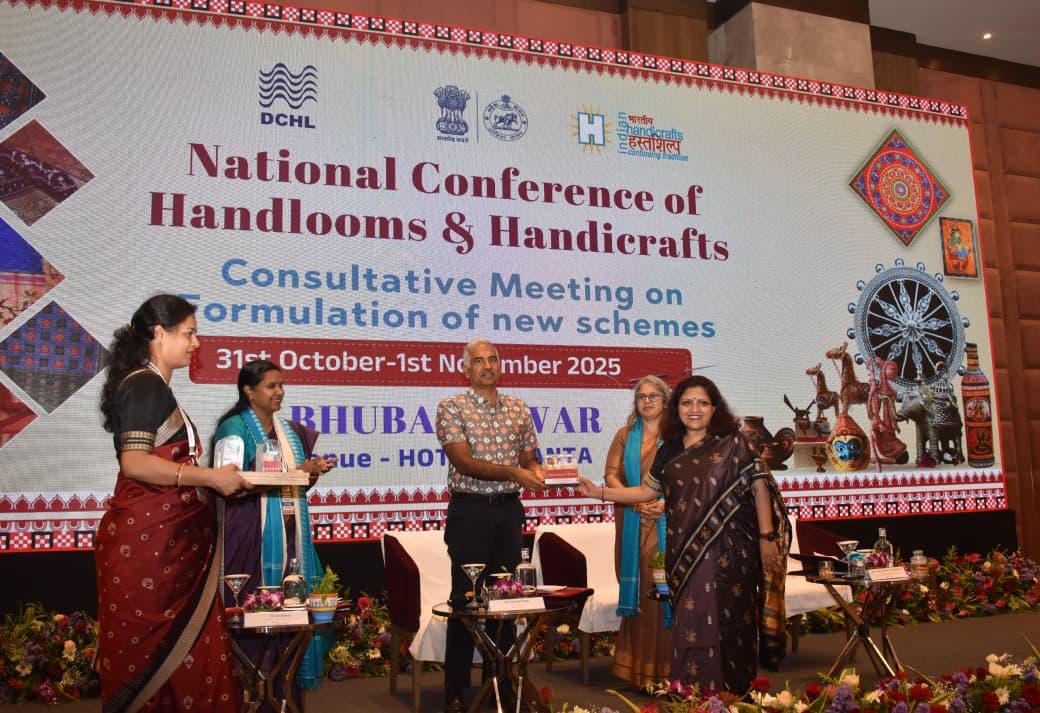
Bhubaneswar: Bringing together India’s finest weaving traditions and contemporary innovations, the National Conference on Handlooms and Handicrafts commenced today at Bhubaneswar. Organized by the Ministry of Textiles, Government of India, the two-day event is a major step toward strengthening India’s craft economy by empowering artisans, expanding market reach, and integrating sustainable practices into the handloom and handicraft sectors.
The conference seeks to foster collaboration among states, promote innovation, and explore new growth avenues for traditional artisans who form the backbone of India’s creative economy. It also aims to bridge the gap between tradition and technology, ensuring that handloom and handicraft products remain competitive in domestic and international markets.
Inaugurating the event, Odisha Chief Secretary Manoj Ahuja emphasized that handlooms and handicrafts reflect India’s soul — its artistry, resilience, and diversity. He called for a renewed focus on skill upgradation, innovation, and inclusivity, highlighting the sector’s potential to drive rural livelihoods and women’s economic empowerment.
Veena Kumari Meena, Development Commissioner (Handlooms), and Amrit Raj, Development Commissioner (Handicrafts), Ministry of Textiles, reiterated the government’s commitment to revitalizing India’s craft heritage. They emphasized strengthening artisan clusters, improving access to raw materials, and leveraging digital tools to connect artisans directly with markets across India and abroad.
In her welcome address, Guha Poonam Tapas Kumar, Commissioner-cum-Secretary, Handlooms, Textiles & Handicrafts Department, Government of Odisha, reaffirmed Odisha’s dedication to nurturing its vibrant weaving and craft communities. She said the state government is implementing targeted initiatives that combine traditional artistry with modern design and innovation, enabling artisans to enhance both income and identity.
The first thematic session, “Market Connect: Expanding Reach, Building Brands,” showcased presentations from Assam, Haryana, Uttar Pradesh, and Rajasthan, where innovative marketing approaches and digital interventions are helping local artisans access larger markets.
Over the next two days, experts will discuss key themes such as cluster-based development (Andhra Pradesh, Karnataka), craft village infrastructure (Madhya Pradesh, Odisha, Meghalaya, Nagaland), and skill and welfare programmes (Tamil Nadu, Odisha, Himachal Pradesh). The conference will conclude with an Open House Discussion, providing a platform for policymakers, artisans, and stakeholders to chart the future of India’s handloom and handicraft sectors.