Sarakpatna, Dhenkanal: While Buddhism today is often associated with historic monuments and distant geographies of South and Southeast Asia, a quiet village in Odisha continues to practise it as a lived way of life. Heritage enthusiasts, under the aegis of Dhenkanal Heritage Walks (DHW), on Sunday explored Sarakpatna village in Dhenkanal district and encountered a rare example of Buddhism surviving not as memory, but as a living tradition.
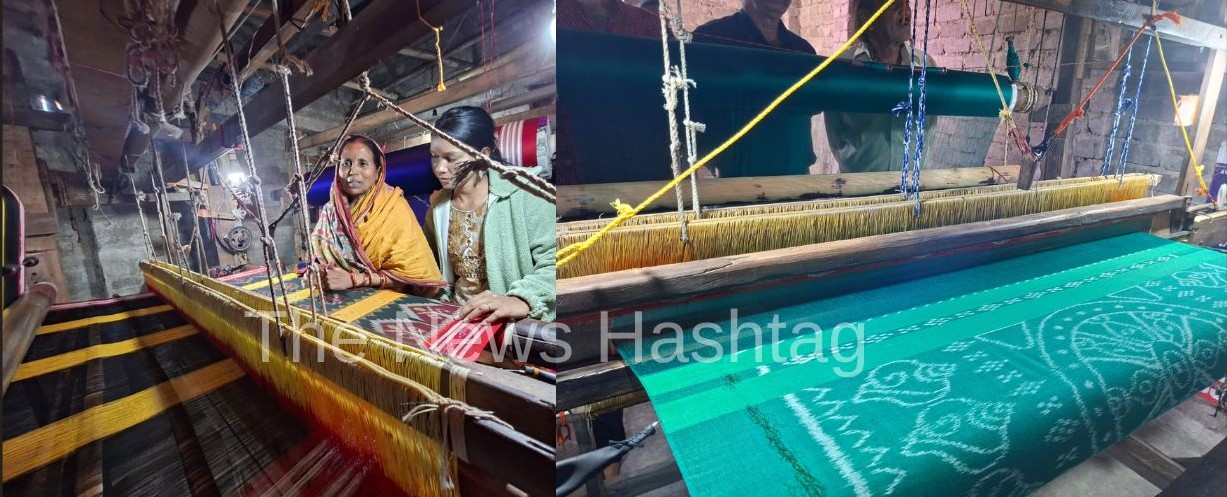
Located around 15 km from the Dhenkanal district headquarters along the banks of the Sapua river, Sarakpatna falls under Bhapur block and is predominantly inhabited by the Tantubaya or Rangani weaving community. The village presents a striking continuity of traditional handloom practices, with almost every household operating one or more looms. Both elders and youth actively engage in weaving, reflecting the inter-generational transmission of skills without formal institutional support or administrative patronage.
What sets Sarakpatna apart in Odisha’s cultural landscape is its religious composition. Nearly 98 per cent of the villagers continue to follow Buddhism, making it an exceptional case in a region where Buddhism declined as a community religion centuries ago. The ethical principles of Buddhism shape everyday life in the village, influencing food habits, social conduct, and rituals related to birth and death. A centrally located Buddhist temple with a stone image of the Buddha serves as the spiritual and social nucleus of the village, while Buddha Jayanti, observed on Baisakh Purnima, remains the most significant collective celebration.
The village’s name itself offers clues to its historical roots. Sarakpatna is believed to derive from ‘Sarak’, considered a linguistic evolution of ‘Shravaka’, referring to disciples or listeners of the Buddha’s teachings. Scholars have identified Sarak communities across eastern India as descendants of ancient Buddhist populations who preserved vegetarianism and ethical codes long after the institutional decline of Buddhism. Sarakpatna appears to be a localised continuation of this broader historical thread.
Although definitive historical records explaining the village’s conversion to Buddhism are lacking, oral traditions passed down by village elders speak of visits by Buddhist monks from China, Japan, Tibet and Sri Lanka. While these accounts await academic verification, they suggest that Sarakpatna may once have been connected to wider trans-regional Buddhist networks of learning and pilgrimage, especially significant given Kalinga’s role as a transit region following the Kalinga War.
The 33rd DHW, conducted under the guidance of convener Suresh Prasad Mishra, enabled participants to engage directly with more than 50 weaving households. Discussions centred on weaving techniques, economic sustainability, and the relationship between religious ethics and occupational life. The presence of researchers, retired administrators, heritage practitioners and college students highlighted growing interest in Sarakpatna not as a relic of the past, but as a functioning socio-cultural system.
A key proposal emerging from the walk was the establishment of a village library dedicated to Buddhist literature, aimed at strengthening knowledge transmission among younger generations. Such an initiative marks a shift from merely documenting heritage to actively sustaining it within the community.
Sarakpatna stands as a reminder that heritage does not always survive through monuments or official recognition. Its continued existence demonstrates how belief systems, occupational continuity and collective memory can preserve civilisational legacies in everyday spaces. As a living Buddhist village, Sarakpatna invites deeper scholarly attention and a rethinking of heritage as something lived, practised and ethically grounded.