
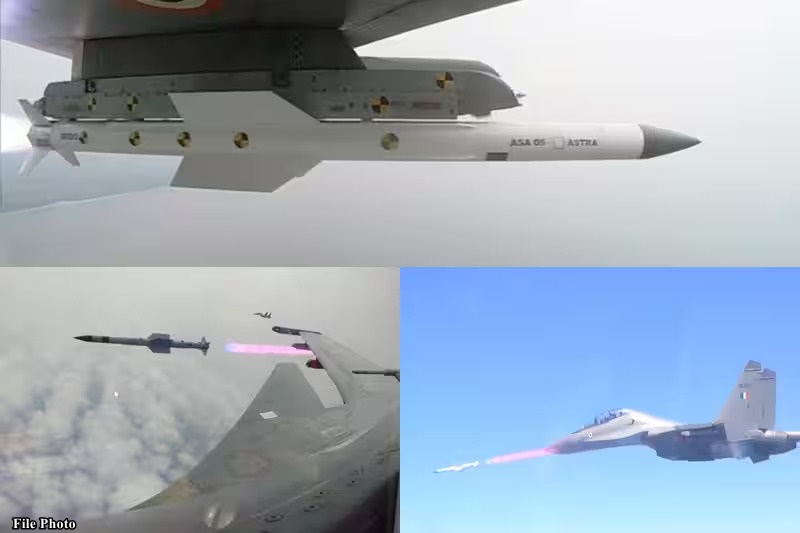
Bhubaneswar: In a major boost to India’s self-reliance in defence technology, the Defence Research and Development Organisation (DRDO) and the Indian Air Force (IAF) successfully conducted the flight-test of the indigenous Beyond Visual Range Air-to-Air Missile (BVRAAM) ‘Astra’ from a Su-30 Mk-I fighter aircraft off the coast of Odisha on July 11, 2025. Notably, the missile was tested with an indigenously developed Radio Frequency (RF) Seeker, marking a significant milestone in India’s missile development capabilities.
Two test launches were carried out against high-speed unmanned aerial targets under varying range, target aspect, and launch conditions. In both trials, the Astra missile demonstrated precision strike capability by successfully intercepting and destroying the targets with pinpoint accuracy.
According to DRDO, all subsystems—including the RF seeker—performed flawlessly during the tests. The performance was validated through flight data collected using advanced range tracking instruments deployed by the Integrated Test Range (ITR) at Chandipur, Odisha. The tests have reaffirmed the accuracy and reliability of the Astra missile system equipped with an indigenous seeker.
The Astra BVRAAM, with a strike range of over 100 kilometres, is equipped with cutting-edge guidance and navigation systems. It has been developed with significant contributions from various DRDO laboratories and over 50 public and private sector industries, including Hindustan Aeronautics Limited (HAL).
Defence Minister Shri Rajnath Singh congratulated the DRDO, IAF, and industry partners for the successful test. He hailed the development of the indigenous RF seeker and described the achievement as a “major milestone in critical defence technology.”
Dr. Samir V. Kamat, Secretary of the Department of Defence R&D and Chairman of DRDO, also extended his congratulations to all teams involved in the successful testing of the advanced missile system.