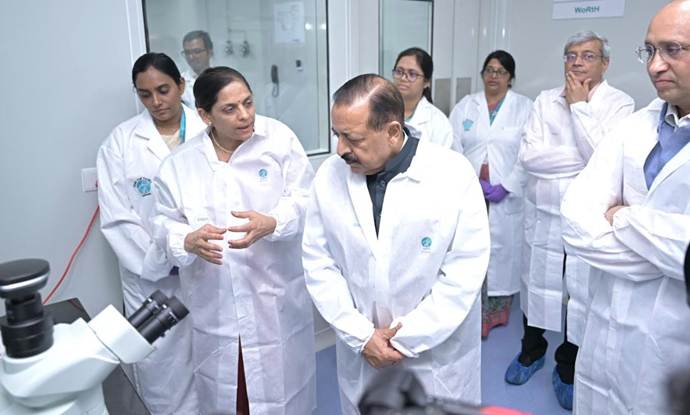
Bengaluru: Union Minister of State (Independent Charge) for Science and Technology, Earth Sciences, and Minister of State for PMO, Dr. Jitendra Singh, on Wednesday hailed India’s first-in-human gene therapy trial for Haemophilia as a landmark achievement during his visit to BRIC-inStem, a premier research institution under the Department of Biotechnology (DBT). The trial, conducted in collaboration with CMC Vellore, marks a major advancement in India’s regenerative and preventive healthcare capabilities.
Calling it a “milestone in India’s scientific journey,” the Minister inspected various state-of-the-art facilities at BRIC-inStem and reviewed ongoing clinical research collaborations with top medical institutes and hospitals. He commended the institution for its pioneering role in translating lab-based research into real-world solutions.
“This is not just about science—it’s about nation-building,” Dr. Singh stated, highlighting the strategic importance of biotechnology in shaping India’s economic and health infrastructure. He praised the Department of Biotechnology for its evolution into a nationally relevant body, with game-changing contributions in recent years.
India’s biotechnology sector, which has grown 16-fold in the past decade, now stands at $165.7 billion and is projected to reach $300 billion by 2030. Dr. Singh attributed this remarkable progress to a series of enabling policy measures, including the recently approved BIO-E3 Policy that emphasizes biotechnology’s role in boosting the economy, employment, and environmental sustainability. “From just 50 biotech startups a decade ago, we now have over 10,000,” he noted.
During the visit, Dr. Singh lauded the creation of the Biotechnology Research and Innovation Council (BRIC), which consolidated 14 autonomous biotech institutions into a unified framework. He described BRIC-inStem as “at the cutting edge of fundamental and translational science,” citing innovative outcomes such as a germicidal anti-viral mask developed during the COVID-19 pandemic and the ‘Kisan Kavach’—a protective solution for farmers exposed to neurotoxic pesticides.
A key highlight of the tour was the Biosafety Level III (BSL-3) laboratory, a high-containment facility vital to India’s preparedness under the One Health Mission. “The pandemic taught us the value of being ready. This lab ensures that we stay a step ahead in tackling high-risk pathogens,” he said.
The Minister also inaugurated the newly launched Centre for Research Application and Training in Embryology (CReATE), focused on addressing infertility and birth defects through developmental biology research. “With 3 to 4 percent of babies born with some form of defect, this centre is crucial for improving maternal and neonatal health,” Dr. Singh emphasized.
Calling for deeper collaboration between scientific and medical communities, Dr. Singh urged BRIC-inStem to explore MD-PhD programs, strengthen clinical integration, and enhance national visibility through coordinated outreach. “What’s being done here should echo across the country—not for publicity, but because the nation needs it,” he remarked.
Concluding his visit, the Minister said India’s future economy would be bio-driven, with institutions like BRIC-inStem leading the charge. “As Mark Twain said, the economy is too serious a subject to be left to economists alone. Biotechnology is no longer just a science—it is a pillar of our national strategy,” he said.