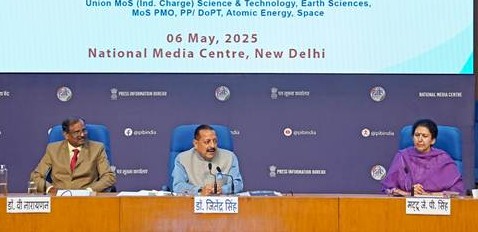
New Delhi: Marking a significant stride in India’s journey towards becoming a global space power, the country’s first human space mission, Gaganyaan, has entered its final phase, with the maiden crewed flight now scheduled for the first quarter of 2027. The announcement was made by Union Minister Dr. Jitendra Singh at a media interaction held at the National Media Centre in the capital today.
Providing a comprehensive update on the programme’s progress, Dr. Singh—who holds key portfolios including Science and Technology, Earth Sciences, and Space—highlighted that Gaganyaan is more than a space mission; it is a symbol of India’s technological self-reliance and strategic ambition.
“Gaganyaan is a historic mission that reflects India’s rise as a global space power—driven by indigenous capability, economic prudence, and visionary leadership,” said Dr. Singh.
Accompanied by ISRO Chairman and Secretary, Department of Space, Dr. V. Narayanan, the Minister detailed the successful completion of the TV-D1 mission and the first uncrewed Test Vehicle Abort Mission earlier this year—both key milestones leading to the eventual human spaceflight. The second abort test (TV-D2) is slated for later in 2025, followed by uncrewed orbital flights before the final human spaceflight.
The critical components of the mission, including the Human-rated LVM3 launch vehicle, the Crew Escape System, and the Crew and Service Modules, are now in the advanced stages of testing and integration. Dr. Singh also confirmed that recovery trials with the Indian Navy have been completed, with further sea recovery simulations planned.
The Minister informed the media that four Indian Air Force pilots, selected as astronaut-designates, have completed training in Russia and are currently undergoing mission-specific training in India. Their physical and psychological fitness, as well as operational readiness, are being closely monitored at the Indian astronaut training facility.
Dr. Singh reiterated Prime Minister Narendra Modi’s long-term space vision, which includes establishing a Bharatiya Antariksha Station by 2035 and sending the first Indian to the Moon by 2040. “These goals underline India’s unwavering commitment to expanding its footprint in space,” he said.
A key highlight of the interaction was the emphasis on Gaganyaan’s cost-effectiveness. The Minister pointed out that the programme’s expenditure is “minimal compared to similar missions globally,” and that its return in terms of technological advancements and economic stimulus far outweighs the investment.
Dr. Singh noted that the mission has already spurred innovations in robotics, electronics, advanced materials, and medicine, and is enabling deeper industry collaboration, especially with private companies and startups following recent space sector reforms.
“Today, Gaganyaan is not just ISRO’s mission—it is India’s mission, powered by the spirit of Atmanirbhar Bharat,” he asserted.
ISRO Chairman Dr. Narayanan echoed these sentiments, emphasizing the role of Gaganyaan as a catalyst for inspiring the next generation of Indian scientists, engineers, and entrepreneurs. Once completed, the mission will place India among a select group of nations—including the U.S., Russia, and China—that have successfully developed independent human spaceflight capabilities.