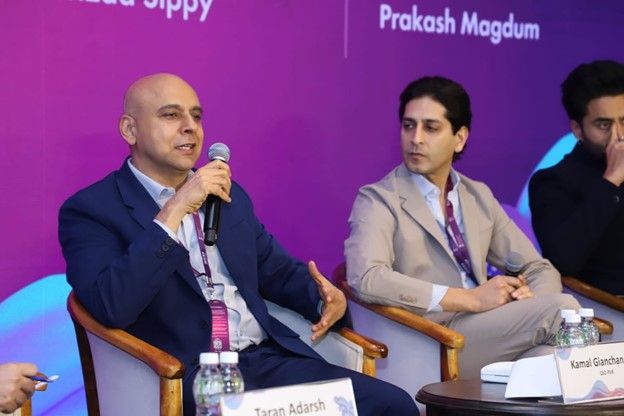
Mumbai: At the World Audio Visual and Entertainment Summit (WAVES) 2025, Indian cinema took center stage in a thought-provoking panel titled “Beyond Nostalgia: The Business of Restored Classics.” Curated and moderated by renowned film trade analyst Taran Adarsh, the session brought together a diverse group of industry stalwarts to explore the importance of restoring India’s cinematic gems for today’s audiences.
Kamal Gianchandani, a leading figure in film exhibition and distribution, kicked off the discussion by emphasizing the urgent need to make classic films more accessible in the digital age. “So many of our films disappear from public memory because they aren’t readily available,” Gianchandani said. He noted that despite the overwhelming influx of new content, there is a growing demand for revisiting and preserving the classics. “Audiences constantly tell us they want to revisit the films that defined an era,” he added, stressing that preserving these films is critical to maintaining the legacy of Indian cinema.
Shehzad Sippy, a representative of iconic cinema, shared his thoughts on the evolution of filmmaking and the unique storytelling methods of earlier decades. “Filmmaking was a different art then. It’s an art form that today’s audience is curious to experience. But restoration demands a significant investment of money, time, and skilled resources,” he explained. Sippy’s reflections highlighted the challenges of ensuring that restored films maintain their original integrity while also appealing to modern sensibilities.
Film producer and actor Jackky Bhagnani offered his insights into the unpredictable nature of audience preferences. “People’s time is precious—they want quality content. What resonates with them can be subjective, seasonal, or driven by mood,” Bhagnani said. “But regardless of the era, we always strive to give our best.” His comments emphasized that the demand for classic films can be as diverse as the audiences themselves, further complicating the restoration and distribution process.
Adding a policy perspective, Prakash Magdum, Additional Director General of PIB & CBC, shared valuable insights on the government’s role in preserving India’s cinematic legacy. “Indians are deeply nostalgic. The older generation seeks to relive the magic of their youth, while the younger generation is eager to experience the classics they’ve heard so much about,” said Magdum. He elaborated on the National Film Heritage Mission, an initiative led by the Government of India aimed at preserving, digitizing, and restoring cinematic treasures. “Classic films are more than entertainment; they are a reflection of our collective cultural identity,” he said, highlighting the significant effort involved in the restoration process. “The challenge is enormous, especially with the wear and tear on film reels and the complexities of digital data preservation.”
Magdum acknowledged the challenges posed by environmental factors, such as temperature and humidity, which affect the physical condition of film reels. Despite these obstacles, he assured that with the help of cutting-edge technology, the restoration process remains true to the original vision of the filmmakers.
The panel concluded with a powerful reminder that restored classics are not just relics of the past but vital carriers of culture, emotion, and legacy. As the business of restoration continues to gain momentum, it is clear that a combination of technology, passion, and policy will be pivotal in ensuring that India’s cinematic heritage continues to inspire future generations. The session underscored that the preservation and restoration of films is not merely about nostalgia but about honoring and celebrating the rich cultural identity of Indian cinema.