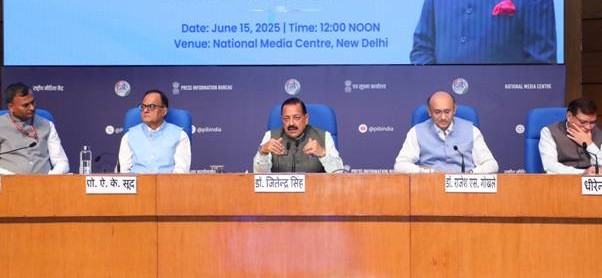
New Delhi: In a transformative move poised to reshape India’s research and development landscape, the Centre has introduced sweeping reforms to ease the bureaucratic burden on scientists, researchers, and academic institutions. Announced by Union Minister Dr. Jitendra Singh at a press briefing in the national capital, the policy overhaul is designed to enhance the “Ease of Innovation” and “Ease of Doing Research,” by removing long-standing procedural bottlenecks and empowering institutions with greater financial and administrative autonomy.
The reforms, which mark a major shift in how public-funded research will now be governed, focus on reducing delays in procurement, granting institutional heads more flexibility, and revising financial thresholds to support faster decision-making. According to Dr. Singh, these measures come in response to persistent demands from the scientific community and are in line with Prime Minister Narendra Modi’s vision of making India a global innovation hub.
A key highlight of the announcement is the delegation of procurement authority to institutional heads. Directors of scientific bodies and Vice Chancellors of universities will now be able to make non-GeM (Government e-Marketplace) purchases for specialized scientific equipment—a major deviation from earlier rules that often led to unnecessary delays when suitable items were not listed on GeM.
“This is a strong message from the Modi Government: we trust our scientists,” said Dr. Singh. “By giving them autonomy, we’re not just reducing red tape—we’re enabling excellence.”
The reforms follow comprehensive consultations led by the Office of the Principal Scientific Adviser, involving 13 IITs and several premier research bodies. These discussions highlighted how well-intended procurement rules were stifling innovation due to excessive red tape.
To further support this shift, the General Financial Rules (GFR) have been significantly relaxed. The limit for direct purchases has been raised from ₹1 lakh to ₹2 lakh, while the cap for departmental committee purchases now ranges from ₹2 lakh to ₹25 lakh—up from the previous ₹1–10 lakh bracket. Limits for limited and advertised tenders have been enhanced from ₹50 lakh to ₹1 crore. In a major move, institutional heads can now approve Global Tender Enquiries (GTEs) up to ₹200 crore, a responsibility earlier vested only with central authorities.
These measures are expected to drastically reduce delays in procurement, speed up research timelines, and provide a morale boost to India’s research community—particularly young scholars and start-ups who have often voiced frustration over cumbersome administrative norms.
Dr. Singh stressed that this new flexibility also comes with responsibility. “Autonomy must go hand-in-hand with accountability. These reforms are built on trust, but that trust must be respected and upheld.”
He also pointed to the success of liberalization in India’s space sector, which has grown into an $8 billion economy with projections to quintuple in the coming years. “Just as reforms unlocked space and atomic energy, we now want to replicate that success across the broader research ecosystem,” the Minister said.
The announcement aligns closely with the National Education Policy (NEP) 2020, which encourages multidisciplinary learning and student-led academic choices. Dr. Singh emphasized that a flexible research framework is essential to support that vision.
Bhubaneswar: Responding to mounting criticism and political consensus, the Odisha government has begun the process…
Bhubaneswar: The inaugural edition of the National Indoor Athletics Championships concluded on a high note…
Bhubaneswar: The Higher Education Department, Government of Odisha has announced that the Common PG Entrance…
Bhubaneswar: The Government of Odisha has nearly concluded paddy procurement for the 2025–26 Kharif season,…
Bhubaneswar: Strengthening its efforts to stabilise farm incomes and streamline agricultural marketing, the Odisha Rural…
Bhubaneswar: With a growing focus on sustainable agriculture and income diversification, the Agricultural Promotion and…