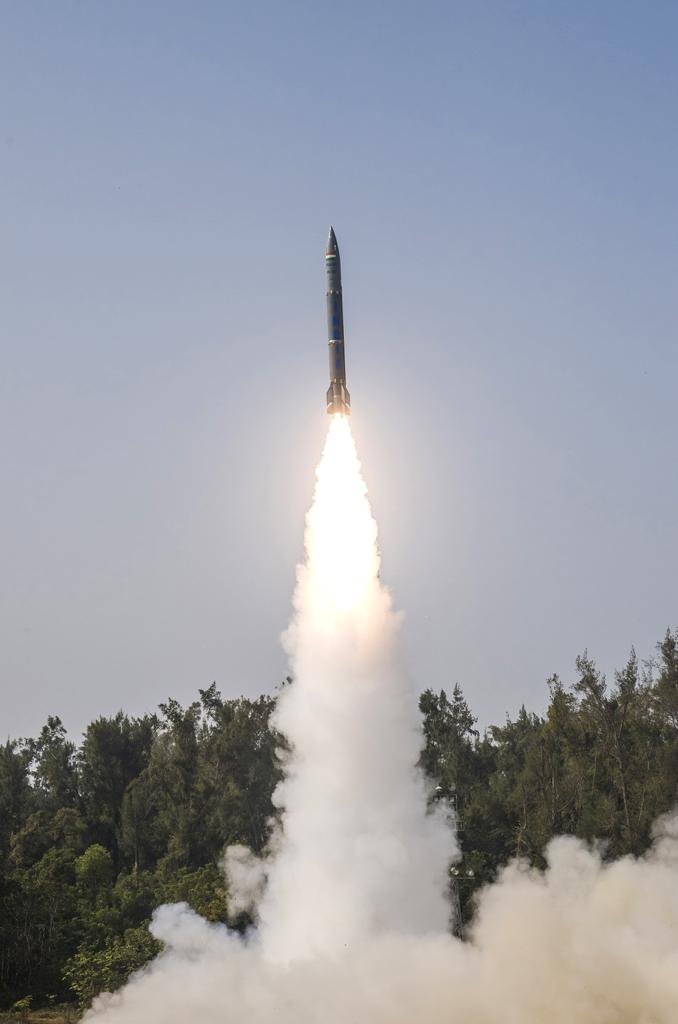
Bhadrak: In a significant boost to India’s conventional deterrence capabilities, the Defence Research and Development Organisation (DRDO) on Monday successfully test-fired its advanced short-range ballistic missile (SRBM) ‘Pralay’ from Abdul Kalam Island off the Odisha coast.
The launch, conducted at 9:35 am, met all mission parameters, reaffirming India’s growing expertise in missile technology and underlining its commitment to indigenous defence development under the Atmanirbhar Bharat initiative.
‘Pralay’ is a canisterised surface-to-surface missile, designed for rapid deployment and high mobility. Its ability to be launched from mobile platforms allows for quick response and enhanced survivability on the battlefield. The missile can be readied for launch in under 10 minutes.
With a strike range between 150 to 500 km and the capability to carry a payload of up to 1,000 kg, Pralay is designed to deliver precision strikes on high-value enemy targets such as airbases, ammunition depots, and troop formations.
Uniquely, Pralay is classified as a quasi-ballistic missile — it follows a ballistic trajectory but with manoeuvrable warheads in the terminal phase, providing greater accuracy and evading traditional missile defence systems. It is equipped with advanced guidance systems, including inertial navigation and a radio frequency seeker for terminal targeting.
Though similar in size and weight to India’s earlier Prithvi missile, Pralay offers a significantly extended range and improved targeting capability. Its deployment is intended to provide the armed forces with credible conventional deterrence along sensitive fronts, including the Line of Actual Control (LAC) with China and the Line of Control (LoC) with Pakistan.
Defence analysts see Pralay’s induction as part of India’s evolving doctrine to maintain strategic superiority without breaching the nuclear threshold, offering the military flexible options for tactical strikes in potential conflict zones.