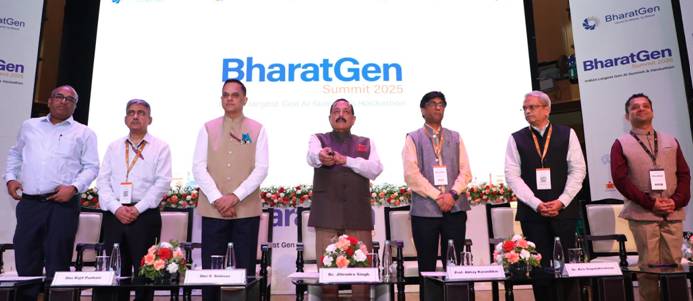
New Delhi: Marking a historic milestone in India’s Artificial Intelligence (AI) journey, Union Minister of State (Independent Charge) for Science & Technology, Dr. Jitendra Singh today launched ‘Bharat Gen’, the country’s first government-funded, AI-based multimodal Large Language Model (LLM) tailored for Indian languages. The launch took place at the BharatGen Summit, India’s largest generative AI and LLM summit and hackathon, which brought together government officials, academic leaders, industry veterans, and student innovators.
Developed under the National Mission on Interdisciplinary Cyber-Physical Systems (NM-ICPS) and implemented through the TIH Foundation for IoT and IoE at IIT Bombay, BharatGen is designed to empower inclusive digital transformation by offering AI solutions in 22 Indian languages, integrating text, speech, and image modalities. The initiative is supported by the Department of Science and Technology (DST) and represents a collaborative effort involving top-tier academic institutions and AI experts.
Calling BharatGen a “national mission” rooted in Indian values and linguistic diversity, Dr. Jitendra Singh said, “This AI platform is a step toward building a multilingual, ethical, and inclusive digital ecosystem. It has the potential to transform governance, healthcare, education, and agriculture by offering region-specific solutions tailored to the needs of every Indian.”
He cited a real-world success story from his own constituency where AI-powered telemedicine, delivered in local languages, significantly improved patient trust and outcomes. “AI that speaks your language builds confidence and delivers care that truly connects with people,” the Minister noted.
Dr. Singh underlined BharatGen’s alignment with Prime Minister Narendra Modi’s vision of ‘India’s Techade’, emphasizing the mission’s dual goals of innovation and inclusion. He referenced India’s AI-powered grievance redressal system CPGRAMS, now globally recognized as a model, and highlighted how feedback in multiple languages is enhancing citizen participation in governance.
The Minister also drew attention to the broader innovation landscape, including over 3,000 Agri-tech Startups and unique success stories like lavender cultivation in Jammu & Kashmir, underscoring that tech-led development is no longer confined to metropolitan cities. “Innovation now thrives in the heart of India’s villages and small towns,” he declared.
Another major highlight of the event was the launch of the Generative AI Hackathon 2025, an initiative designed to foster student-led solutions to real-world challenges using AI. BharatGen’s execution spans 25 Technology Innovation Hubs (TIHs), with four hubs already upgraded to Technology Translational Research Parks (TTRPs). The mission is anchored on four pillars: technology development, entrepreneurship, human resource development, and international collaboration.
The summit also witnessed a high-level MoU exchange ceremony to boost partnerships across government departments and research institutions, paving the way for deeper synergy in India’s AI ecosystem.
Several dignitaries attended the launch, including Prof. Abhay Karandikar, Secretary, DST; V. Srinivas, Secretary, DARPG; Rajit Punhani, Secretary, Ministry of Skill Development & Entrepreneurship; Abhishek Singh, Additional Secretary, MEITY; Kris Gopalakrishnan, Co-founder of Infosys; and Prof. Ganesh Ramakrishnan, Principal Investigator of BharatGen.
Their presence, along with young student innovators and senior academicians, underscored the collective commitment to transforming India into a global AI powerhouse.
With BharatGen, India takes a bold leap forward in creating a future-ready, inclusive AI ecosystem that respects its linguistic richness, cultural diversity, and the aspirations of over a billion citizens.