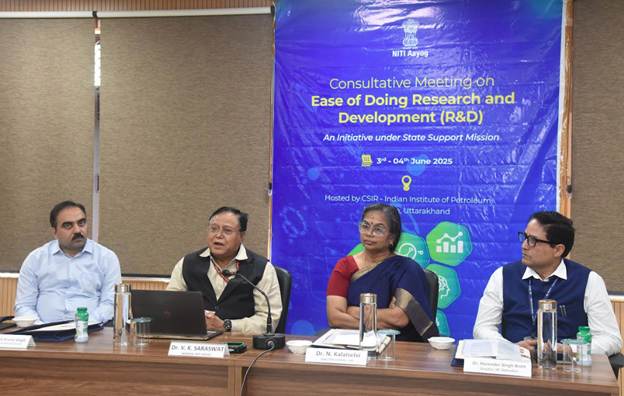
Dehradun: In a significant push to reform and rejuvenate India’s research and development (R&D) ecosystem, the second National Consultative Meeting began today at the CSIR–Indian Institute of Petroleum (CSIR-IIP), Dehradun. Spearheaded by NITI Aayog, this two-day consultation—chaired by Dr. V.K. Saraswat, Member of NITI Aayog—builds on the momentum generated by the first meeting held in Lucknow in May 2025.
The consultative series is part of NITI Aayog’s broader initiative to establish a forward-looking, innovation-driven, and globally competitive R&D landscape, with a special emphasis on revitalising government-funded laboratories and institutions across the country.
The Dehradun meeting brought together top scientific minds and policymakers, including Dr. N. Kalaiselvi, Director General of CSIR and Secretary, DSIR; Prof. Ashutosh Sharma, President of the Indian National Science Academy (INSA); and Dr. Harender Singh Bisht, Director of CSIR-IIP. Prof. Vivek Kumar Singh, Senior Adviser at NITI Aayog, opened the day’s proceedings, outlining a thematic agenda that focused on institutional agility, innovation-centric governance, and stronger industry-academia partnerships.
In his keynote address, Dr. Saraswat stressed the urgent need to unshackle India’s R&D institutions from bureaucratic constraints and transform them into autonomous, mission-oriented entities. “India’s scientific progress must be driven by institutional autonomy, decentralised decision-making, and robust accountability mechanisms,” he said. Dr. Saraswat reaffirmed NITI Aayog’s commitment to pushing systemic reforms through sustained stakeholder engagement and evidence-backed policy measures.
Dr. Kalaiselvi echoed this sentiment, lauding the consultative initiative and calling for a culture of collaborative governance to tackle long-standing structural hurdles. She advocated for the rejuvenation of research infrastructure in tier 2 and tier 3 institutions, while also urging for stronger industry linkages to enable meaningful translational research. “Aligning national research priorities with grassroots innovation needs is key to inclusive scientific development,” she remarked.
Prof. Ashutosh Sharma highlighted the human element in the R&D conversation, calling for reduced micromanagement and enhanced institutional trust in scientists. “We must retain our brightest young minds by offering flexibility, global exposure, and a supportive research environment,” he said.
Day two of the meeting, scheduled for June 4, will delve into critical themes including researcher mobility, translational science, institutional governance reform, and public-private collaboration models. The insights from this regional consultation will feed into a national framework aimed at overhauling India’s R&D structure in line with future innovation goals.
Bhubaneswar: Responding to mounting criticism and political consensus, the Odisha government has begun the process…
Bhubaneswar: The inaugural edition of the National Indoor Athletics Championships concluded on a high note…
Bhubaneswar: The Higher Education Department, Government of Odisha has announced that the Common PG Entrance…
Bhubaneswar: The Government of Odisha has nearly concluded paddy procurement for the 2025–26 Kharif season,…
Bhubaneswar: Strengthening its efforts to stabilise farm incomes and streamline agricultural marketing, the Odisha Rural…
Bhubaneswar: With a growing focus on sustainable agriculture and income diversification, the Agricultural Promotion and…