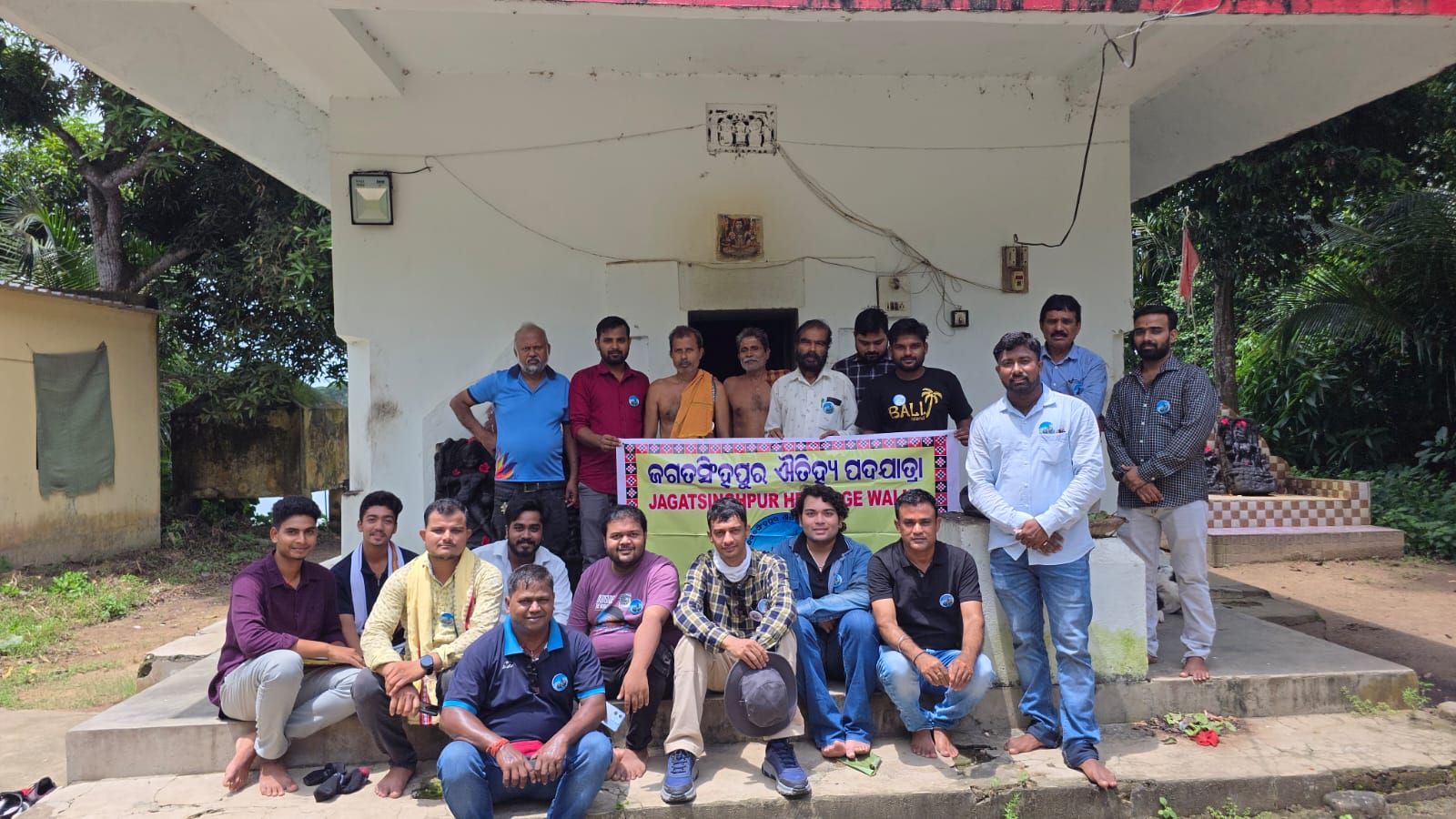
Jagatsinghpur: The eighth edition of the Jagatsinghpur Heritage Walk (JHW) unfolded on Sunday at the historic Ishaneshwar Mahadev Temple in Kostimallikapur village under Tirtol block. Coinciding with the birth of the holy Bhagabat and Indu Purnima, the event brought together 22 heritage enthusiasts, who retraced the layered history of the shrine and its cultural significance.
Historians and archaeologists recalled how the temple, a contemporary of the revered Sharala Peetha, had faced multiple destructions at the hands of Muslim invaders. During the reign of Mukunda Dev, the last independent Gajapati ruler of Odisha, Kalapahad—the commander of Bengal’s Nawab Sulaiman Karrani—razed hundreds of temples across Cuttack, Jagatsinghpur, Puri, Kendrapara, and Jajpur. The Ishaneshwar shrine, like the Sharala temple, also fell victim to his onslaughts.
Though restoration efforts were undertaken during the reign of Gajapati Kapilendra Dev, the temple was again damaged and its idols destroyed. A stone inscription of Kapilendra Dev still stands at the entrance. The Rekha-style temple houses a Swayambhu Shiva Linga, believed to extend nearly two feet deep into the ground.
The temple complex is dotted with remarkable sculptures: Kartikeya to the west, Goddess Parvati to the south, and Ganesha to the north. The south courtyard also features an imposing idol of Chamunda (Charchikai), depicted standing on a corpse and holding a sword, cup, severed head, and lotus. Other striking figures include Bhairava, adorned with a crown of thorns and clutching a drawn sword, and Astikajratkaru, portrayed in meditative company. Devotees revere the latter as Yogi Yogiani.
While the temple’s Jagamohan was damaged by a storm, the State Archaeological Department later constructed a roof to preserve the sanctum. Local priest Shankar Panda and his brother Shiva Panda enriched the heritage walkers with insights into the temple’s rituals, worship traditions, and folklore tied to the Kashia-Kapila legend of Kapilendra Dev.
The heritage walk also coincided with a lunar eclipse, during which participants witnessed elaborate pujas performed at the shrine. Among the attendees were Hemanta Kumar Nayak, historian Kailash Pradhan, and young professional Nishant Singh from Delhi.
Convenor Srikant Singh opened the session by introducing participants and facilitating discussions on the temple’s past. Highlighting the growing movement, Biswaranjan Dehury of Odisha Heritage Walks announced that similar initiatives are being planned for every district, with the Sonepur Heritage Walk scheduled to commence next month in western Odisha.