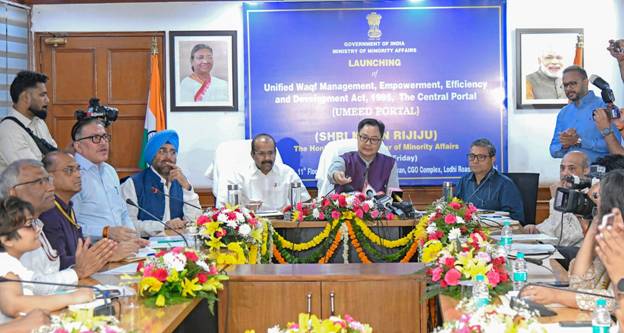
New Delhi: In a landmark move aimed at transforming Waqf property administration in India, Union Minister for Minority Affairs and Parliamentary Affairs, Kiren Rijiju, today launched the UMEED Central Portal in the national capital. The platform is set to become a critical tool in ensuring transparency, accountability, and equitable usage of community-owned assets.
Terming the initiative “a new chapter in the history of Waqf property management,” Rijiju said the portal would be especially beneficial to common Muslims, with a focus on empowering women and children. He emphasized that UMEED is not just a technological upgrade, but a reflection of the government’s commitment to protecting the rights of minorities and ensuring that Waqf properties serve their intended purpose—uplifting the poor and underprivileged.
The launch event was also attended by George Kurian, Union Minister of State for Minority Affairs, and senior ministry officials, including Secretary Dr. Chandra Shekhar Kumar.
Developed by the Ministry of Minority Affairs, the UMEED (Unified Waqf Management, Empowerment, Efficiency and Development) Portal will serve as a centralized digital platform for the real-time uploading, verification, and monitoring of Waqf properties across the country. It aims to bring public participation into the fold of property oversight by providing access to verified records and ensuring that misuse or mismanagement is swiftly addressed.
Key features of the platform include digital inventory creation with geo-tagging, integration with GIS mapping, a public grievance redressal system, and tools for transparent leasing and usage tracking.
Speaking at the launch, George Kurian described the portal as a long-overdue reform. “This initiative will significantly reduce opportunities for misuse and corruption while bringing Waqf governance closer to the people,” he said.
Dr. Chandra Shekhar Kumar expressed confidence that UMEED will serve as the backbone of digital Waqf governance, and enable Waqf properties to contribute meaningfully to key sectors like education, healthcare, livelihoods, and social welfare.