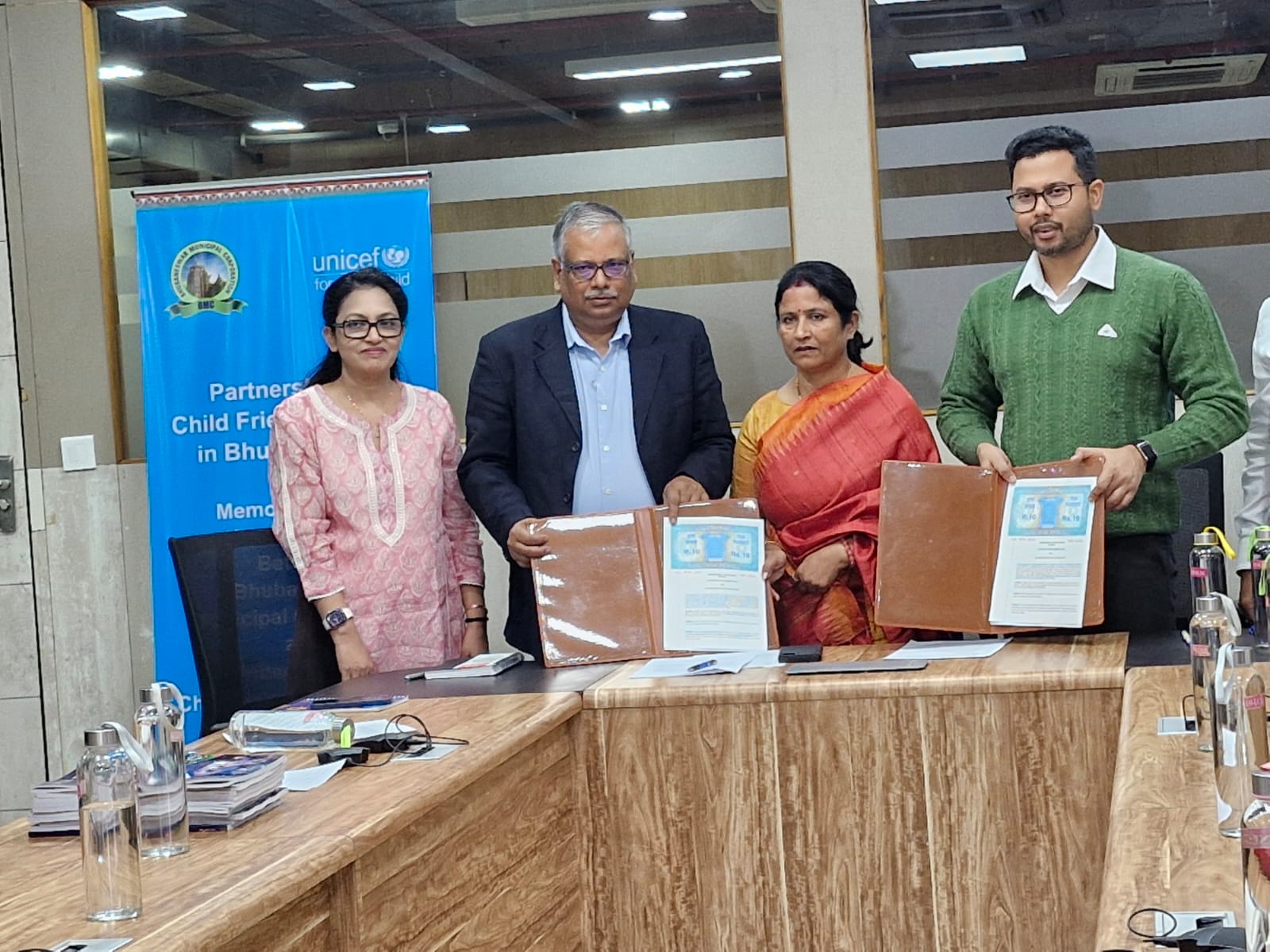
Bhubaneswar: In a significant step towards making Bhubaneswar a more inclusive and liveable city for children, the Bhubaneswar Municipal Corporation (BMC) and UNICEF Odisha signed a Memorandum of Understanding (MoU) to create safe, green and child-friendly spaces across the city. The MoU was signed at the BMC office, marking the beginning of a collaborative effort to reimagine public spaces through a child-centric lens.
A child-friendly space goes beyond the idea of a conventional playground. It is envisioned as a safe and inclusive environment where children can freely play, learn, interact and remain physically active, supporting their overall development and well-being.
Speaking on the occasion, Prasanta Dash, Chief of Field Office, UNICEF Odisha, underscored the importance of play in a child’s life. “Play is not a luxury—it is a right. When children are given the freedom to explore, imagine and create, they grow healthier and more confident. These spaces will help children learn through play, connect with nature and develop a sense of belonging within their communities. UNICEF is proud to partner with BMC in building a city that truly works for its children,” he said.
The initiative will begin with the transformation of 16 locations spread across three zones of Bhubaneswar. Rather than limiting the effort to conventional parks, the project aims to redesign everyday streets, neighbourhood playgrounds and underutilised spaces into vibrant, safe areas where children can feel secure and welcome.
Mayor Sulochana Das described the initiative as a commitment to the city’s youngest residents. “We want our children to step outside their homes and find places that feel safe, welcoming and truly theirs—spaces where they can play, breathe fresh air and grow. These 16 neighbourhoods are just the beginning of a new way of thinking about our city. This initiative is not merely a project; it is our promise to our children,” she said.
BMC Commissioner Chanchal Rana, IAS, highlighted the broader impact of designing cities with children in mind. “When public spaces and streets are designed better, children feel safer—and so does everyone else. Measures such as improved lighting, calmer traffic and welcoming layouts can completely transform neighbourhoods. Through these child-friendly spaces, we aim to make Bhubaneswar safer, stronger and more compassionate for every child,” he noted.
Under the partnership, UNICEF will provide technical expertise in design, working closely with the Department of Planning and Architecture at NIT Rourkela. The BMC has committed full city funding for the construction and long-term maintenance of these spaces, ensuring their sustainability.
The initiative aligns with the global SPACES framework, a guide developed by UN-Habitat, UNICEF and the World Health Organization to help governments and urban planners create safe, inclusive and child-friendly public spaces. Based on six core principles—Safety, Play, Access, Child Health, Equity and Sustainability—SPACES offers practical guidance, tools and examples from cities across diverse contexts, reinforcing Bhubaneswar’s vision of becoming a city built for children and communities alike.