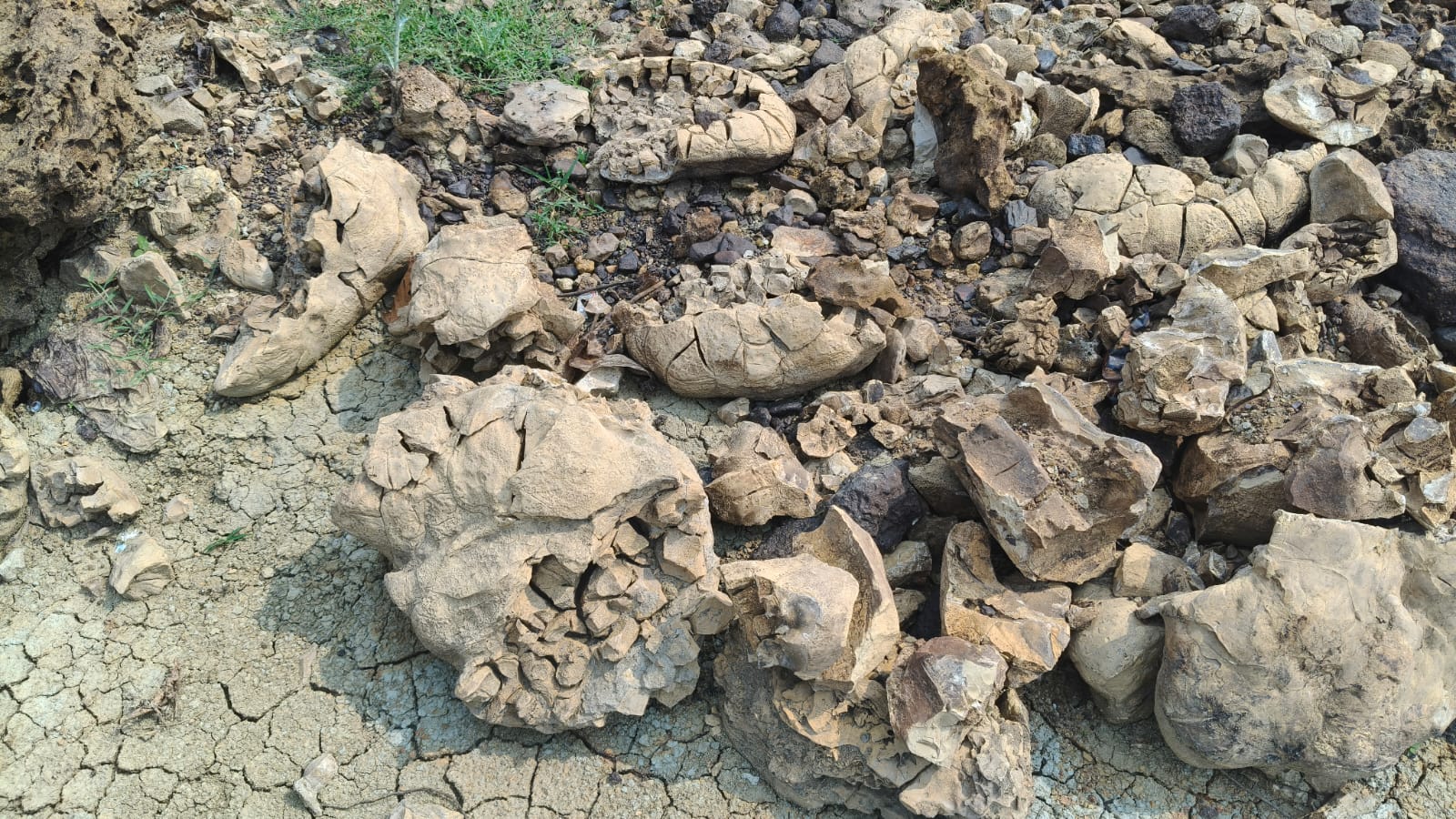
Baripada: A vast deposit of prehistoric marine fossils along the Budha Balanga river near Baripada is drawing renewed attention, as the Mayurbhanj chapter of INTACH has urged the Odisha government to develop the site into a dedicated fossil park.
Spread across villages such as Satpautia, Usurudihi, Itamundia, and Mukuramatia, the area—popularly known as the “Baripada Fossil Beds”—dates back nearly 12–15 million years to the Miocene epoch. Scientific findings indicate that the region was once part of a shallow sea, preserving an extensive record of ancient marine biodiversity.
Researchers have identified a wide range of fossils at the site, including shark teeth, rays, fish remains, molluscs, and microfauna. Recent field visits have also revealed fossilised remains of crocodiles, turtles, and partial skulls, underscoring the site’s rich and varied prehistoric record.
However, despite its importance, the site remains largely neglected and vulnerable. Locally known as “Asura Hada” or “Demon Bones,” it is often avoided by residents, limiting both awareness and preservation efforts.
Anil Dhir, Convener of INTACH’s Bhubaneswar Chapter, said the fossil beds offer critical insights into the geological and ecological history of the region. He noted that establishing a fossil park here could position Odisha on the global map of geo-tourism destinations.
Highlighting the uniqueness of the site, he pointed out that while India has several fossil parks, none focus exclusively on marine fossils, making Baripada a potential first of its kind in the country.
Meanwhile, Rashmi Rajya Laxmi Bhanj Deo has formally appealed to authorities to declare the site a State Geo-Heritage Site, ensuring legal safeguards against damage and unregulated activities.
INTACH has recommended the creation of a fossil park supported by an interpretation centre and museum to preserve and display the findings. It has also called for fencing the area and banning sand mining to protect the fragile fossil deposits.
Experts believe that safeguarding the Baripada Fossil Beds could unlock opportunities for research, education, and sustainable tourism, while preserving a rare chapter of Earth’s history embedded in Odisha’s landscape.