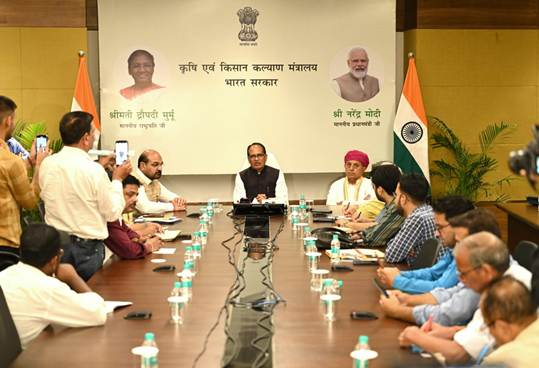
New Delhi: On the sidelines of the Annual Conference of Vice-Chancellors of Agricultural Universities and Directors of ICAR Institutes, Union Minister for Agriculture and Farmers’ Welfare and Rural Development, Shivraj Singh Chouhan, addressed a press conference where he emphasized that agricultural education, research, and extension are critical pillars of India’s developmental journey. He asserted that the collective efforts of all institutions involved in the agriculture sector must be aligned in a single direction to meet the ambitious target of maintaining a 5% annual agricultural growth rate.
Chouhan described agriculture as the backbone of the Indian economy and the primary source of livelihood for nearly half of the country’s population. Contributing 18% to the national GDP, the agriculture sector, he said, will remain central to India’s economy in the years ahead. He reaffirmed that Prime Minister Narendra Modi’s vision of a “Viksit Bharat” is firmly anchored in the concept of “Viksit Krishi aur Samruddh Kisan,” which serves as a guiding philosophy for policy and planning.
The Minister underlined that the discussions at the conference revolved around achieving developed agriculture and farmer prosperity, with a strong focus on education, research, and extension. He said the efforts of agricultural universities, state agricultural departments, 113 ICAR institutes, and 731 Krishi Vigyan Kendras (KVKs) must converge under the unified approach of “One Nation – One Agriculture – One Team.”
Chouhan noted that the conference concluded with consensus that a 5% growth rate in agriculture and allied sectors is both essential and achievable. However, he pointed out challenges such as low growth in pulses and oilseeds, which stand at approximately 1.5%, and significant disparities in crop productivity across different states. For instance, maize yields in Tamil Nadu are considerably higher compared to those in Uttar Pradesh. Bridging such regional gaps, he said, is vital and will require clear delineation of responsibilities among agricultural institutions and departments.
The Minister also laid out a vision in which agriculture would contribute $1 trillion to India’s goal of becoming a $5 trillion economy. With current agricultural exports hovering around 6%, the Ministry aims to increase this share to 20% through the adoption of modern technology and value-added practices. A key part of this strategy involves closing the gap between research labs and farmers, ensuring that innovations are practical and directly useful at the farm level.
He drew attention to the shrinking size of landholdings in India, which are projected to reduce to an average of 0.6 hectares by 2047. In such a context, Chouhan emphasized the need for agricultural diversification to supplement food grain production. He advocated for the promotion of allied activities such as beekeeping, animal husbandry, fisheries, and horticulture, all of which are being actively integrated into agricultural policy planning.
In a notable announcement, the Minister expressed gratitude to Prime Minister Modi for allocating funds in the Union Budget for the establishment of a new gene bank, underscoring the government’s commitment to agricultural innovation. He informed that two new varieties of rice have been developed through genome editing, and similar advancements are underway for soybeans, pulses, and other key crops like urad, chana, and tur.
Water-use efficiency was also a key topic in the press conference, with Chouhan highlighting the importance of maximizing yield with minimal water per hectare. He said the Ministry is working on setting time-bound goals for both short- and long-term outcomes, with an urgency to translate plans into action swiftly.