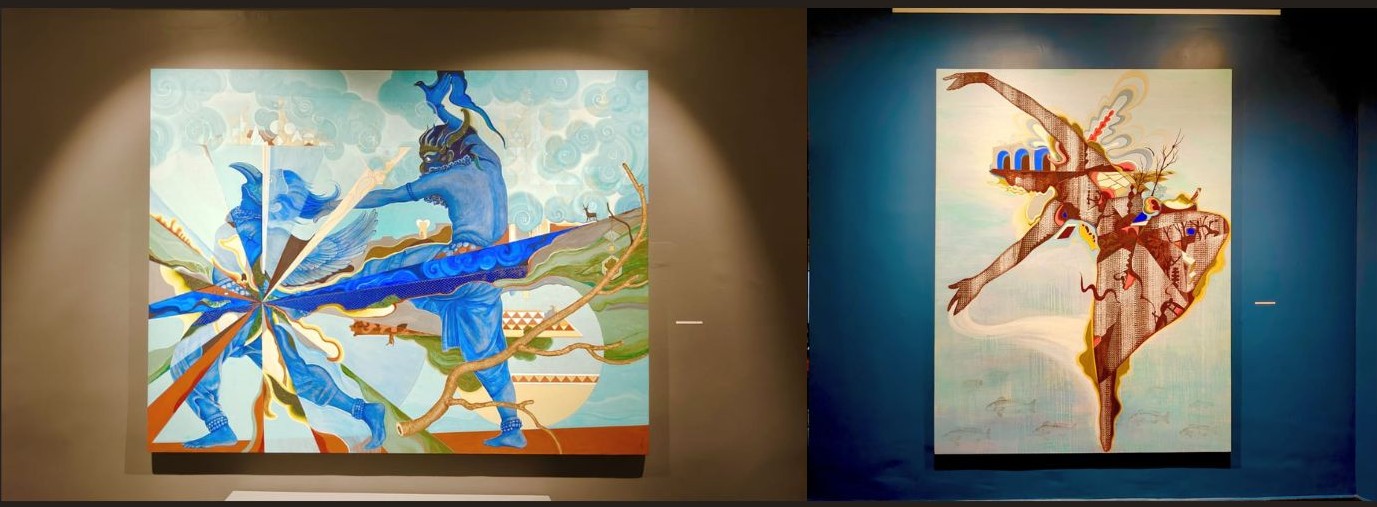
Bhubaneswar: After a long wait, art lovers in Bhubaneswar finally have the opportunity to experience the evocative and layered works of eminent Odia contemporary artist Jagannath Panda. His solo exhibition, The Long Now of Us, currently on display at the Lalit Kala Akademi, offers a deeply immersive journey through three decades of artistic exploration—where memory, myth, urban change and cultural inheritance intersect.
The exhibition unfolds as a visual dialogue between Panda’s roots in Odisha and his sustained engagement with metropolitan life in Delhi. Through paintings, installations and sculptural forms, he creates an intricate world that reimagines cultural symbols—particularly Odissi dance and the iconic chariot—transforming them into powerful metaphors that speak across places and generations.
At the heart of the exhibition stands a striking chariot installation, a centrepiece intricately connected to several other works. Far from a conventional representation, Panda’s chariot appears dissected and opened, exposing its internal structures. The work invites reflection on memory, ecology, collective history and shared knowledge, blurring the boundaries between the sacred and the personal.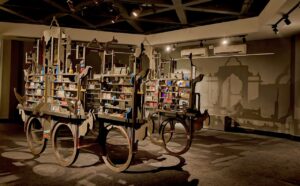
Curator Sibdas Sengupta explained that Panda’s practice is deeply influenced by traditional cultural practices and collective memory. “When we conceptualised this exhibition, we wanted to represent Odisha’s artistic imagination through cultural symbols and traditional practices, while also allowing space for broader interpretations. When Panda references Odissi dance, it becomes a carrier of multiple narratives. Similarly, the chariot is not merely an object—it evokes ideas of ecological fragility, archiving and collective knowledge. He has decontextualised it and redefined its meaning,” he said.
The exhibition deliberately moves beyond a regional narrative. While Odisha’s cultural imprint remains evident, the works speak to universal concerns—urbanisation, gentrification, displacement and transformation. According to Sengupta, Panda’s artistic journey over the past 30 years reflects two dominant forces: the rapid shifts of metropolitan life and an enduring engagement with myth-making. “In his works, myth and the modern city operate like oscillating forces. Neither belongs solely to the past nor the present. Together, they generate new meanings.”
Tracing the evolution of Panda’s stylistic language is central to the exhibition. “We wanted to map his journey—from early works to his present inquiries—showcasing both his initial approach and the transformation of his image-making and conceptual depth,” Sengupta added.
The title The Long Now of Us reflects a philosophical engagement with time, memory and continuity. It suggests a present that is constantly unfolding—neither anchored in the past nor rushing into the future. The urgency that marked Panda’s early works continues to resonate, reframed through contemporary sensibilities. The exhibition thus becomes a meditation on collective imagination, aspiration and layered temporal experience.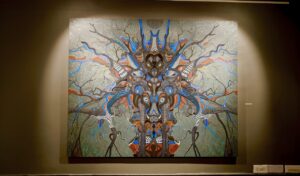
The chariot installation, undoubtedly the exhibition’s most arresting element, offers a radically reimagined form. Dissected and open, it reveals its internal anatomy. “Traditionally, the chariot symbolises collective faith and restricted access. Here, visitors can enter it, inhabiting the space and making it their own. It becomes a vessel of memory, history and personal archive, where multiple narratives converge. The wheel suggests motion—carrying stories, identities and time itself,” Sengupta explained.
For Panda, bringing this body of work back to Odisha holds deep personal meaning. “Many people felt audiences here deserved to see this exhibition. A serious art exhibition in Odisha is important—not just for me, but for other artists too. It can strengthen the local art fraternity and infrastructure,” he reflected. Acknowledging Odisha as the foundation of his artistic sensibility, he added, “My first way of seeing and understanding art was shaped here. I went out with that sensibility and returned transformed. What I draw from Odissi or local imagery becomes something entirely new, layered with multiple meanings.”
The exhibition is also a meditation on time—its movement, contradictions and transformations. “We are constantly evolving. The question is whether we are attentive to it. When we pay attention, the contradictions between who we are and how the world moves become visible. That tension finds expression in my works,” Panda said.
Summing up Panda’s philosophy, Sengupta remarked, “For him, art emerges from a rupture in perception—a shift that unsettles normalcy and opens new ways of seeing. That rupture is where his art truly begins.”
In The Long Now of Us, Jagannath Panda invites viewers into a contemplative space where memory, myth, ecology and urban experience converge. It is not merely an exhibition to be seen, but one to be felt and absorbed—urging audiences to pause, reflect and engage with the deeper rhythms of time and transformation.