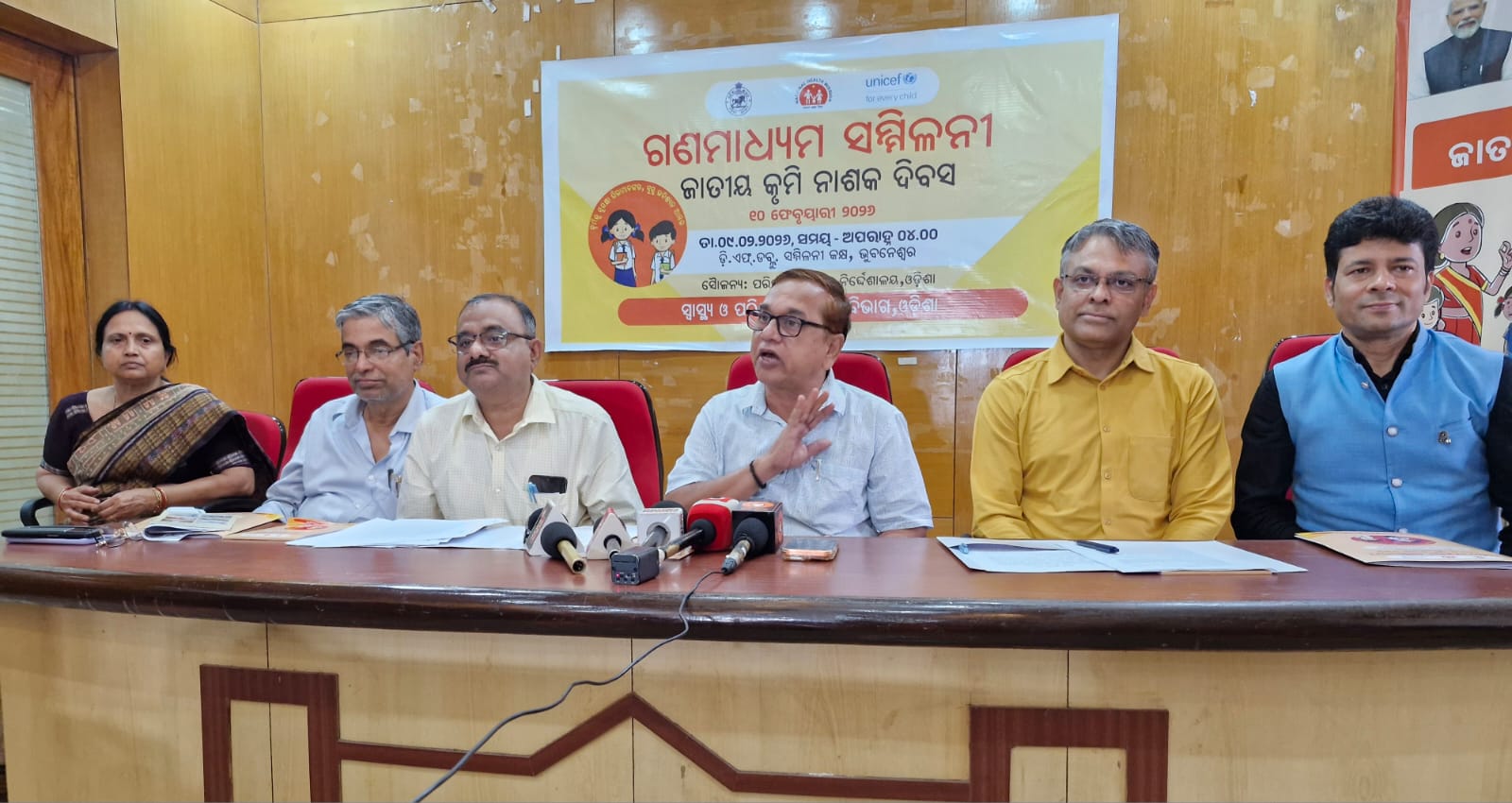
Bhubaneswar: In a major public health push to strengthen child nutrition, tackle anaemia, and prevent intestinal worm infections, the Department of Health and Family Welfare, Government of Odisha, with support from UNICEF, will roll out the National Deworming Day (NDD) and Vitamin A Supplementation (VAS) programmes across the State on February 10, 2026.
Alongside these initiatives, the State will also implement the Lymphatic Filariasis–Mass Drug Administration (LF-MDA) programme in selected districts as part of an integrated strategy to eliminate neglected tropical diseases. The LF-MDA drive involves community-wide administration of anti-filarial drugs to interrupt disease transmission and move towards the elimination of lymphatic filariasis.
Under the NDD programme, Albendazole tablets will be administered to over 1.59 crore children in the age group of 1 to 19 years and more than 19 lakh women of reproductive age (20–24 years) across all 30 districts of Odisha. Simultaneously, the biannual Vitamin A Supplementation campaign is expected to benefit around 32 lakh children aged between 9 and 60 months, helping boost immunity and reduce child morbidity and mortality.
Highlighting the importance of the initiative, Dr. Shakti Prakash Mishra, Director of Family Welfare, Government of Odisha, said that National Deworming Day is a crucial public health intervention to protect children from parasitic infections and address anaemia among young women. “Regular deworming supports better nutrition, healthier growth, and improved participation of children in school, contributing significantly to their long-term development,” he added.
Sourav Bhattacharjee, Nutrition Specialist, UNICEF Odisha, noted that combining deworming with Vitamin A supplementation enables families to access multiple essential health services through a single platform. “This integrated approach strengthens child nutrition, supports immunity, and helps create a strong foundation for healthy growth and learning,” he said.
The programme will also be implemented alongside the LF-MDA drive in seven implementation units across five selected districts—Bargarh, Bolangir, Dhenkanal, Ganjam, and Jajpur. In these districts, children aged 1 to 2 years will additionally receive deworming medication as part of the integrated approach.
Coordinated by the Department of Health and Family Welfare, the large-scale campaign will involve government, government-aided, and private schools, as well as Anganwadi centres. Over two lakh frontline workers, including teachers, Auxiliary Nurse Midwives (ANMs), supervisors, Anganwadi Workers, and ASHAs, will be engaged in administering the medicines. UNICEF is providing technical and operational support to ensure effective implementation of the programme across the State.