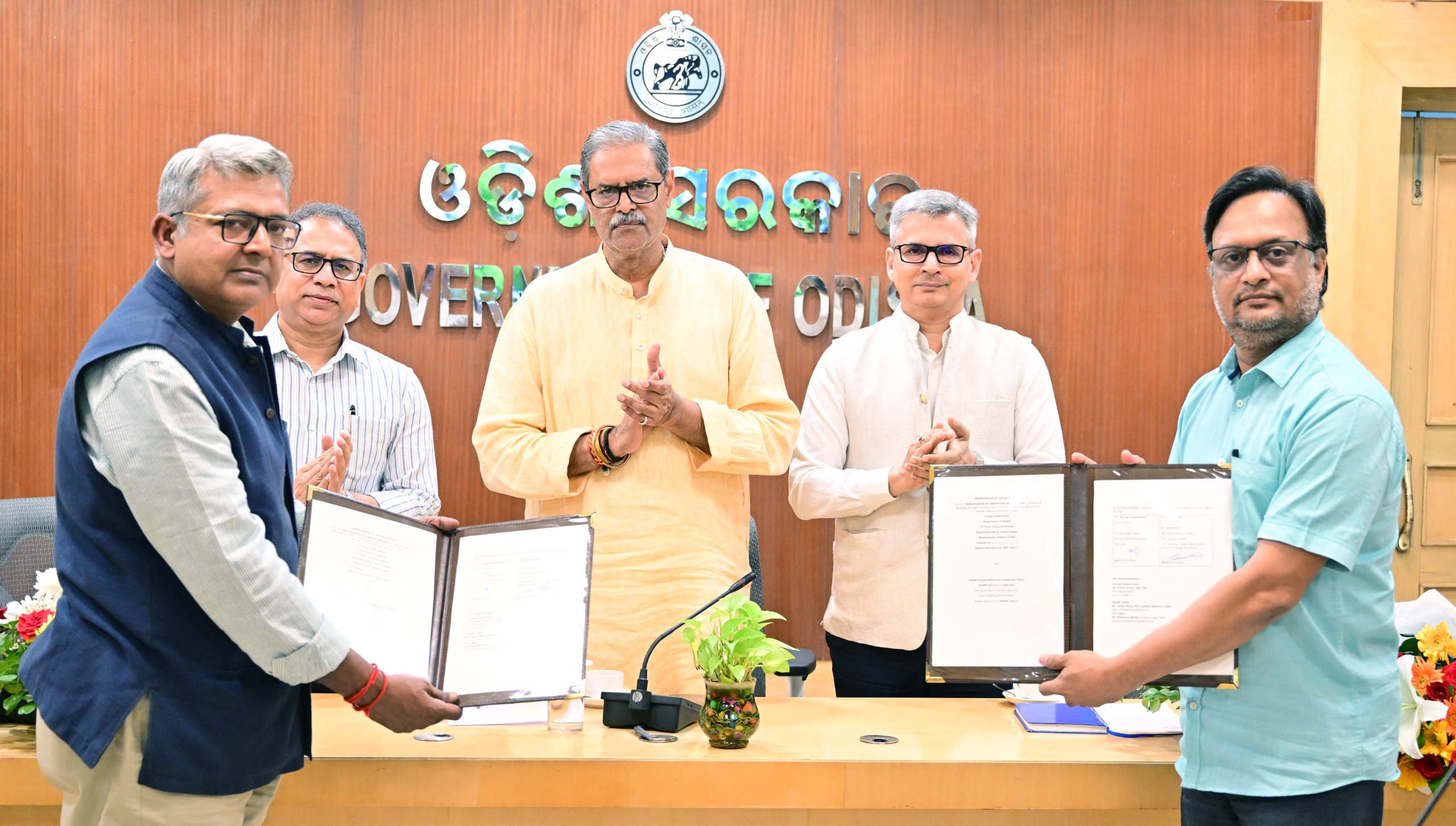
Bhubaneswar: In a significant step towards accelerating Odisha’s clean energy transformation, the Energy Department and the Global Energy Alliance for People and Planet (GEAPP) today signed a Memorandum of Understanding (MoU) in the presence of Deputy Chief Minister and Energy Minister Kanak Vardhan Singh Deo. The partnership aims to drive a coordinated programme focused on energy transition, grid modernization, and renewable-linked livelihood opportunities across the State.
Speaking at the ceremony, the Deputy Chief Minister said the MoU marks a strategic collaboration that aligns Odisha’s energy ambitions with specialised technical expertise, policy support, and financing pathways. “This partnership will help accelerate Odisha’s journey towards a resilient, equitable, and investment-ready clean energy future. We remain committed to providing reliable power to all,” he said.
Under the agreement, the State Government and GEAPP will jointly work on comprehensive energy transition planning, including the development of multi-sector transition strategies and support for utility digitisation to integrate higher shares of renewable energy. This will include demand-side management measures aimed at optimising power consumption, managing peak loads, and improving both system efficiency and consumer experience.
A major component of the partnership is the acceleration of Battery Energy Storage Systems (BESS) deployment across Odisha. GEAPP will assist the Department of Energy, GRIDCO, OREDA, and DISCOMs with techno-economic feasibility studies, identification of suitable substations, and evaluation of use cases such as peak shifting, renewable integration, and ancillary services. The collaboration also covers preparation of procurement documents, establishment of a dedicated Project Management Unit for commissioning, and design of monitoring frameworks to ensure maximum economic and technical value from BESS installations.
The MoU also places a strong emphasis on renewable energy–driven livelihoods. This includes support for solarisation of irrigation under the PM-KUSUM scheme, promotion of the Decentralised Energy for Women’s Economic Empowerment (DEWEE) initiative, and scaling up women-led enterprises through decentralised renewable solutions. In addition, the partnership will promote solarisation and energy-efficiency interventions among MSMEs, enabling improved productivity, reduced power costs, and expansion of green livelihood opportunities.
The Energy Department will lead the coordination of this multi-stakeholder initiative, engaging government departments, industry, academia, and civil society to ensure effective implementation and monitoring.
Balangir district has been selected as the model district for piloting interventions under the partnership.