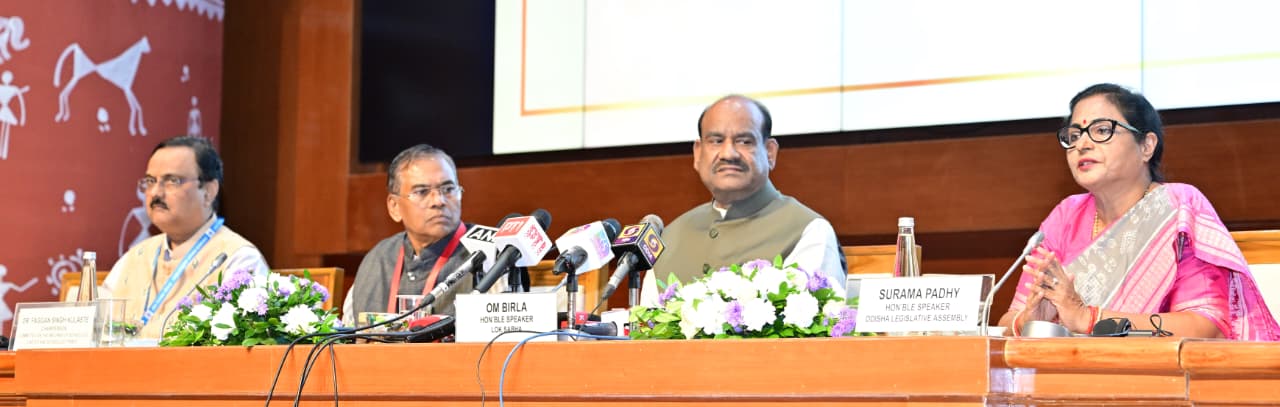
Bhubaneswar: Lok Sabha Speaker Om Birla on Saturday called upon states that have not yet constituted legislative committees for the welfare of Scheduled Castes (SCs) and Scheduled Tribes (STs) to do so, emphasising their crucial role in advancing social justice and ensuring accountability.
Birla was addressing reporters at the conclusion of the two-day National Conference of Chairpersons of Parliamentary and State Legislatures’ Committees on SC/ST Welfare, held in Bhubaneswar after 25 years and for the first time outside Delhi. The meet brought together representatives from 19 state legislatures, one Union Territory, and the Parliamentary panel.
At the conference, participants adopted the ‘Bhubaneswar Agenda 2025’, a set of recommendations that will be taken up with both the Centre and state governments for implementation. Birla noted that the impact of such committees is significant, with nearly 70–80% of their recommendations typically accepted by governments. He cited examples such as the regularisation of over 1.5 lakh jobs and the extension of reservation benefits to new sectors that had emerged from panel deliberations.
“The objective of this conference is to encourage states to learn from each other’s best practices and strengthen efforts for the welfare of marginalised communities,” Birla said. He stressed that India has undertaken wide-ranging reforms to expand SC/ST rights in line with contemporary aspirations.
On questions regarding Opposition complaints about limited opportunities in Parliament, Birla asserted that Opposition members are often given more time than allotted but underscored the need for debates to follow parliamentary rules. “Disagreement is the strength of democracy, but it must be expressed in a dignified way,” he said, criticising frequent disruptions during the recent Monsoon session.
Addressing the gathering, Odisha Governor Hari Babu Kambhampati said the welfare of SCs and STs must be seen as a measure of national progress. “Their empowerment is not charity but the essence of democracy,” he remarked, stressing the principles of equality, dignity, liberty, and fraternity.