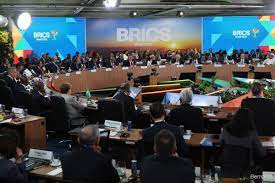
New Delhi: The global economy is witnessing a fundamental shift, with BRICS nations emerging stronger than the traditional G7 bloc, US economist Richard Wolff has said. He noted that BRICS now contribute 35 per cent of global GDP, compared to the G7’s 28 per cent, signalling a rebalancing of economic power.
Wolff pointed to India’s decision to continue buying Russian oil despite US pressure as an example of how the balance of influence is changing. “India is now, according to the United Nations, the largest country on earth. The United States telling India what to do is like a mouse hitting its fist on an elephant,” he said during a podcast.
He also drew attention to China’s reduced holdings of US Treasury bonds, warning that America’s $36 trillion debt could trigger serious consequences for the dollar’s dominance. If the trend persists, Wolff said, the US may face rising borrowing costs and cuts to domestic spending, further weakening its global position.
Criticising Washington’s trade policies, Wolff argued that tariffs imposed on countries like India are ineffective and risk isolating American businesses. “What you’re doing is developing the BRICS to be an ever larger, more integrated and successful economic alternative to the West,” he explained.
The Trump administration’s move to raise tariffs on Indian goods by an additional 25 per cent, bringing the total to 50 per cent, has drawn sharp criticism from New Delhi. Prime Minister Narendra Modi has rejected the measures as “unjustified and unfair,” making it clear that India will not compromise on the interests of its farmers and small businesses.
As economic tensions simmer, Modi is set to meet Chinese President Xi Jinping on the sidelines of the Shanghai Cooperation Organisation (SCO) Summit in Tianjin on Sunday. This marks his first visit to China in seven years, with both leaders expected to discuss regional cooperation and strengthening the BRICS framework.