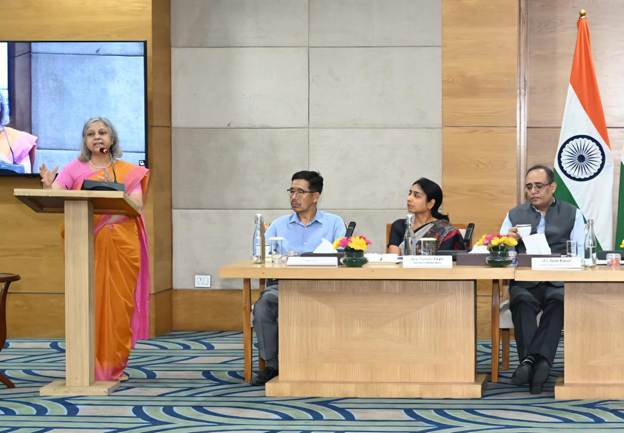
New Delhi, June 3, 2025: In a decisive push toward a sustainable and circular textile economy, the Ministry of Textiles held the fourth meeting of the Environmental, Social, and Governance (ESG) Task Force today, led by Secretary Neelam Shami Rao. The gathering brought together senior government officials, industry leaders, multilateral agencies, and stakeholders from across the textile value chain to co-develop a forward-looking vision for the Indian textiles and apparel sector.
The meeting witnessed participation from prominent figures including Additional Secretary Rohit Kansal, Textile Commissioner Dr. M. Beena, Joint Secretary (Fibre) Padmini Singla, Economic Advisor Renu Lata from the Ministry of Commerce & Industry, and Ashok Kumar, Deputy Director General, Bureau of Energy Efficiency. The session also included representation from various ministries, brands, industry associations, and ESG experts, ensuring a comprehensive and inclusive dialogue.
Delivering the keynote address, Rao emphasized that sustainability is not just an abstract goal but a lived reality in textile clusters such as Tiruppur, Surat, and Panipat. “Initiatives like wastewater recycling, renewable energy adoption, and waste management are already being practiced at the grassroots level,” she said. However, she cautioned that these local successes must now be scaled nationally through unified, cooperative action. “Sustainability is no longer a choice—it is the defining imperative for the future of India’s textile sector,” she added.
Echoing the sentiment, Rohit Kansal underlined that sustainable practices are deeply embedded in India’s traditional ethos. He spoke about the need to translate sustainability from being a compliance requirement to a strategic advantage for Indian textiles globally. “We must ensure that sustainability becomes a core value of our production and branding,” he said, reiterating the Prime Minister’s vision of positioning India as a global leader in “Fashion for Environment and Empowerment.”
The Ministry also presented its draft Roadmap 2047 for a Sustainable, Circular, and Resource-Efficient Indian Textile Industry, inviting feedback from participants. Discussions spanned several critical areas including awareness building across the value chain—from large corporations and MSMEs to consumers and students—alongside research and development, innovation, capacity building, and education.
A major focus was the need for a unified and harmonized framework for sustainability standards and certifications. Stakeholders highlighted the importance of simplifying compliance processes while balancing regulatory and voluntary mechanisms to promote circular practices. Emphasis was also laid on aligning domestic policies with evolving global benchmarks in ESG compliance, green finance, and responsible consumption.
The meeting concluded with a strong show of support from industry leaders who commended the Ministry’s inclusive and consultative approach. Participants reaffirmed their commitment to actively contribute to the ongoing revision of the policy framework, reinforcing a collective ambition to make India’s textile sector not just globally competitive but environmentally and socially responsible.