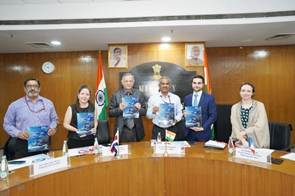
New Delhi: The Ministry of Earth Sciences (MoES), Government of India, in collaboration with the Embassies of France and Costa Rica, hosted the second edition of the Blue Talks at Prithvi Bhawan, New Delhi, marking a significant step towards global ocean sustainability. The event served as a key milestone in the lead-up to the 3rd United Nations Ocean Conference (UNOC3) scheduled to be held in Nice, France, from June 9 to 13, 2025.
Building on the momentum of the first Blue Talks held in February 2024, this edition brought together a diverse group of scientists, policymakers, academics, industry leaders, and civil society representatives. The primary objective was to catalyse action and foster partnerships aligned with the UNOC3 theme—“Scaling up Ocean Action Based on Science and Innovation for the Implementation of Goal 14”.
The event was chaired by Dr. M. Ravichandran, Secretary, MoES, and co-chaired by H.E. Néstor Baltodano Vargas, Ambassador of Costa Rica to India, and Damien Syed, Deputy Head of Mission, French Embassy.
Dr. Ravichandran underscored the urgency of coordinated marine initiatives, stating, “To truly achieve SDG 14 and the goals of the UN Ocean Decade, we must prioritise comprehensive ocean resource mapping, invest in innovative technologies, implement supportive policies, and build skilled human capital for the marine economy.” Echoing this vision, Ambassador Vargas noted, “This event strengthens cooperation between our nations and drives concrete progress towards ocean conservation and sustainable development.”
A key highlight of the event was the release of a white paper titled “Transforming India’s Blue Economy: Investment, Innovation and Sustainable Growth” by the MoES, in collaboration with its strategic knowledge partner. The document provides a roadmap for aligning India’s national ocean-related initiatives under a cohesive framework and identifies key investment opportunities to unlock the economic potential of the country’s vast marine resources.
The white paper emphasizes the strategic role of India’s extensive 7,500-km coastline and Exclusive Economic Zone (EEZ) in driving sustainable growth. It reflects the contributions of 25 ministries, coastal states, and union territories in shaping India’s marine vision under the Viksit Bharat 2047 agenda and builds upon commitments made during India’s G20 Presidency, including the Chennai High-Level Principles.
Despite notable progress, the report outlines challenges such as fragmented governance, limited data sharing, and gaps in private sector investment—particularly in offshore wind, deep-sea mining, and emerging marine technologies. The document proposes scalable models such as women-led seaweed farming, smart ports, and green ship recycling as pathways for integrated economic and environmental progress.
The second Blue Talks featured a dynamic multi-stakeholder consultation around four critical themes:
-
Conservation and Restoration of Marine and Coastal Ecosystems
-
Enhancing Scientific Cooperation and Marine Technology
-
Reducing Marine Pollution from Land-Based Activities
-
Addressing the Ocean-Climate-Biodiversity Nexus
Speaking on the importance of global collaboration, Damien Syed of the French Embassy remarked, “As India moves toward ratifying the BBNJ Agreement and with UNOC3 approaching, it is vital to gather insight from India’s scientific and policy communities to inform international strategies.”