
New Delhi: In a historic stride for India’s space and biotechnology sectors, Union Minister Dr. Jitendra Singh announced that the country is set to carry out its first-ever biological experiments aboard the International Space Station (ISS) to explore the sustainability of human life in space. The initiative forms a key part of the government’s BioE3 (Biotechnology for Economy, Environment & Employment) policy launched under the leadership of Prime Minister Narendra Modi.
The groundbreaking experiments will be undertaken as part of the AXIOM-4 mission, with Indian astronaut Group Captain Shubhanshu Shukla representing the nation aboard the ISS. Spearheaded by the Indian Space Research Organisation (ISRO) in partnership with the Department of Biotechnology (DBT) and with support from NASA, this mission marks a new era of India’s involvement in space biotechnology.
Dr. Singh shared that the first of the two experiments will focus on studying the growth of edible microalgae under microgravity and space radiation. These microalgae are rich in proteins, lipids, and essential bioactive compounds, making them ideal candidates for space-based nutrition during long-duration missions. The experiment will analyze transcriptomes, proteomes, and metabolomes of different species in space, compared to Earth controls, helping identify the most viable food sources for astronauts.
The second experiment will examine the behavior of cyanobacteria such as Spirulina and Synechococcus in microgravity conditions. These microorganisms are known for their fast growth, oxygen generation, and high nutrient content, and they can play a crucial role in recycling nitrogen and carbon from human waste — vital for closed-loop life support systems in space habitats.
Dr. Singh emphasized the significance of these experiments, noting that they will help establish the foundation for long-term human sustainability in space and future interplanetary missions.
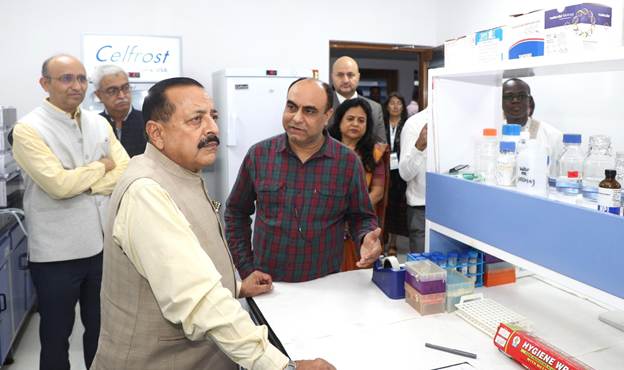
The Minister made these announcements during a formal visit to the newly inaugurated DBT-ICGEB Biofoundry at the International Centre for Genetic Engineering and Biotechnology (ICGEB), New Delhi. Virtually inaugurated during the 31st Meeting of the ICGEB Board of Governors, the Biofoundry represents India’s growing technological self-reliance.
Built around the Design-Build-Test-Learn (DBTL) model, the Biofoundry integrates AI, big data, and computational biology with advanced DNA assembly and microbial engineering. The facility supports high-throughput development of biotech products for sectors such as food, agriculture, chemicals, energy, pharmaceuticals, and now, space research.
With an in-house capacity to produce up to 20 liters of bioproducts and a focus on scaling innovations for industry adoption, the Biofoundry aims to empower startups and boost biomanufacturing at a national level.
Dr. Singh attributed these achievements to the visionary guidance of Prime Minister Narendra Modi, under whose leadership India has rapidly emerged as a global force in biotechnology. He highlighted the 2024 BioE3 policy as a game-changer, designed to catalyze high-performance biomanufacturing across six priority sectors — including marine and space research.
President of the ICGEB Board of Governors, Dr. Jelena Begovic, lauded India’s pioneering efforts in the emerging field of space biotechnology. Senior officials including Dr. Rajesh Gokhale, Dr. Alka Sharma, and ICGEB New Delhi Director Dr. Ramesh Sonti were present during the announcement.