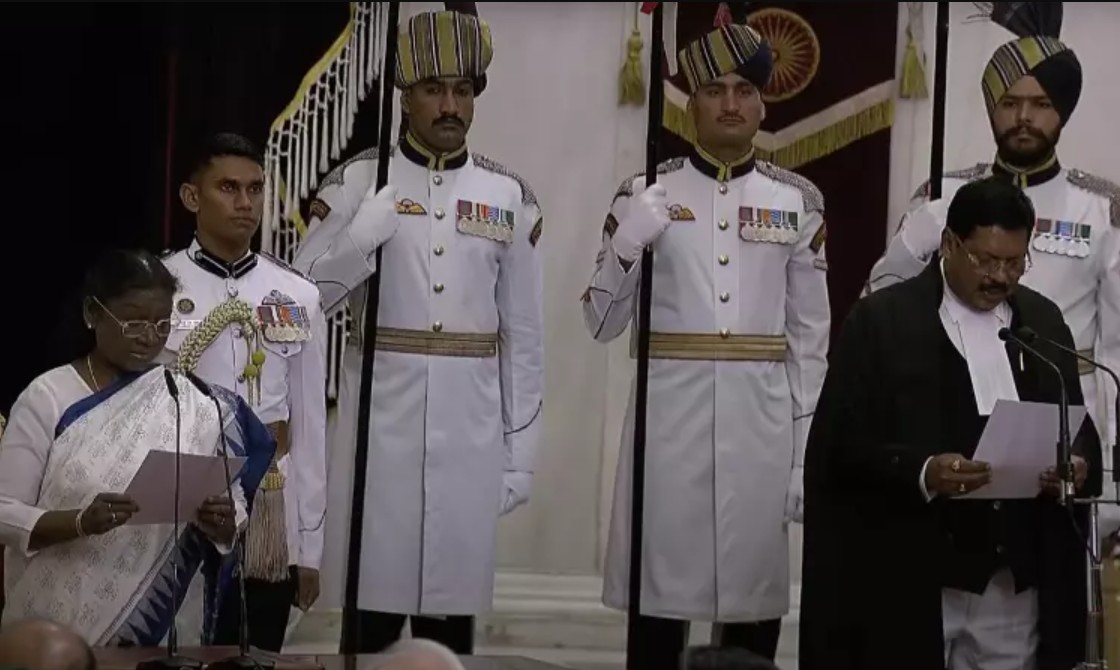
New Delhi: Justice Bhushan Ramkrishna Gavai was sworn in as the 52nd Chief Justice of India (CJI) on Wednesday. The oath of office was administered by President Droupadi Murmu at a ceremonial event held at Rashtrapati Bhavan in the national capital.
Justice Gavai will serve as CJI for a tenure exceeding six months, with his term set to conclude on November 23, 2025. His appointment follows the recommendation of former CJI Sanjiv Khanna, and the official notification was issued by the Ministry of Law and Justice on April 29. “In exercise of the powers conferred by Clause (2) of Article 124 of the Constitution of India, the President is pleased to appoint Shri Justice Bhushan Ramkrishna Gavai, Judge of the Supreme Court, to be the Chief Justice of India with effect from 14th May, 2025,” the notification stated.
Having joined the Supreme Court on May 24, 2019, Justice Gavai has been a part of nearly 700 Benches during his tenure, addressing a wide range of subjects such as constitutional law, criminal justice, civil disputes, arbitration, education law, environmental matters, and administrative issues. His deep engagement with diverse legal domains underscores his judicial versatility.
Over the past six years, he has authored approximately 300 judgments, many of which were delivered by Constitution Benches. His rulings have consistently reinforced the principles of justice, safeguarded fundamental rights, and upheld constitutional values.
Justice Gavai began his judicial career in the Bombay High Court, where he was appointed as an Additional Judge in November 2003 and became a permanent judge in November 2005. Before his elevation to the Bench, he had an active legal practice in constitutional and administrative law. He also served as Standing Counsel for the Municipal Corporations of Nagpur and Amravati, and Amravati University.
His public service record also includes his tenure as Assistant Government Pleader and Additional Public Prosecutor at the Nagpur Bench of the Bombay High Court from August 1992 to July 1993. In 2000, he was appointed as Government Pleader and Public Prosecutor for the Nagpur Bench.