New Delhi: The 71st National Film Awards turned Vigyan Bhawan into a stage of pride and celebration as President of India, Droupadi Murmu, conferred honours on some of the brightest talents of Indian cinema. From standing ovations to emotional tributes, the evening reflected the power of films to shape hearts and unite the nation.
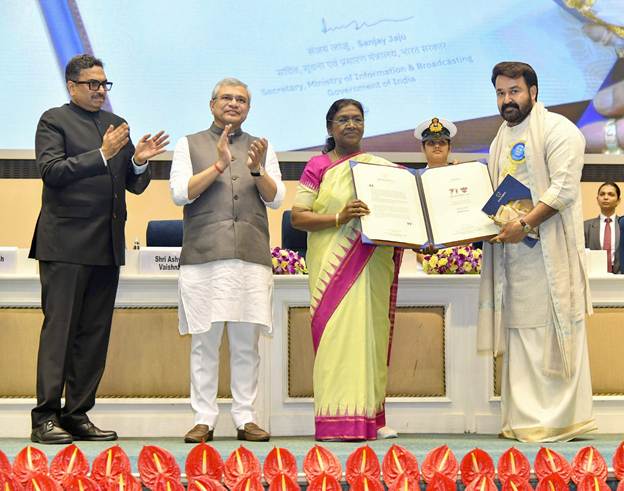
The highlight of the ceremony was the presentation of the Dadasaheb Phalke Award to legendary actor Mohanlal. Applauding his extraordinary journey, the President said Mohanlal had not only displayed unmatched versatility across more than 360 films but also carried India’s cultural heritage onto the world stage. Recalling his early days in theatre and his acclaimed performance in Vanaprastham, she said, “His name commands deep respect and has earned a special place in the hearts of audiences across generations.”
In her address, President Murmu also underlined cinema’s democratic essence, calling it a reflection of Bharat’s cultural diversity. She emphasized how films, much like literature in Indian languages, serve as instruments of awareness and social sensitivity. The President particularly noted the growing role of women in cinema, both on and off screen, stressing the importance of equal opportunities for their meaningful participation. She also praised the creativity of child artists and welcomed the environmental consciousness emerging in recent films.
As Mohanlal accepted the Dadasaheb Phalke Award, Vigyan Bhawan rose to its feet in thunderous applause. With characteristic humility, the actor bowed to his audience and colleagues. “This honour is magical and sacred. It belongs to the entire Malayalam film fraternity and to all the masters who shaped me,” he said, dedicating the award to his predecessors and reaffirming his lifelong commitment to cinema.
Union Minister for Information and Broadcasting, Ashwini Vaishnaw, hailed Mohanlal as a true legend and spoke of the government’s vision for positioning India as a global content economy. He highlighted milestones such as the Waves 2025 summit and the launch of the International Institute of Cinema and Technology (IICT) in Mumbai, which has begun offering 17 specialized courses in collaboration with Meta, NVIDIA, Microsoft and Google. He also emphasized the government’s plans to strengthen indigenous production of film equipment, boost the live concert economy, and introduce Model State Cinema Regulation Rules as part of the roadmap for Viksit Bharat 2047.
Secretary of the Ministry of Information and Broadcasting, Sanjay Jaju, described cinema as a celebration of stories and dreams, noting the success of initiatives like the Waves Summit that brought together cinema, music, gaming, and technology. He captured the spirit of the evening with the phrase: “Ek Desh, Hazaron Kahaniyan, Ek Junoon” — one country, thousands of stories, one passion.
The ceremony also honoured outstanding performances and films across categories. Shah Rukh Khan was named Best Actor for his powerful role in Jawan, sharing the honour with Vikrant Massey for 12th Fail, a film that also won Best Feature Film. Rani Mukerji received the Best Actress Award for Mrs. Chatterjee v/s Norway, a performance that deeply resonated with audiences. Supporting actors Vijayaraghavan, Muthupettai Somu Bhaskar, Urvashi, and Janki Bodiwala were also celebrated for their memorable roles.
Beyond mainstream cinema, awards highlighted new creative frontiers. Flowering Man was named Best Non-Feature Film, while God Vulture and Human took Best Documentary. Hanu-Man received recognition as Best Film in AVGC (Animation, Visual Effects, Gaming & Comics), signaling India’s growing strength in visual storytelling, and Giddh: The Scavenger was declared Best Short Film.
The 71st National Film Awards celebrated not only individual excellence but also the evolving landscape of Indian cinema — a medium that continues to inspire, question, and bind together the stories of a diverse nation.