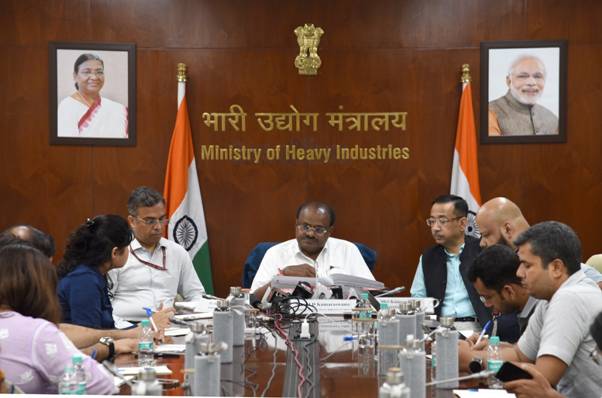
New Delhi: Union Minister for Heavy Industries & Steel, H.D. Kumaraswamy, today introduced two ambitious government schemes aimed at revolutionizing electric mobility in India—the “PM-eBus Sewa-Payment Security Mechanism (PSM) Scheme” and the “PM Electric Drive Revolution in Innovative Vehicle Enhancement (PM E-DRIVE) Scheme.” The announcement was made during a press briefing held at Udyog Bhawan, New Delhi.
PM-eBus Sewa-Payment Security Mechanism (PSM) Scheme
The Union Cabinet, chaired by Prime Minister Narendra Modi, has approved the PM-eBus Sewa-Payment Security Mechanism (PSM) Scheme with an outlay of ₹3,435.33 crore. The scheme is designed to support the procurement and operation of over 38,000 electric buses (e-buses) by Public Transport Authorities (PTAs) from FY 2024-25 to FY 2028-29, enabling up to 12 years of service from deployment.
“Most public buses currently run on diesel or CNG, contributing to environmental degradation. E-buses, on the other hand, are eco-friendly and cost-effective,” Minister Kumaraswamy explained. However, the upfront cost of e-buses has made it difficult for PTAs to adopt them.
Under the scheme, PTAs will operate e-buses on a Public-Private Partnership (PPP) model without having to pay the high upfront costs. The Original Equipment Manufacturers (OEMs) will procure and operate the buses, receiving payments on a monthly basis. To mitigate payment default risks, a dedicated fund will ensure timely payments to OEMs. If PTAs delay payments, the fund will cover the cost, with recovery happening from the PTAs or State/UTs.
This initiative is expected to encourage private sector participation, significantly reduce greenhouse gas emissions, and decrease fossil fuel consumption.
PM Electric Drive Revolution in Innovative Vehicle Enhancement (PM E-DRIVE) Scheme
In addition to the PM-eBus Sewa scheme, the Minister announced the launch of the PM E-DRIVE Scheme, with an outlay of ₹10,900 crore over two years, to promote electric mobility across various vehicle segments. The scheme will provide subsidies and incentives worth ₹3,679 crore for electric two-wheelers (e-2Ws), three-wheelers (e-3Ws), e-ambulances, and e-trucks. It will support the deployment of 24.79 lakh e-2Ws, 3.16 lakh e-3Ws, and 14,028 e-buses.
To make EV purchases more accessible, the government will introduce e-vouchers that allow buyers to avail demand incentives. The voucher, authenticated through Aadhaar, will be issued at the time of purchase and sent to the buyer’s registered mobile number. This voucher will be signed by both the buyer and the dealer, making it essential for OEMs to claim reimbursements.
The scheme also allocates ₹500 crore specifically for the deployment of e-ambulances, a new initiative aimed at enhancing patient transport with eco-friendly vehicles. Standards for these ambulances will be formulated in collaboration with relevant stakeholders, including the Ministry of Health and Family Welfare.
Incentives for E-Trucks and Charging Infrastructure
Trucks are among the biggest contributors to air pollution, and the PM E-DRIVE Scheme aims to curb this by promoting e-trucks. A budget of ₹500 crore has been allocated to incentivize e-trucks, with additional incentives for those scrapping old vehicles following MoRTH’s Vehicle Scrapping Scheme.
To address range anxiety and promote widespread adoption of electric vehicles, the scheme plans to install 22,100 fast chargers for electric four-wheelers (e-4Ws), 1,800 fast chargers for e-buses, and 48,400 fast chargers for e-2Ws/3Ws. A total of ₹2,000 crore has been earmarked for expanding charging infrastructure in cities with high EV penetration and on selected highways.
The Minister emphasized the importance of electric mobility in reducing pollution and enhancing India’s energy security, and noted that these schemes will drive sustainable transportation, innovation, and economic growth.
Bhubaneswar: Students seeking admission to undergraduate courses in Odisha for the 2026–27 academic session have…
Bhubaneswar: In an effort to showcase and promote Odisha's rich handloom and handicraft traditions, a…
Bhubaneswar: Efforts to improve access to government welfare schemes for vulnerable urban communities received a…
Bhubaneswar: The Odisha Electricity Regulatory Commission (OERC) on Tuesday welcomed a new member with the…
Bhubaneswar: The Odisha government has set a March 2027 deadline for the completion of all…
Bhubaneswar: The West Bengal government on Tuesday announced that the word “Dham” will no longer…