
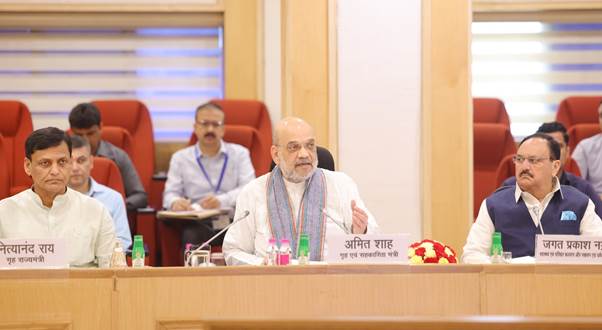
New Delhi: Union Home Minister and Minister of Cooperation, Amit Shah, chaired a high-level review meeting on Left Wing Extremism (LWE) today in New Delhi. The meeting saw the participation of the Chief Ministers of Chhattisgarh, Madhya Pradesh, Maharashtra, Odisha, and Telangana, along with the Deputy Chief Minister of Bihar and Home Minister of Andhra Pradesh. Senior officials from the central and state governments, including Union Ministers from various departments and heads of Central Armed Police Forces (CAPFs), also took part in the session.
During the meeting, Amit Shah emphasized the government’s unwavering commitment to eradicating Naxalism by March 2026. He stated that under Prime Minister Narendra Modi’s leadership, the central and state governments have worked “shoulder to shoulder” to combat left-wing extremism, aiming to remove the biggest obstacle to the development of remote and tribal areas.
“Prime Minister Modi has set a goal of making India a developed nation by 2047, and our 8 crore tribal brothers and sisters have a crucial role in this journey. However, Naxalism prevents vital services like education, healthcare, and connectivity from reaching remote areas. To achieve true development for all, we must eliminate Naxalism entirely,” said Shah.
Highlighting the progress made from 2019 to 2024, Shah noted that the country has seen a major decline in Naxal-related incidents. For the first time in 30 years, the number of casualties due to LWE violence fell below 100 in 2022. He attributed the success to the coordinated efforts of the central and state governments, which have focused on enforcing the rule of law and promoting development in LWE-affected regions.
In his address, Shah revealed that 14 top Naxal leaders had been neutralized, and government welfare schemes had been better implemented to benefit vulnerable communities in these areas. “By March 2026, we will be able to declare that Naxalism has been completely eradicated,” he said.
The Home Minister outlined a multi-pronged strategy deployed by the Modi government since 2019, which included the rapid establishment of 194 security camps in LWE-affected regions within a year. He noted that strengthening state intelligence units, setting up 45 new police stations, and deploying helicopters had drastically reduced the number of casualties among security personnel. The deployment of 12 helicopters—six from the BSF and six from the Indian Air Force—has significantly improved the efficiency of operations.
Shah also highlighted the government’s efforts to address the security vacuum in affected areas, which included the deployment of six additional CRPF battalions and the creation of 15 new Joint Task Forces.
Praising the success of the Chhattisgarh government, Shah pointed out that since January 2024, 237 Naxalites had been killed, 812 arrested, and 723 had surrendered in the state. He appealed to the youth involved in Naxalism to abandon the path of violence and rejoin the mainstream to contribute to India’s development. He stressed that beneficial rehabilitation schemes are available in every state for those willing to renounce extremism.
The minister further stated that several areas previously under Naxal control, such as Buddha Pahad and Chakarbandha, have now been liberated. In Chhattisgarh, 85% of the Naxal cadre strength has been eliminated, bringing the fight against LWE closer to its final phase.
Shah outlined the Modi government’s significant investments in LWE-affected areas. Between 2014 and 2024, the government tripled spending under the security-related expenditure scheme, increasing it from Rs 1,180 crore to Rs 3,006 crore. Under the Special Central Assistance scheme, Rs 3,590 crore was allocated over the last decade to accelerate development projects.
Additionally, the construction of 544 fortified police stations, 14,400 km of road networks, and the installation of 6,000 mobile towers were credited for transforming LWE-affected areas. Education also saw major investments, with 216 Eklavya Model Residential Schools (EMRS) approved, up from just 38 before 2014.
Looking ahead, Shah called on all affected states to continue reviewing the progress of development and anti-Naxal operations regularly. He urged state police forces and their leadership to maintain an offensive strategy and emphasized the need to cut off Naxalite financing channels.
Shah concluded by reaffirming that Naxalism is not just a hindrance to development but also a violation of human rights, as it deprives millions of tribal communities of basic services. He urged all stakeholders to unite in the mission to eradicate Naxalism by April 2026, stating, “Once Naxalism is eliminated, there will be no obstacle to development, no human rights violations, and no violence in the name of ideology.”