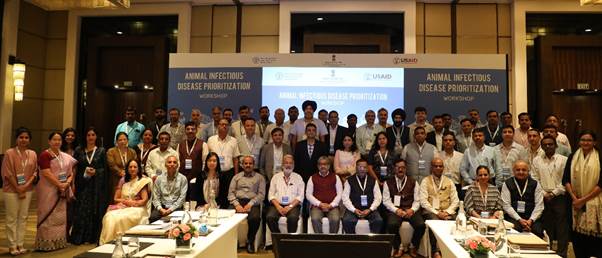
New Delhi: A pivotal three-day workshop on Animal Infectious Disease Prioritization commenced today in New Delhi, organized by the Food and Agriculture Organization of the United Nations (FAO) in collaboration with the Department of Animal Husbandry & Dairying (DAHD), Ministry of Fisheries Animal Husbandry and Dairying, Government of India.
The workshop, inaugurated by Dr. Abhijit Mitra, Animal Husbandry Commissioner (AHC) at DAHD, aims to enhance the process of prioritizing infectious diseases that impact animals. Dr. Mitra highlighted the critical importance of considering economic losses in disease prioritization. He emphasized that the financial repercussions of infectious diseases—ranging from reduced productivity to the costs of treatment and control—have profound implications not only for the agricultural sector but also for the broader national economy.
In his address, Dr. Mitra also advocated for incorporating biodiversity loss as a significant criterion in the disease prioritization process. He pointed out that the spread of diseases among wildlife and other species leads to biodiversity loss, which has long-term effects on ecosystems and their services. By including biodiversity impacts, the prioritization process can adopt a more comprehensive approach, recognizing the interconnectedness of animal health, environmental sustainability, and human well-being.
Dr. Raj Kumar Singh, Epidemiology, AMR, and Zoonoses Specialist at FAO India, provided a detailed overview of the Animal Infectious Disease Prioritization process and the role of various committees involved. His presentation outlined the steps taken to map, identify, and prioritize animal infectious diseases based on their economic and health impacts.
The workshop brought together a diverse group of experts, including representatives from DAHD, the Indian Council of Agricultural Research (ICAR), State Veterinary Universities, State Animal Husbandry Departments, USAID, Jhpiego, and the ECTAD Team of FAO India.
The primary goal of the workshop is to map, identify, and prioritize key animal infectious diseases through a comprehensive process. The workshop’s agenda includes:
The next two days will involve in-depth discussions and evaluations to rank diseases according to their significance. The workshop aims to bolster surveillance efforts and inform the development of more effective disease control programs. By prioritizing diseases with the highest impact on the economy and biodiversity, the workshop seeks to create strategies and allocate resources more effectively, fostering a more sustainable and resilient animal health system in India.
This workshop marks a significant step toward strengthening India’s approach to managing animal infectious diseases, integrating economic, ecological, and public health considerations into the disease prioritization process.
Bhubaneswar: The Odisha government has entered into six partnerships with the Department of Posts, Odisha…
Bhubaneswar: Odisha has stepped up food safety inspections across the State amid continued rainfall and…
Bhubaneswar: In a move to support Odisha residents who may have been caught up in…
Bhubaneswar: Odisha is stepping up efforts to turn Deras into a major centre for seafood…
Bhubaneswar: Women passengers will be able to travel free of cost on Ama Bus services…
Bhubaneswar, August 26: The overall flood and rainfall situation in Odisha remains under control, although…